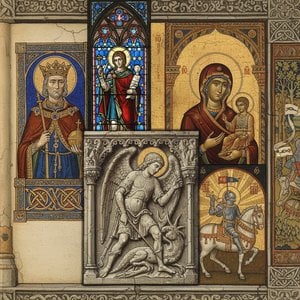
Elisabeth Sonrel: A Visionary Watercolorist Rooted in Myth and Brittany
Elisabeth Sonrel (1874 – 1953) stands as a singular figure within the Art Nouveau movement, an artist whose ethereal watercolors captured not only the beauty of Brittany’s landscapes but also profound explorations of mythology, spirituality, and the enduring fascination with Arthurian legend. Born in Tours, France, she inherited artistic talent from her father, Nicolas Stéphane Sonrel, himself a painter who instilled in her a foundational understanding of visual storytelling. Recognizing her potential, Sonrel pursued formal training at the École des Beaux-Arts in Paris, where she honed her skills under Jules Lefebvre, establishing herself as a serious artist amidst the burgeoning Parisian avant-garde.
- Early Influences & Training: Lefebvre’s instruction fostered Sonrel's appreciation for academic tradition alongside an emerging interest in Symbolist aesthetics—a crucial duality that would shape her artistic vision.
- Diploma Work & Recognition: Her diploma piece, ‘Pax et Labor,’ presented at the Musée des Beaux-Arts de Tours in 1892, immediately signaled her talent and ambition, securing a prominent place within the artistic landscape of her time.
Sonrel’s career blossomed during the Salon des Artistes Français (1893–1941), where she consistently showcased her distinctive style—large watercolors imbued with Pre-Raphaelite sensibilities—a stylistic choice directly influenced by her transformative journey to Florence and Rome. There, encountering the monumental paintings of Botticelli ignited a passion for Renaissance grandeur and informed her artistic explorations. Her subjects ranged from allegorical narratives reflecting moral dilemmas to depictions of biblical themes and medieval folklore, demonstrating an unwavering commitment to storytelling through visual imagery. Works like ‘Ames errantes’ (1894) and ‘Les esprits de l’abime’ (1899) exemplify her fascination with the subconscious and spiritual dimensions of human experience.
- The Florentine Revelation: Sonrel's exposure to Botticelli’s frescoes profoundly impacted her artistic sensibilities, propelling her towards a style characterized by luminous color palettes and meticulous detail—a stylistic hallmark that distinguishes her oeuvre.
- Notable Exhibitions & Awards: Her participation in the Exposition Universelle of 1900 resulted in recognition for ‘Le sommeil de la vierge,’ earning her a bronze medal and the Henri Lehmann Prize, cementing her reputation as a gifted watercolorist within the Parisian artistic community.
Following the First World War, Sonrel shifted her focus primarily to portraiture and landscape painting—particularly Brittany—where she established herself as an observant chronicler of Breton life and culture. Her expeditions into the Brocéliande Forest inspired countless canvases, capturing the mystical atmosphere of this legendary woodland. From 1910 onwards, she frequented coastal towns like Concarneau, Plougastel, Pont-l’Abbé and Loctudy, documenting the region's scenic beauty alongside its vibrant social life. Her artistic practice was underpinned by a genuine connection to her surroundings—she befriended young Breton girls whom she regularly invited to pose for paintings, reflecting her belief in the transformative power of observation and empathy.
- Brittany’s Influence: Sonrel's unwavering dedication to Brittany served as an enduring source of inspiration, resulting in a prolific body of work that celebrates both its natural splendor and its cultural heritage.
- Technique & Style Evolution: Primarily utilizing watercolor and gouache, Sonrel perfected her craft through meticulous layering and blending techniques—a stylistic hallmark that distinguishes her paintings from many contemporaries.
Elisabeth Sonrel’s legacy extends beyond her artistic achievements; she represents a pivotal voice within Art Nouveau, embodying the movement's commitment to exploring psychological depth alongside aesthetic beauty. Her enduring fascination with mythic narratives and Breton landscapes ensures that her work continues to resonate with audiences today—a testament to her singular vision and unwavering dedication to capturing the essence of both imagination and observation.