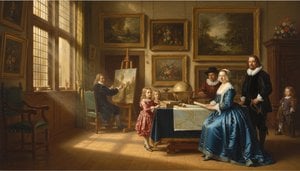
The Quiet Elegance of Elias Vonck
In the vibrant, bustling landscape of the Dutch Golden Age, where grand historical narratives and flamboyant maritime scenes often commanded the spotlight, Elias Vonck carved out a space of profound intimacy and subtle observation. Born in Amsterdam around 1605, Vonck was a painter who found his greatest strength not in the theatrical, but in the quiet dignity of the natural world. His oeuvre serves as a window into a period defined by humanist values, where the meticulous rendering of a single feather or the soft light hitting a hunting trophy could convey as much depth as any epic battle. Through his brush, the fleeting moments of rural life—the stillness of a farmscape and the heavy silence of a completed hunt—were elevated to a level of timeless grace.
The foundations of Vonck’s mastery were laid in the studios of Amsterdam, where he underwent rigorous training under Hendrick Jacobsz. van Balen I. This apprenticeship was crucial, as it introduced him to the sophisticated Baroque conventions of his era, most notably the dramatic interplay of light and shadow known as chiaroscuro. While his mentor was celebrated for allegorical and mythological themes, Vonck would eventually pivot away from these grander myths to embrace a more grounded naturalism. This early technical discipline allowed him to develop a remarkable sensitivity to texture and light, a skill that would become the hallmark of his later, more specialized works.
A Journey Through Europe and Artistic Evolution
Vonck’s artistic identity was significantly shaped by his travels, most notably his transformative years in Poland between 1631 and 1639. Commissioned by Prince Christian Casimir Vasa to decorate the royal palace in Krakow, this period of international exposure broadened his visual vocabulary far beyond the borders of the Netherlands. The cultural exchange inherent in his time at the Polish court infused his work with a unique breadth, blending Dutch precision with the burgeoning influences of Central European traditions. This era of his life was not merely a professional detour but a vital period of growth that allowed him to integrate diverse aesthetic perspectives into his established style.
As his career progressed, Vonck’s focus sharpened toward the specialized genre of still life and animal portraiture. He became particularly renowned for his ability to capture the weight and presence of fauna, specifically in compositions featuring hares, herons, and various poultry. These works were far more than mere anatomical studies; they were meditations on life and mortality. His ability to render the soft down of a bird or the coarse fur of a hare demonstrated a level of realism that resonated with the era's growing interest in scientific observation and the beauty of the tangible world.
Legacy and the Continuation of a Workshop
The historical significance of Elias Vonck lies in his contribution to the development of the hunting still life, a genre that would flourish in the decades following his death. His influence extended through his family lineage, most notably through his son, Jan Vonck. Following the elder Vonck's passing in 1652, Jan continued the family workshop in Amsterdam, carrying forward the stylistic hallmarks of his father’s naturalism and precision. The lineage of the Vonck workshop ensured that the master's dedication to capturing living birds within landscapes and the somber beauty of dead game remained a vital part of the Dutch artistic canon.
Today, we look back at Elias Vonck not merely as a painter of subjects, but as a poet of the understated. His work remains a testament to the power of observation, reminding us that there is profound beauty to be found in the most modest corners of existence. Through his mastery of light and his reverence for nature, Vonck secured his place as a vital voice in the 17th-century artistic dialogue, leaving behind a legacy of quiet, enduring splendor.
Pitanja i odgovori
Kako se umetnost autora Elias Vonck razvijala tokom vremena?
Hronika umetnika Elias Vonck predstavlja hronološku vremensku liniju koja se pomera uz skrolovanje i prikazuje dela umetnika po hronološkom redu, grupisana u poglavlja prema periodima stvaralaštva.
Gde se mogu pronaći dela umetnika Elias Vonck grupisanja po paleti boja?
Stranica Preko palete boja grupiše dela umetnika Elias Vonck prema njihovim paletama boja.
Mogu li da proučim način na koji Elias Vonck koristi boju u svim svojim delima?
Kolorit dela umetnika Elias Vonck možete videti na njegovoj stranici Genom palete.