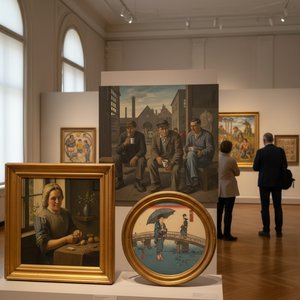
Clark Hulings: A Painter of Everyday Life
Clark Hulings (November 20, 1922 – February 2, 2011) stands as a compelling figure in American realist painting, a master of capturing the vibrant pulse of daily life through his evocative depictions of European and Mexican markets, intimate still lifes, and the quiet dignity of donkeys. Born in Florida and raised amidst the complexities of early 20th-century America—a childhood marked by his mother’s untimely death and subsequent relocation to Potsdam, New York—Hulings' artistic journey was shaped by a unique blend of formal training, extensive travel, and an unwavering dedication to portraying the human experience. His work, now celebrated for its warmth, authenticity, and meticulous detail, offers a window into worlds both familiar and foreign, inviting viewers to contemplate the beauty found in the commonplace.
Hulings’ artistic foundation began with private instruction from Sigismund Ivanowsky, a former court painter to Tsar Nicholas II, at the age of thirteen. This early mentorship instilled within him a deep appreciation for classical technique and composition. Later, he honed his skills at the prestigious Art Students League of New York under the guidance of Frank Reilly, further refining his draftsmanship and understanding of color theory. However, it was his travels throughout Europe—spanning from Florence to Düsseldorf—that truly ignited his artistic vision. These journeys weren’t merely vacations; they were immersive experiences that exposed him to diverse cultures, bustling marketplaces brimming with life, and the subtle nuances of human interaction. He meticulously documented these observations in his paintings, imbuing them with a sense of place and authenticity rarely found in contemporary art.
Early in his career, Hulings established himself as a successful portraitist and illustrator, working for newspapers and magazines. Yet, he always maintained a deep-seated desire to pursue easel painting, dedicating himself fully to this medium after 1962. His subjects quickly became defined by their accessibility—ordinary people engaged in everyday tasks: vendors hawking wares in European squares, farmers tending their livestock, children playing in sunlit streets. Donkeys, particularly, held a special fascination for Hulings; he saw in them a quiet strength and resilience, capturing their weathered faces and expressive eyes with remarkable sensitivity. His paintings of donkeys are not simply depictions of animals but rather portraits of character, imbued with a profound sense of dignity and wisdom.
A Life Shaped by Travel and Family
Hulings’ family history played an integral role in shaping his artistic sensibilities. Born into a family connected to the American cyanamid trade—his father, Courtland Marcus Hulings, managed a plant producing a gas for fumigating orange trees—the family moved frequently, reflecting the demands of his father's business. This itinerant lifestyle exposed young Clark to diverse cultures and perspectives, fostering an open-mindedness that would later inform his artistic practice. A pivotal moment occurred in Valencia, Spain, where his father married Elena Harker, the 21-year-old daughter of a British consul. This union brought Hulings into a world of international connections, further broadening his horizons and enriching his understanding of human relationships.
The early years of Hulings’ life were marked by hardship—his mother's death from tuberculosis when he was an infant and subsequent moves to Potsdam, New York. Despite these challenges, his father recognized the importance of artistic training and arranged lessons with Sigismund Ivanowsky, providing him with a foundation in classical technique. This early exposure to art instilled within him a lifelong passion for painting, shaping his artistic trajectory and ultimately leading him to become one of America’s most respected realist painters.
Technique and Style
Hulings' distinctive style is characterized by its meticulous attention to detail, vibrant color palette, and masterful use of light. He employed a technique that combined elements of realism with an expressive quality, capturing not just the appearance of his subjects but also their essence—their character, their emotions, their place in the world. His brushwork is often loose and impressionistic, yet always grounded in careful observation and technical skill. He was particularly adept at rendering textures—the rough bark of a donkey’s hide, the worn cobblestones of a European street, the folds of a merchant's cloak—creating a tactile sense of reality that draws viewers into his paintings.
The influence of George Bridgman, another prominent draftsman and instructor, is evident in Hulings’ meticulous attention to anatomy and form. However, Hulings ultimately developed his own unique style, characterized by its warmth, authenticity, and ability to capture the beauty of everyday life. His compositions are often dynamic and engaging, drawing the viewer's eye through a carefully orchestrated arrangement of figures and objects.
Legacy and Recognition
For decades, Hulings’ art has been eagerly sought after by collectors, museums, and corporations—a testament to its enduring appeal and artistic merit. His Santa Fe studio became a hub for artists and patrons alike, fostering a vibrant community of creative individuals. He received numerous awards and accolades throughout his career, including the Prix de West award from the National Cowboy and Western Heritage Museum in 1973. His work has been featured in prestigious exhibitions across the United States and Europe, solidifying his place as one of America’s leading realist painters.
Clark Hulings passed away on February 2, 2011, leaving behind a rich legacy of paintings that continue to captivate and inspire viewers. His art serves as a reminder of the beauty found in the ordinary—the dignity of labor, the warmth of human connection, and the enduring spirit of the American West. The Clark Hulings Foundation continues his mission by supporting working artists and promoting his artistic vision for future generations.