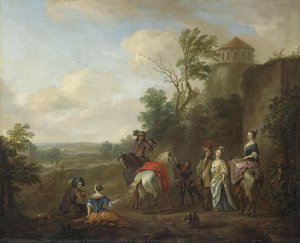
Karel van Falens: The Battle Painter of Flanders
Karel van Falens (bautizado en amberes el 24 de noviembre de 1683 – parís, 26 de mayo de 1733) emerged as a prominent figure in the Flemish art scene during the Baroque period, leaving an indelible mark on the landscape of Dutch Golden Age painting. Born in Antwerp, Belgium, he honed his artistic skills amidst the vibrant intellectual and cultural ferment of his time—a crucible for innovation that would propel him to international acclaim.
- Early Life & Training: Falens’s formative years were spent absorbing the stylistic precepts of Antwerp’s established artists. While biographical details remain somewhat sparse, evidence suggests he studied under Philips Wouwerman, arguably his most influential mentor—a painter celebrated for his dramatic depictions of cavalry battles and hunting expeditions. This apprenticeship instilled in him a profound understanding of compositional dynamism and meticulous realism.
- Style & Technique: Falens’s artistic vision firmly rooted itself within the Battle Painting style championed by Wouwerman, characterized by rapid brushstrokes, theatrical lighting, and an obsessive attention to detail. He skillfully captured the visceral energy of combat—the terror of soldiers, the fury of horses—transforming historical narratives into emotionally charged visual experiences. His canvases pulsate with movement, conveying not merely what transpired but also *how* it felt.
- Career in France: Recognizing the opportunities afforded by Parisian artistic circles, Falens relocated to France around 1705, establishing himself as a court painter and gaining membership into the Académie Royale. This move proved pivotal in shaping his oeuvre—he embraced the stylistic conventions of French Baroque art while retaining his distinctive Flemish sensibility. He produced numerous portraits for aristocratic patrons and contributed significantly to decorative arts, showcasing his versatility as an artist.
- Notable Works: Falens’s artistic legacy rests upon a corpus of approximately 150 paintings—primarily hunting scenes and cavalry compositions—that exemplify the apex of Battle Painting. Among his most celebrated works are “A Hunting Party,” currently housed at Museum Smidt Van Gelder, Antwerp, and “The Siege of Maastricht,” which exemplifies his masterful command of perspective and dramatic storytelling. These canvases continue to captivate viewers with their immediacy and psychological depth.
- Historical Significance: Karel van Falens stands as a testament to the enduring influence of Flemish artistic tradition on European art history. His unwavering devotion to Wouwerman’s style—a stylistic hallmark of the Battle Painting movement—solidified his place among the foremost painters of his era. Furthermore, his contribution to the Académie Royale and his patronage by influential figures underscore his role in shaping the cultural landscape of 18th-century France. Falens's work serves as a window into the anxieties and aspirations of a period marked by political upheaval and artistic experimentation—a legacy that resonates powerfully with contemporary audiences.