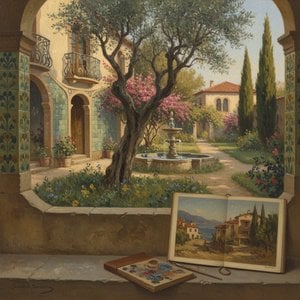
Càndid Duran i Farrés: A Master of Light and Color in Catalan Art
Born in the picturesque coastal town of Sitges, Spain, in 1841, càndid duran i farrés emerged as a significant figure within the vibrant artistic landscape of late 19th-century Catalonia. His life coincided with a period of intense cultural and political change for Spain, and his art reflects both the evolving trends of the time and the unique character of his Catalan homeland. Duran’s legacy lies not just in the beauty of his paintings but also in his embodiment of the realist movement's commitment to capturing everyday life with meticulous detail and luminous color.
Duran’s artistic journey began with a strong grounding in traditional techniques, yet he quickly developed a distinctive style characterized by an exceptional command of light and shadow. He was particularly renowned for his still lifes—lush arrangements of flowers and fruit that seemed to radiate with captured sunlight. These weren't merely depictions; they were celebrations of color, texture, and form. His meticulous attention to detail – the delicate veins on a petal, the subtle variations in skin tones – speaks to a deep appreciation for the natural world and a desire to faithfully represent its beauty. Beyond still lifes, Duran also excelled as a portrait painter, capturing the personalities of his subjects with remarkable sensitivity and insight.
The Influence of Realism and Catalan Artistic Circles
Duran’s artistic development was profoundly shaped by the realism movement, which gained considerable traction throughout Europe during the mid-19th century. This movement championed a return to direct observation and an honest portrayal of reality, rejecting idealized or romanticized representations. Duran embraced this approach, prioritizing accuracy and detail in his work. However, he wasn’t simply a follower of European trends; he was deeply rooted in the Catalan artistic tradition. He actively participated in the Barcelona artistic circle, engaging with fellow artists and contributing to exhibitions that showcased the region's burgeoning talent.
The “Pintamones” – or “The Daubers,” as they were affectionately known – a group of Catalan painters who favored a looser, more expressive style, exerted a subtle influence on Duran’s work. While he maintained a greater degree of precision than some of his colleagues within the circle, the spirit of experimentation and vibrant color found in their paintings undoubtedly informed his own approach. His palette was particularly notable for its boldness – he wasn't afraid to use intense hues and dramatic contrasts to create visual impact.
Technique and Artistic Style
Duran’s technical skill is evident in every brushstroke. He employed a layering technique, building up color gradually to achieve rich depth and luminosity. His understanding of light was exceptional; he skillfully manipulated shadows and highlights to create a sense of three-dimensionality and atmosphere. He often worked *alla prima*, directly on the canvas without extensive underpainting, allowing for spontaneity and immediacy in his execution.
His compositions were carefully balanced, drawing the viewer’s eye through the arrangement of objects and figures. He favored warm color palettes, particularly reds, oranges, and yellows, which evoke a sense of warmth and vitality. While influenced by realism, Duran's work possesses an undeniable elegance and refinement, distinguishing it from purely documentary depictions.
Legacy and Recognition
Càndid duran i farrés’s paintings continue to be admired for their beauty, technical skill, and evocative power. His works are held in various museums and private collections across Spain and internationally, including the Imperial College Healthcare Charity Art Collection in London – a testament to his enduring appeal. His contribution to the Catalan art scene of the late 19th century remains significant, representing a vibrant period of artistic innovation and cultural expression.
Duran’s legacy extends beyond individual artworks; he embodies the spirit of a generation of artists who sought to capture the essence of their time and place. His paintings offer a glimpse into the beauty of everyday life, inviting viewers to appreciate the simple pleasures of color, light, and form. Further exploration can be found through resources like WahooArt.com and online encyclopedias such as Wikipedia’s article on Catalan art.