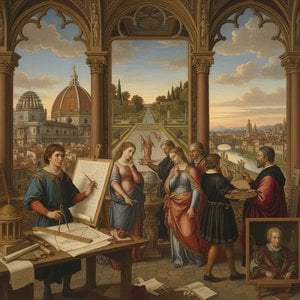
Bertoldo di Giovanni: The Unsung Architect of Renaissance Sculpture
Bertoldo di Giovanni, a name perhaps less familiar than those of his contemporaries Donatello and Michelangelo, nevertheless stands as a pivotal figure in the artistic landscape of 15th-century Florence. Born around 1420 in Poggio a Caiano, a small village near Florence, Bertoldo’s life was inextricably linked to the city's burgeoning artistic spirit and the patronage of the powerful Medici family. His story is one of apprenticeship, mentorship, and ultimately, a quiet but profound influence on some of the greatest artists who would shape Western art history. Initially overlooked by mainstream narratives, recent scholarship has begun to illuminate Bertoldo’s crucial role as both a student of Donatello and a teacher of Michelangelo – a connection that fundamentally altered our understanding of the Renaissance artistic ecosystem.
Early Years and Apprenticeship under Donatello
Bertoldo's early life remains somewhat shrouded in mystery, but it is known he was born into a family with German roots, a common occurrence in Florence at the time. He began his artistic training as a young apprentice to the legendary Donatello, one of the most innovative and influential sculptors of the Italian Renaissance. Donatello’s workshop was a crucible of creativity, attracting artists from across Italy and fostering an environment of experimentation and daring. Bertoldo spent many years immersed in this vibrant atmosphere, learning not just technical skills but also Donatello's distinctive approach to capturing human form – his emphasis on realism, dynamism, and psychological depth. Crucially, Bertoldo wasn’t simply a copyist; he absorbed Donatello’s spirit, developing a style that retained elements of the master while gradually forging his own unique voice. His early works, though often small bronzes, demonstrate this evolution, showcasing an increasing confidence and mastery of technique.
The Medici Academy and the Shaping of Future Masters
Following Donatello’s death in 1466, Bertoldo continued to work in his workshop, diligently completing unfinished projects – a testament to his dedication and skill. However, his influence extended far beyond the confines of the workshop. Lorenzo de' Medici, recognizing Bertoldo’s talent and experience, established an informal academy within the Medici gardens at San Marco, inviting leading artists from across Italy to study alongside him. This remarkable gathering included Michelangelo, Baccio da Montelupo, Giovanni Francesco Rustici, and Jacopo Sansovino – a constellation of artistic giants who benefited immensely from Bertoldo’s guidance. Bertoldo served as both teacher and custodian of the Medici's vast collection of Roman antiquities, exposing these young artists to classical sculpture and inspiring them to emulate its grandeur and elegance. This environment fostered a dialogue between Renaissance ideals and ancient precedents, profoundly shaping the artistic sensibilities of the next generation.
A Sculptor of Medals and Subtle Innovation
While Bertoldo is not typically regarded as a major sculptor in the same league as Donatello or Michelangelo, his contributions to the art of the medal are significant. He produced a series of exquisitely crafted medals, often depicting historical figures and events – including a notable portrait of Sultan Mehmed the Conqueror. These medals demonstrate a remarkable level of technical skill and artistic sensitivity, showcasing Bertoldo’s ability to capture likenesses with precision and convey complex narratives through subtle details. Interestingly, many of his medals were mistakenly attributed to Antonio del Pollaiolo in the past, highlighting the challenges faced by art historians in accurately assessing the work of lesser-known artists during that period. Bertoldo's meticulous attention to detail and refined style are evident in each piece, revealing a sculptor who possessed a quiet but undeniable mastery of his craft.
Legacy and Historical Significance
Bertoldo di Giovanni’s legacy is one of quiet influence and understated brilliance. He was not a revolutionary innovator like Donatello or Michelangelo, but rather a skilled craftsman and dedicated teacher who played a crucial role in shaping the artistic landscape of Florence. His connection to Donatello provided a vital link between the early Renaissance and its later flowering, while his mentorship of Michelangelo ensured that his teachings would continue to resonate for centuries to come. Recent scholarship has rightly begun to re-evaluate Bertoldo’s contributions, recognizing him as an essential figure in the development of Renaissance sculpture and a key player in the Medici court's patronage system. His story serves as a reminder that artistic history is often more complex and nuanced than we initially assume, and that even seemingly minor figures can have a profound impact on the course of art. The Frick Collection’s 2019 exhibition dedicated solely to Bertoldo di Giovanni stands as a testament to this rediscovery, finally bringing his artistry into the spotlight it deserves.