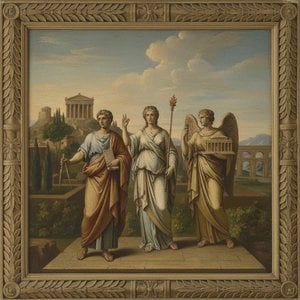
Angelica Kauffman: A Swiss Pioneer in the World of Art
Born Maria Anna Angelika Kauffmann on October 30, 1741, in Chur, Switzerland, Angelica Kauffman’s life was a testament to ambition and artistic determination. Her early years were marked by a nomadic existence, shaped by her father, Joseph Johann Kauffmann, a skilled Swiss muralist who traveled extensively throughout Europe. This itinerant upbringing exposed young Angelica to diverse artistic styles and cultures, laying the foundation for her own distinctive approach. Unlike many women of her time, she received formal training in painting, initially under her father and later with prominent artists like Jean-Baptiste-Simon Sue in Paris. Her family’s move to Lombardy, Italy, further solidified her artistic development, immersing her in the vibrant art scene of the era and fostering a deep appreciation for classical ideals.
Angelica's talent quickly became apparent, attracting commissions from wealthy patrons across Europe. She demonstrated remarkable versatility, excelling not only in portraiture but also in landscapes and historical paintings – genres typically dominated by men at the time. Her early works often showcased a vibrant palette and dynamic compositions, reflecting her Swiss heritage and a keen interest in capturing the beauty of nature. Crucially, she navigated a challenging professional landscape, becoming one of the first women to be admitted into the Royal Academy of Arts in London in 1768 – a landmark achievement that challenged societal expectations and paved the way for future generations of female artists.
Neoclassicism and the Borghese Collection
Angelica Kauffman’s artistic style firmly aligned with Neoclassicism, an aesthetic movement that sought to revive the principles of ancient Greek and Roman art. Characterized by its emphasis on order, clarity, and idealized forms, Neoclassicism provided a framework for Angelica's compositions, which often depicted scenes from mythology, history, and portraiture. Her paintings were meticulously rendered, showcasing a remarkable attention to detail and a mastery of technique. A pivotal moment in her career occurred in 1807 when Napoleon Bonaparte purchased the Borghese art collection, including several key pieces. This included a stunning second-century bust of Antinous Mondragone, which Angelica herself had painted, and a portrait of Ludwig, Crown Prince of Bavaria. The acquisition brought these works to Paris, where they were displayed at the Louvre, significantly elevating Angelica’s international recognition.
The Campaign of France, 1814 – A Masterpiece of Historical Painting
Among Angelica Kauffman's most celebrated achievements is *Campaign of France, 1814*, a monumental historical painting completed in 1807. This work, now housed at the Kunsthistorisches Museum in Vienna, exemplifies her skill in capturing dramatic narratives and conveying complex emotions. The scene depicts a moment of intense action during Napoleon’s retreat from Moscow, showcasing the chaos and desperation of war. Meissonier's meticulous attention to detail—from the uniforms of the soldiers to the expressions on their faces—creates a remarkably realistic and immersive experience for the viewer. It is notable that this painting was one of the largest and most ambitious works undertaken by an artist renowned for meticulously rendered cabinet pictures, reflecting Meissonier’s ambition and technical prowess.
Legacy and Influence
Angelica Kauffman's career spanned several decades and continents, leaving a lasting impact on the art world. She defied societal constraints to establish herself as one of the most successful female artists of her time, demonstrating exceptional talent and unwavering determination. Her work influenced subsequent generations of painters, particularly in the realm of historical painting and portraiture. While she faced challenges due to gender bias and limited opportunities for women artists, Angelica Kauffman’s achievements remain a testament to her artistic vision and her pioneering spirit. She stands as an important figure in art history, representing not only exceptional skill but also a courageous pursuit of professional fulfillment in a world that often sought to limit women's aspirations.
Early Life and Family
Angelica Kauffman’s early life was shaped by a family deeply involved in the artistic profession. Her father, Joseph Johann Kauffmann, was a respected Swiss muralist who traveled extensively throughout Europe, providing Angelica with invaluable exposure to diverse artistic styles and techniques. Her mother, Cleophea Lutz, instilled in her a love of learning and fostered her linguistic abilities, enabling her to master four languages – German, Italian, French, and English – by the age of twelve. This multilingual background proved advantageous as she navigated the international art scene. The family’s frequent moves contributed to Angelica's artistic development, exposing her to different cultural influences and broadening her understanding of artistic traditions.