The Master of the Burin: The Life and Legacy of Aegidius Sadeler II
In the vibrant, swirling currents of the late Renaissance and early Baroque periods, few artists possessed the ability to translate the monumental grandeur of painting into the intimate, precise language of printmaking as masterfully as Aegidius Sadeler II. Born in 1570 within the illustrious artistic dynasty of Antwerp, Sadeler was destined for a life steeped in the fine arts. As a member of the famed Sadeler family of engravers and print dealers, his very lineage was woven into the fabric of European visual culture. His early training under his uncle, Jan I, provided him with a rigorous foundation in the exacting techniques of the Antwerp Guild of St. Luke, instilling in him a discipline that would later allow him to capture the most delicate nuances of light and shadow through the sharp tip of a burin.
The trajectory of Sadeler’s career was as much a journey across Europe as it was an evolution of style. His wanderings took him through the intellectual hubs of Munich, Rome, and Naples, exposing him to the diverse aesthetic currents of the continent. This cosmopolitan upbringing allowed him to absorb the sophisticated elegance of Italian Mannerism and the robust realism of the Northern traditions. By the time he settled in Prague in 1597, he had become a versatile virtuoso, capable of navigating the complex visual vocabulary required by the most demanding patrons of the age.
At the Heart of the Imperial Court
The zenith of Sadeler’s professional life was undoubtedly his appointment as the court engraver to Rudolf II, the Holy Roman Emperor. The court in Prague was a glittering epicenter of Mannerist innovation, a place where art, alchemy, and intellect converged. Within this rarefied atmosphere, Sadeler found his greatest inspiration and his most significant subjects. He did not merely record the images of his era; he acted as a vital conduit for their dissemination. Through his meticulous reproductions, the masterpieces housed in the Emperor's private collections were liberated from the confines of palace walls and shared with the wider European intelligentsia.
His collaboration with the leading lights of the Mannerist movement was profound. Sadeler possessed a rare ability to translate the fluid, often elongated forms of Bartholomeus Spranger and the whimsical, transformative imagery of Giuseppe Arcimboldo into the monochromatic medium of engraving. His work after the sculptures of Giambologna and Adriaen de Vries demonstrated an uncanny ability to render the tactile quality of bronze and marble through nothing more than black ink and white paper. This period of his life was marked by a relentless pursuit of technical perfection, where every line served to heighten the theatricality and emotional depth characteristic of the era.
A Lasting Impression on Art History
The significance of Aegidius Sadeler II extends far beyond the individual prints he produced. He was a pivotal figure in the democratization of high art, playing a crucial role in the creation of a shared European visual language. By reproducing the works of masters like Albrecht Dürer and Raphael, he helped sustain the prestige of these Renaissance icons long after their original eras had passed. His engravings served as both a tribute to the past and a blueprint for the future, influencing generations of artists who looked to his prints for compositional guidance and technical inspiration.
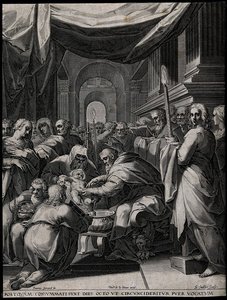
Even today, when we examine his portraits or his dramatic religious scenes, such as his poignant etchings of The Martyrdom of St. Sebastian, we are struck by a sense of profound permanence. His work captures the tension between the physical and the spiritual, the human and the divine, with a clarity that remains undiminished by time. Through his mastery of the engraver's craft, Sadeler ensured that the fleeting brilliance of the Prague court would be etched into the enduring memory of art history.
Pitanja i odgovori
Kako mogu pratiti rad umetnika Aegidius Ii Sadeler godinu po godinu?
Stranica Hronologija dela umetnika prikazuje dela umetnika Aegidius Ii Sadeler poređana hronološki, godinu po godinu.
Mogu li da proučim način na koji Aegidius Ii Sadeler koristi boju u svim svojim delima?
Kolorit dela umetnika Aegidius Ii Sadeler prikazan je na njegovoj stranici Genom palete.
Postoji li 3D virtuelna obilaznica kroz dela umetnika Aegidius Ii Sadeler?
Radove umetnika Aegidius Ii Sadeler možete pogledati u 3D galeriji na stranici 3D muzej umetnika.