The Ephemeral Canvas: Monet’s Pursuit of the Fleeting Moment
To understand the revolution ignited by Claude Monet, one must first grasp the concept of the ephemeral. Before the Impressionist movement disrupted the rigid hierarchies of the French Academy, painting was a pursuit of permanence, focused on historical grandeur and immutable forms. Yet, Monet looked elsewhere. He sought the transient, the momentary, and the atmospheric. Inspired by the plein air techniques of his mentor Eugène Boudin, Monet embarked on a lifelong quest to capture not just the landscape, of the world, but the very breath of it—the way light dances upon a river or how mist clings to a morning meadow.
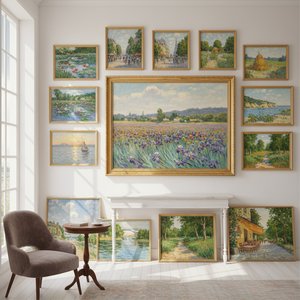
This pursuit was never about documenting a static scene; it was an attempt to freeze time itself. In works such as Lavacourt, we see the early tremors of this revolution, where the tranquility of the French landscape is rendered with a sensitivity to the shifting atmosphere. For Monet, the subject matter—be it a bridge, a haystack, or a lily pond—was merely a vessel for the true protagonist of his work: light. By prioritizing the sensory experience of a single moment, he invited the viewer to inhabit a world that is constantly in flux, forever escaping the grasp of the permanent.
The Science of Light: Breaking from Academic Tradition
The transition from traditional realism to Impressionism required more than just a change in subject; it demanded a fundamental restructuring of visual language. The academic tradition relied heavily on chiaroscuro—the dramatic use of light and shadow to create volume and depth through dark, heavy tones. Monet, however, realized that shadows are rarely black or grey; they are composed of reflected colors, deep blues, and violets. By abandoning the heavy outlines and somber palettes of his predecessors, he began to build form through the juxtaposition of pure, vibrant pigments.
This was a scientific endeavor as much as an artistic one. Monet observed how sunlight interacts with different surfaces, how the moisture in the air scatters color, and how the time of day alters the perceived temperature of a landscape. His brushwork became more fragmented, utilizing short, thick strokes that allowed the eye to optically mix colors from a distance. This technique did not merely represent light; it simulated the very vibration of light hitting the retina, creating a sense of luminosity that traditional glazing could never achieve.
Seriality as Narrative: The Evolution of the Haystacks and Water Lilies Series
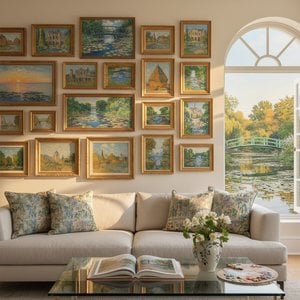
Perhaps Monet’s most profound contribution to the art historical canon is his development of "serial vision." In his later years, he moved away from single-canvas narratives toward a repetitive, rhythmic exploration of a single subject under varying conditions. His Grainstacks series, particularly works like Grainstacks at the End of the Day, Autumn, serves as a masterclass in this concept. By painting the same haystacks at dawn, midday, and dusk, he demonstrated that the object itself is secondary to the light that bathes it.
This serial approach reached its zenith in his Water Lilies. In these monumental works, the horizon line often disappears, leaving the viewer suspended in a world of reflections and aquatic flora. The repetition of the subject allowed Monet to push the boundaries of abstraction, focusing entirely on the interplay of color and texture. These series function as a visual symphony, where each painting is a single note contributing to a larger, continuous movement of light and atmosphere that transcends the limits of a single frame.
Beyond the Subject: How Color Theory Redefined Visual Perception
As Monet’s career progressed, his use of color became increasingly liberated from the constraints of literal representation. He understood that color is a psychological experience as much as a physical one. By utilizing complementary colors—placing oranges against blues or yellows against violets—he heightened the visual tension and brilliance of his compositions. This mastery of color theory allowed him to evoke emotions ranging from the serene tranquility of a summer afternoon to the melancholic chill of an autumn twilight.
This liberation had profound implications for how we perceive reality. Monet taught us that color is not an inherent property of an object, but a relationship between light, surface, and the observer. His ability to manipulate temperature through hue—using warm tones to suggest heat and cool tones to suggest shade—redefined the painterly palette. This shift paved the way for future generations of artists to explore the expressive power of color, moving art closer to the realm of pure emotion and away from mere imitation.
The Legacy of Impressionism: From En Plein Air to Modern Abstraction
The ripples of Monet’s revolution extend far beyond the borders of 19th-century France. By breaking the tether between art and literal representation, he laid the essential groundwork for the birth of modern abstraction. The dissolution of form in his late works, where the subject becomes almost indistinguishable from the atmosphere, directly prefigures the gestural freedom of Abstract Expressionism. His legacy is found in every artist who seeks to capture the intangible, the emotional, and the sensory.
Today, we see his influence in the way we interact with the visual world—in photography, cinema, and even digital media. Monet’s vision reminds us that beauty lies in the fleeting, and that there is profound depth to be found in the most transient of moments. His life's work remains a testament to the power of observation and the enduring magic of light, inviting us all to look more closely at the world around us and find the extraordinary within the ordinary.
At WahooArt.com, we celebrate this enduring legacy of master craftsmanship. As a global leader in fine art reproductions, we specialize in bringing the profound textures and luminous colors of masters like Monet into the modern home. Whether you seek a Handmade Oil Reproduction that captures the authentic impasto brushstrokes of an Impressionist masterpiece or a custom commission that reimagines your own memories through a historical lens, our artists are dedicated to preserving the soul of art. From museum-quality oils on cotton canvas to bespoke architectural murals, WahooArt offers an unparalleled gateway to the world's greatest artistic achievements.