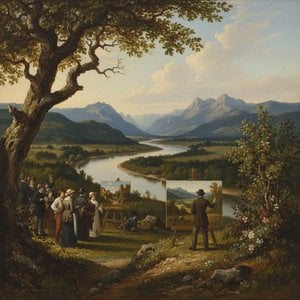
Early Life and Academic Foundations: A Promising Start
Thomas Stothard (17 August 1755 – 27 April 1834) was a British painter, illustrator and engraver. His son, Robert T. Stothard was a painter (fl. 1810): he painted the proclamation outside York Minster of Queen Victoria's accession to the throne in J...
Thomas Stothard, born in London in 1755, emerged from a relatively modest background – his father was an innkeeper in Long Acre – into a world poised on the cusp of significant artistic change. A delicate constitution led to a period spent with relatives in Yorkshire as a young boy, a formative experience that instilled a quiet sensitivity perhaps reflected later in his work. His early education included schooling at Acomb, Tadcaster, and Ilford, but it was an apprenticeship with a draughtsman specializing in patterns for brocaded silks that first channeled his innate artistic talent. This seemingly prosaic beginning belied a burgeoning passion for illustration, fueled by a deep love of poetry. Stothard’s self-directed studies, sketching scenes from beloved verses, caught the eye of James Harrison, editor of the Novelist's Magazine, offering early encouragement and validation. The death of his master proved pivotal; it liberated him to pursue art with unwavering dedication, a decision that would shape not only his own career but also the aesthetic landscape of British illustration.
In 1778, Stothard formally entered the Royal Academy as a student, marking a crucial step in his artistic development. He wasn’t merely absorbing technique; he was immersing himself in a world of classical ideals and burgeoning Romantic sensibilities. His election as an associate academician in 1792, followed by full academicianship in 1794, solidified his position within the established art community. These weren't simply accolades; they represented recognition of a unique voice – one that skillfully blended meticulous draftsmanship with a distinctly literary and emotionally resonant vision.
Stothard's Illustrative Prowess: Book Illustrations and Popular Appeal
 thomas stothard
Thomas Stothard (1755-1834) was a renowned English painter & illustrator known for his graceful book illustrations, historical scenes, and charmingly sentimental style. Celebrated for works like 'Canterbury Pilgrims' & designs inspired by classical l
While Stothard achieved renown as a painter, it is arguably his work as a book illustrator for which he remains most celebrated. He possessed an exceptional ability to translate the nuances of literary narratives into captivating visual form. From early plates accompanying editions of Ossian to his prolific contributions to Bell's Poets, and particularly his extensive series for the Novelist’s Magazine – encompassing a remarkable 148 designs including scenes from Tobias Smollett’s The Adventures of Peregrine Pickle and the emotionally charged works of Samuel Richardson like Clarissa and Sir Charles Grandison – Stothard demonstrated an unparalleled gift for characterization and atmospheric detail. These weren't mere accompaniments to the text; they were integral to the reading experience, enriching the stories with a visual depth that resonated deeply with audiences.
The collaborative partnership with engraver Thomas Fielding further amplified his reach. Fielding’s skill in color engraving brought Stothard’s designs to life with exceptional aesthetic quality, particularly in their Arcadian scenes which became highly sought after by collectors. Beyond these larger projects, Stothard consistently produced illustrations for pocket-books, concert tickets, and almanacs – a testament to his versatility and the widespread demand for his work. His ability to capture grace and distinction in even the smallest of formats cemented his popularity and established him as a leading figure in British illustration.
Navigating Neoclassicism and Romanticism: Style, Themes, and Influences
Stothard’s artistic journey unfolded during a period of stylistic transition, straddling the waning influence of Neoclassicism and the burgeoning power of Romanticism. He wasn't strictly aligned with either movement but rather skillfully synthesized elements from both. His grounding in classical principles – evident in his balanced compositions, refined draftsmanship, and emphasis on idealized forms – provided a structural foundation for his work. However, unlike the austere formality often associated with Neoclassicism, Stothard infused his paintings and illustrations with a distinctly Romantic sensibility: an emotional warmth, a fascination with narrative, and a penchant for sentimental themes.
His subjects frequently explored themes of love, innocence, and idyllic pastoral life. Works like Cupid Bound To A Tree exemplify this delicate balance – the neoclassical clarity of form is tempered by a palpable sense of vulnerability and emotional longing. He drew inspiration from a wide range of sources, including classical literature, Shakespearean drama, and the works of contemporary poets like William Cowper and John Milton. The influence of Rubens, particularly his rich coloring and dynamic compositions, is also readily apparent in Stothard’s oil paintings. This ability to absorb diverse influences and forge them into a uniquely personal style was central to his artistic success.
The Canterbury Pilgrims and Beyond: Key Paintings and Artistic Contributions
While his illustrations were prolific, Stothard's ambition extended to larger-scale painting. His most enduring legacy arguably lies in The Canterbury Pilgrims (1806), a work that heralded the Pre-Raphaelite style with its meticulous detail and vibrant narrative energy. Commissioned by Robert Hartley Cromek, this painting sparked controversy due to a dispute with William Blake, who also desired the commission. Regardless of the circumstances, The Canterbury Pilgrims became immensely popular through Luigi Schiavonetti’s engraving, captivating audiences with its lively depiction of Chaucer's iconic characters.
Beyond The Canterbury Pilgrims, Stothard produced a wealth of other significant works. His figure subjects for Samuel Rogers’s Italy (1830) and Poems (1834) demonstrated his continued artistic vitality even in old age. He also undertook ambitious decorative projects, including the grand staircase at Burghley House, near Stamford, Lincolnshire, depicting scenes of War, Intemperance, and Orpheus’s descent into Hell, and the library at Colonel Johnes' mansion of Hafod, North Wales, illustrating episodes from Froissart and Monstrelet. These large-scale commissions showcased his versatility and ability to adapt his style to diverse architectural settings.
Legacy and Influence: Stothard’s Impact on British Art and Illustration
Thomas Stothard's influence extended far beyond the immediate circle of his contemporaries. His graceful style, meticulous draftsmanship, and emotionally resonant imagery profoundly impacted British art and illustration throughout the 19th century. He helped to elevate book illustration from a purely functional craft to a recognized art form, inspiring generations of artists to explore the expressive possibilities of visual storytelling. His synthesis of Neoclassical principles with Romantic sensibilities paved the way for later movements like the Pre-Raphaelites, who admired his attention to detail and narrative clarity.
Ralph Nicholson Wornum estimated that Stothard produced approximately five thousand designs, of which around three thousand were engraved – a testament to his extraordinary productivity. His oil paintings, though often smaller in scale, continue to captivate with their rich coloring and dynamic compositions. Today, Stothard’s work is celebrated for its enduring beauty, technical mastery, and profound sensitivity. WahooArt.com offers high-quality reproductions of his most iconic works, allowing art enthusiasts to experience the charm and elegance of this pivotal figure in British artistic history. Explore our collection and discover the timeless appeal of Thomas Stothard’s captivating vision.