Early Life & Apprenticeship: The Foundations of a Maritime Painter
 samuel walters
Explore the evocative art of Samuel Walters (1811-1882), a British painter known for his detailed landscapes & biblical scenes, capturing Victorian era aesthetics.
Samuel Walters, born in London in 1811, wasn’t destined for the grand salons of artistic renown but rather emerged from a practical lineage of tradesmen and artists. His father, Miles Walters, was a master craftsman – a marine painter himself – and it was within the bustling atmosphere of his workshop that young Samuel first encountered the allure of capturing the sea on canvas. This wasn’t merely an introduction to painting; it was immersion in a world defined by the rhythms of the docks, the scent of salt air, and the constant movement of vessels navigating the Thames. The early years were formative, steeped not in formal academic training but in the meticulous observation of light playing upon water, the intricate rigging of ships, and the sheer physicality of maritime life. This apprenticeship wasn’t about abstract theory; it was a hands-on education in precision, detail, and an understanding of the very materials that would become his tools – the oils, canvases, and brushes he would wield with increasing skill.
The Liverpool School & Collaborative Beginnings with His Father
Around 1826, the Walters family relocated to the burgeoning port city of Liverpool, a pivotal moment in Samuel’s artistic development. Liverpool at this time was a vibrant hub of maritime activity and home to a distinctive school of marine painting. This wasn't a formal institution but rather a collective of artists who shared a common fascination with depicting ships and the sea. It was here that Samuel truly began to hone his craft, enrolling in the Liverpool Mechanics’ School of Arts and later joining the Royal Institution. Crucially, this period also marked the beginning of a remarkable artistic collaboration with his father. For over six years, Miles and Samuel worked side-by-side on approximately forty paintings, blending their skills and establishing a reputation for accuracy and evocative detail. These early collaborations weren’t simply exercises in shared labor; they were a masterclass in technique, composition, and the nuances of capturing the maritime world – a foundation upon which Samuel would build his individual style.
Mastering Detail: Walters’ Technique & the Pursuit of Realism
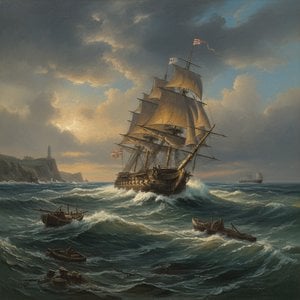
 An Outward-bound Merchantman Heading Down The Channel
Samuel Walters’ "An Outward-bound Merchantman" captures 19th-century maritime life in oil. Admire its realistic style, detailed composition & atmospheric lighting – a Victorian masterpiece.
What sets Samuel Walters apart is not simply *what* he painted but *how*. He possessed an almost obsessive attention to detail, meticulously rendering every rope, sail, and plank with astonishing accuracy. This wasn't merely about photographic realism; it was a pursuit of capturing the very essence of maritime life – the texture of weathered wood, the glint of sunlight on waves, the subtle shifts in light that signaled changing weather conditions. His oil paintings are characterized by layered brushwork, creating depth and luminosity. He didn’t shy away from complex compositions, often depicting ships crowded with activity, their sails billowing in the wind. This dedication to realism wasn't accidental; it stemmed from his intimate knowledge of seafaring life and a desire to convey not just an image but a feeling – the power, beauty, and sometimes, the peril of the sea. Walters’ technique involved careful sketching, precise layering of colors, and a patient approach that allowed him to build up textures and create a sense of atmospheric perspective.
Naval Exploration & Historical Scenes: Beyond Merchant Vessels
 The Niger Expedition
Explore 'The Niger Expedition,' a detailed 19th-century watercolor by Samuel Walters depicting naval exploration. A captivating maritime scene of adventure & power!
While Walters initially gained recognition for his depictions of merchant ships – vessels vital to Britain’s trade and prosperity – his artistic scope extended beyond the commercial world. He also documented scenes of naval exploration, capturing moments of adventure and power on the high seas. Paintings like “The Niger Expedition” exemplify this broader interest, showcasing detailed watercolors that bring to life the challenges and triumphs of 19th-century maritime expeditions. These works weren’t simply historical records; they were imbued with a sense of drama and excitement, conveying the spirit of discovery and the ambition of empire. Furthermore, Walters often incorporated biblical scenes into his landscapes, adding layers of symbolism and moral weight to his compositions. This blending of realism with narrative elements demonstrates a sophisticated artistic sensibility – a desire to not just depict the world but also to imbue it with meaning.
Walters' Legacy and Influence on 19th-Century Marine Art
Samuel Walters’ impact on 19th-century marine art is undeniable. His meticulous technique, dedication to realism, and ability to capture both the beauty and power of the sea set him apart from his contemporaries. He became a highly sought-after artist, exhibiting regularly at the Royal Academy for over three decades and earning widespread acclaim. His influence extended beyond his own paintings; he mentored several other important Liverpool marine artists, including Duncan McFarlane and Francis Hustwick, shaping the next generation of seascape painters. Walters’ popularity also led to the creation of numerous engravings and lithographs based on his originals, further disseminating his style and vision. He wasn't merely a painter; he was a chronicler of an era – capturing the essence of Victorian maritime life with unparalleled skill and artistry.
Collecting Samuel Walters Today: A Victorian Aesthetic for Modern Homes
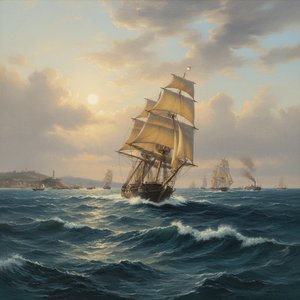
 The Full-rigged Merchantman Vespasian At Sea
Admire "The Full-rigged Merchantman Vespasian At Sea" by Samuel Walters – a stunning Victorian maritime painting. Explore detailed landscapes & biblical scenes in this exquisite hand-painted reproduction.
Today, Samuel Walters’ paintings offer a captivating glimpse into a bygone era. His works are prized by collectors for their historical significance, technical brilliance, and evocative atmosphere. A “Full-rigged Merchantman At Sea,” for example, isn't just a depiction of a ship; it’s a window into the world of 19th-century trade, exploration, and adventure. The detailed landscapes and biblical scenes add layers of depth and symbolism, making these paintings more than mere decorative objects – they are conversation starters, historical documents, and testaments to human ingenuity. WahooArt offers exquisite hand-painted reproductions of Walters’ masterpieces, allowing you to bring the Victorian aesthetic into your own home. Whether you're a seasoned collector or simply appreciate fine art, Samuel Walters’ paintings offer a timeless beauty that transcends generations. Explore our collection and discover the enduring allure of this remarkable artist.