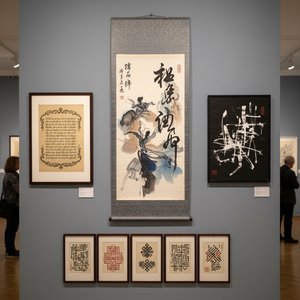
Wu Changshuo: Bridging Calligraphy and Landscape – A Legacy of Tranquility
Wu Changshuo (吳昌碩; 1844-1927), born wu junqing, stands as a pivotal figure in late Qing Dynasty Chinese art, celebrated primarily for his masterful fusion of calligraphy and landscape painting—a technique that profoundly shaped the aesthetic sensibilities of his era and continues to inspire artists today. Born in Zhuzhou, Zhejiang Province, Wu’s artistic journey began amidst the intellectual fervor of his family, fostering an early appreciation for scholarly pursuits and the expressive power of written language.
- Early Influences & Calligraphy Training: Wu's formative years were marked by rigorous training in calligraphy, specifically focusing on early scripts like Xiao Shu (小學), which instilled in him a deep understanding of brushwork, composition, and tonal harmony—principles that would permeate his subsequent artistic endeavors.
- Move to Suzhou & Imperial Service: Recognizing the importance of environment for creative growth, Wu relocated to Suzhou, Jiangsu Province, establishing himself as a respected artist and scholar. He served briefly as an imperial official in Liaoning during the Qing Dynasty’s waning years, gaining invaluable experience navigating the complexities of court patronage.
Wu Changshuo's artistic breakthrough arrived in his thirties when he embarked on a sustained exploration of landscape painting—a genre that had experienced a revival after centuries of decline. Unlike many contemporaries who adhered to rigid conventions, Wu championed a distinctive approach characterized by spontaneity and emotional resonance. He deliberately avoided meticulous detail, prioritizing instead the conveyance of mood and atmosphere through subtle brushstrokes and tonal variations. This stylistic preference aligned him squarely with the burgeoning Shanghai School movement, which sought to liberate painting from academic constraints and embrace expressive freedom.
- The Shanghai School & Floral Bird Painting: Wu Changshuo’s commitment to capturing the essence of nature—particularly flowers and birds—became his trademark. He meticulously studied avian anatomy and floral morphology, translating scientific observation into breathtaking artistic representations. His paintings are renowned for their luminous color palettes and delicate rendering techniques, reflecting a profound connection with the natural world.
- Seal Art & Artistic Philosophy: Wu Changshuo viewed calligraphy and seal carving as inseparable disciplines—each informing and enriching the other. He established the Xiling Seal Art Society, fostering collaboration among Suzhou-based seal artists and promoting a shared aesthetic vision. His seals are characterized by elegant simplicity and understated beauty, embodying his belief that artistic expression should be guided by contemplation and harmony.
Recognition & Legacy
Wu Changshuo’s exceptional talent garnered him considerable acclaim both domestically and internationally. Particularly noteworthy was his admiration in Japan, where his paintings were recognized as masterpieces of Chinese landscape art—a testament to the enduring influence of Wu's artistic vision. His work continues to resonate with audiences today, serving as an exemplar of stylistic innovation and emotional depth within the broader context of Qing Dynasty art history. He remains a cornerstone figure in understanding the evolution of Chinese painting and its profound connection to philosophical ideals.
- Notable Works: Among Wu Changshuo’s celebrated paintings are “Brewing Tea,” “Peach Fruit of Three Thousand Years,” and “Spring Offerings”—each demonstrating his mastery of tonal harmony and expressive brushwork. These pieces exemplify the Shanghai School's ethos of capturing fleeting moments of beauty and conveying profound emotional states.
Further Exploration
For a deeper understanding of Wu Changshuo’s artistic contributions, consider examining his influence on subsequent generations of Chinese painters—particularly Qi Baishi (漆白石), who adopted Wu's stylistic principles and championed the pursuit of lyrical beauty. Also explore Pan Tianshou (潘天壽), another influential artist whose work similarly embraced spontaneity and emotional resonance.