Thomas Eakins, 1844 – 1916

The 100 Most Famous Paintings by Thomas Eakins

The painting that made Thomas Eakins famous is Čeznovo mesto (1875); it hangs in the Philadelphia Museum of Art, Filadelfija. Swimming (1885) and Max Schmitt v enoti skovi (1871) follow it in the hearts of collectors and museum visitors. Of the 346 works by Thomas Eakins in our catalogue, these 100 are the most admired, each presented with its date, its museum and what sets it apart.

Ranked by our popularity score, which combines the searches, visits and orders for each work. Updated oktober 2026. Every masterpiece on this page can be ordered as a museum-quality, hand-painted oil reproduction or a fine art print, at the size you choose.

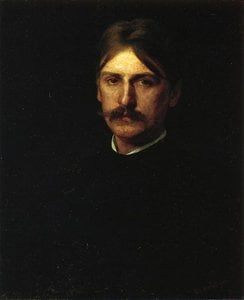
Portrait of Thomas Eakins
Thomas Eakins · 1844 – 1916
Born · died
1844 – 1916, Philadelphia
Movement
Realism
Works in our catalogue
346
Most famous
Čeznovo mesto (1875)
Most works at
Philadelphia Museum of Art

Thomas Eakins: the ten masterpieces

Čeznovo mesto (1875) by Thomas Eakins
1

Čeznovo mesto

1875 · Olje na platnu · Philadelphia Museum of Art, Filadelfija

Thomas Eakins’ “The Gross Clinic,” completed in 1875, stands as an enduring testament to the power of realism within American art history. More than just a depiction of surgical practice, it's a profound meditation on human vulnerability and scientific advancement—a juxtaposition that continues to resonate with audiences today.

Swimming (1885) by Thomas Eakins
2

Swimming

1885 · Acrylic On Canvas · Amon Carter Museum of American Art, Fort Worth

Thomas Eakins' "Swimming," painted in 1884, isn’t merely a depiction of men enjoying a summer afternoon by the water; it’s a meticulously constructed study of human form, motion, and the subtle tensions simmering beneath the surface of American society. This oil on canvas, currently residing within the Amon Carter Museum of American Art in Fort Worth, Texas, is a pivotal work that encapsulates Eakins' revolutionary approach to art – one…

Max Schmitt v enoti skovi (1871) by Thomas Eakins
3

Max Schmitt v enoti skovi

1871 · Olje na platnu · Metropolitanski muzej umetnosti, New York

Thomas Cowperthwait Eakins' 'Max Schmitt in a Single Scull' is more than just a depiction of a rowing race; it’s a masterful study of human movement, light, and the quiet drama of everyday life. Painted in 1871, this iconic work exemplifies Eakins’s commitment to realism, a style that sought to capture reality without idealization – a radical departure from prevailing artistic trends.

Portrait of Samuel Murray (1889) by Thomas Eakins
4

Portrait of Samuel Murray

1889 · Oil On Canvas

To stand before Thomas Eakins’s Portrait of Samuel Murray is not merely to observe a likeness; it is to engage in an intimate confrontation with the spirit of late nineteenth-century America. This oil on canvas, dating from 1889, stands as a monumental testament to the power and conviction of Realism. Eakins, whose career was marked by an almost scientific dedication to truth, eschewed the romantic veneer that often cloaked portraiture.…

The Dancing Lesson (1878) by Thomas Eakins
6

The Dancing Lesson

1878 · Watercolor

To gaze upon Thomas Eakins' "The Dancing Lesson" is to step through a veil into a moment suspended in time—a breath held between notes of music and laughter. This captivating watercolor, executed in 1878, transcends the mere depiction of an event; it captures the very essence of human connection. The scene unfolds with an almost palpable warmth, inviting the viewer into a private gathering where generations interact through the universal…

John Biglin in a Single Scull (1873) by Thomas Eakins
7

John Biglin in a Single Scull

1873 · Watercolor · Yale University Art Gallery, New Haven

Thomas Eakins’ “John Biglin in a Single Scull,” painted in 1873, is more than just a depiction of an oarsman at work; it’s a meticulously crafted meditation on observation, human physicality, and the burgeoning spirit of realism within American art. This watercolor masterpiece, born from Eakins' deep engagement with the everyday lives of Philadelphia’s elite – doctors, sportsmen, and laborers – offers a rare glimpse into a moment of intense…

The gross clinic jefferson medical college of th (1875) by Thomas Eakins
8

The gross clinic jefferson medical college of th

1875 · Painting · Metropolitanski muzej umetnosti, New York

To stand before this depiction of Jefferson Medical College is to step directly into the earnest, rigorous atmosphere of late nineteenth-century American intellectual life. The scene unfolds with an almost documentary precision, capturing not just a moment in time, but the very process of learning itself. We see a gathering—a cohort of men, perhaps students or young practitioners—assembled within what appears to be a lecture hall or clinic space. At…

The Pair Oared Shell (1872) by Thomas Eakins
9

The Pair Oared Shell

1872 · Oil On Canvas · Philadelphia Museum of Art, Filadelfija

To gaze upon Thomas Eakins's The Pair Oared Shell is to be invited into a moment suspended between exertion and profound tranquility. Painted in 1872, this work transcends a mere depiction of sport; it captures the very essence of shared human endeavor set against the backdrop of natural permanence. The scene unfolds on calm water, where two figures propel a long canoe, their synchronized effort forming a visual rhythm that…

Elizabeth Crowell with a Dog (1873) by Thomas Eakins
10

Elizabeth Crowell with a Dog

1873 · Oil On Canvas

To stand before Elizabeth Crowell with a Dog is to step directly into the nuanced, richly observed world of late nineteenth-century Philadelphia. Thomas Eakins, the master chronicler of American realism, has gifted us more than just a portrait; he offers an intimate tableau vivant. The scene unfolds with remarkable quietude: Elizabeth Crowell, clad in striking red, kneels gracefully beside her canine companion. Her posture speaks of deep connection, her hand…

More Thomas Eakins masterpieces, 11 to 100

Portrait of Walt Whitman (1887) by Thomas Eakins
#12

Portrait of Walt Whitman

1887 · Philadelphia Museum of Art

In the quiet, profound depths of Thomas Eakins’ Portrait of Walt Whitman, we encounter more than just a likeness; we witness a monumental collision of two American icons.…

Order a reproduction →
Swimming (1884) by Thomas Eakins
#13

Swimming

1884 · Amon Carter Museum of American Art

Thomas Eakins’ “Swimming,” painted in 1884, isn't merely a depiction of men enjoying a summer day; it’s a profound exploration of the human form, movement, and the burgeoning…

Order a reproduction →
Pushing for Rail (1874) by Thomas Eakins
#15

Pushing for Rail

1874 · Metropolitanski muzej umetnosti

In the quiet, damp expanses of the New Jersey marshes near the Delaware River, a profound drama of human endurance unfolds within Thomas Eakins’s 1874 masterpiece, Pushing for…

Commission a hand-painted copy →
The Chess Players (1876) by Thomas Eakins
#16

The Chess Players

1876 · Metropolitanski muzej umetnosti

In the hushed atmosphere of a Philadelphia parlor, time seems to decelerate within the frame of Thomas Eakins’s 1876 masterpiece, The Chess Players. This intimate oil on wood…

Commission a hand-painted copy →
Portrait of Mary Adeline Williams (1900) by Thomas Eakins
#17

Portrait of Mary Adeline Williams

1900 · Philadelphia Museum of Art

To stand before Thomas Eakins’s Portrait of Mary Adeline Williams is not merely to observe a likeness; it is to engage in an intimate dialogue with the past.…

Bring it home →
The Concert Singer (1890) by Thomas Eakins
#19

The Concert Singer

1890 · Philadelphia Museum of Art

Thomas Eakins: A Pioneer of Anatomical Realism Thomas Cowperthwait Eakins (1844–1916) stands as a monumental figure in American art—a painter of unflinching realism who dedicated his life to…

Commission a hand-painted copy →
Home Ranch (1892) by Thomas Eakins
#20

Home Ranch

1892 · Philadelphia Museum of Art

Thomas Eakins’s “Home Ranch,” painted in 1892 and now residing within the Philadelphia Museum of Art, isn't a grand historical tableau or a dramatic portrait; instead, it offers…

Order a reproduction →
Riter Fitzgerald (1895) by Thomas Eakins
#25

Riter Fitzgerald

1895 · Art Institute of Chicago

In this 1895 oil on canvas, an older gentleman is seated in a large, plush armchair. The chair is a deep red, featuring a soft, velvet-like texture and…

Order a reproduction →
The Courtship (1878) by Thomas Eakins
#26

The Courtship

1878 · Fine Arts Museums of San Francisco

Thomas Eakins' "The Courtship," painted in 1878, is more than just a portrait; it’s a meticulously observed study of human connection—a quiet tableau brimming with unspoken emotions and…

Bring it home →
Arthur B. Frost (1886) by Thomas Eakins
#29

Arthur B. Frost

1886 · Detroit Institute of Arts

Arthur B. Frost emerges from the shadows in this 1886 oil on canvas, a work executed after Thomas Eakins. The subject sits in a bust-length view, his body…

Bring it home →
The Timer (1879) by Thomas Eakins
#33

The Timer

1879 · New Britain Museum of American Art

A solitary man sits anchored in a dimly lit room, his profile cutting a sharp silhouette against the heavy gloom. He leans toward a table, his body caught…

Order a reproduction →
Retrospection (1880) by Thomas Eakins
#36

Retrospection

1880 · Yale University Art Gallery

Retrospection is an oil painting created by the artist Thomas Eakins. The work was executed in 1880. This piece is rendered in oil on a surface of canvas…

Commission a hand-painted copy →
Study of a Groom (1879) by Thomas Eakins
#37

Study of a Groom

1879 · Philadelphia Museum of Art

In this oil study, Thomas Eakins presents a quiet, introspective moment through the figure of a man. Titled Study of a Groom, the work emerged in the United…

Commission a hand-painted copy →
Professor William Woolsey Johnson (1896) by Thomas Eakins
#39

Professor William Woolsey Johnson

1896 · Fine Arts Museums of San Francisco

The portrait presents a bust-length study of Professor William Woolsey Johnson, rendered with a focus on the psychological weight of the subject. Positioned slightly off-center, the man gazes…

Bring it home →
Archbishop James Frederick Wood (1877) by Thomas Eakins
#40

Archbishop James Frederick Wood

1877 · Crystal Bridges Museum of American Art

The portrait presents Archbishop James Frederick Wood in a moment of quiet, seated introspection. Positioned slightly off-center, the figure occupies a space defined by deep shadows and a…

Order a reproduction →
The Red Shawl (1890) by Thomas Eakins
#41

The Red Shawl

1890 · Philadelphia Museum of Art

Step closer and observe the way the light settles upon the subject. In this 1890 oil on canvas, we find ourselves in the presence of a young person…

Commission a hand-painted copy →
Seated Figures (1886) by Thomas Eakins
#43

Seated Figures

1886 · Philadelphia Museum of Art

In this 1886 oil on cardboard study, two figures sit within a dark, indeterminate space. The composition is vertically oriented, focusing on the interaction of light and shadow…

Order a reproduction →
Portrait of Blanche Hurlburt (1885) by Thomas Eakins
#44

Portrait of Blanche Hurlburt

1885 · Philadelphia Museum of Art

In the Portrait of Blanche Hurlburt, Thomas Eakins presents a somber and intimate encounter with his subject. The woman is captured in a bust-length view, her profile turned…

Bring it home →
Portrait of Benjamin Eakins (1894) by Thomas Eakins
#46

Portrait of Benjamin Eakins

1894 · Philadelphia Museum of Art

The room falls away into a deep, indistinct darkness, leaving only the presence of an elderly man emerging from the gloom. He sits in a quiet, contemplative stillness,…

Order a reproduction →
James MacAlister (Sketch) (1895) by Thomas Eakins
#47

James MacAlister (Sketch)

1895 · Metropolitanski muzej umetnosti

The portrait presents James MacAlister through a lens of somber realism. Captured in a three-quarter length view, the subject sits centrally against an indistinct, textured background that offers…

Commission a hand-painted copy →
Portrait of Elizabeth L. Burton (1905) by Thomas Eakins
#48

Portrait of Elizabeth L. Burton

1905 · Minneapolis Institute of Art

The Portrait of Elizabeth L. Burton is a significant oil on canvas work by the American artist Thomas Eakins. Created between 1905 and 1906, this portrait captures a…

Bring it home →
Old Lady Sewing (1879) by Thomas Eakins
#50

Old Lady Sewing

1879 · New Britain Museum of American Art

In 1879, Thomas Eakins turned his attention to a quiet, singular moment of domestic life. Old Lady Sewing presents us with an elderly woman absorbed in the rhythmic,…

Commission a hand-painted copy →
Miss Gertrude Murray (1895) by Thomas Eakins
#51

Miss Gertrude Murray

1895 · Dallas Museum of Art

In this 1895 oil on canvas, a young woman is positioned in a bust-length view, oriented slightly off-center. She looks toward the right of the frame, her gaze…

Bring it home →
Portrait of Douglass Morgan Hall (1889) by Thomas Eakins
#56

Portrait of Douglass Morgan Hall

1889 · Philadelphia Museum of Art

In the quiet corridors of the Philadelphia Museum of Art, there exists a window into the profound psychological landscape of the late nineteenth century. Thomas Eakins’s “Portrait of…

Order a reproduction →
Study of a Nude Man (1869) by Thomas Eakins
#59

Study of a Nude Man

1869 · Philadelphia Museum of Art

The painting titled Study of a Nude Man (The Strong Man) is an oil on canvas work by the artist Thomas Eakins. Created in the United States, this…

Order a reproduction →
General E. Burd Grubb (1841-1914) (1898) by Thomas Eakins
#61

General E. Burd Grubb (1841-1914)

1898 · Yale University Art Gallery

In this 1898 portrait, we encounter a man whose presence seems to emerge from the shadows of his own history. The subject, General E. Burd Grubb, is rendered…

Bring it home →
Miss Eleanor S. F. Pue (1907) by Thomas Eakins
#64

Miss Eleanor S. F. Pue

1907 · Virginia Museum of Fine Arts

In this 1907 oil on canvas, the gaze of Miss Eleanor S. F. Pue meets the observer through the steady hand of Thomas Eakins. The portrait captures a…

Bring it home →
Portrait of Mary Adeline Williams (1899) by Thomas Eakins
#65

Portrait of Mary Adeline Williams

1899 · Art Institute of Chicago

To stand before Thomas Eakins’s Portrait of Mary Adeline Williams is to enter into a silent, profound dialogue with the late nineteenth century. Completed in 1899, this masterpiece…

Bring it home →
Elizabeth at the Piano (1875) by Thomas Eakins
#70

Elizabeth at the Piano

1875 · Addison Gallery of American Art

Thomas Eakins’s “Elizabeth at the Piano” is more than a simple depiction of a woman playing an instrument; it's a meticulously crafted meditation on solitude, observation, and the…

Bring it home →
Views of Harry (1885) by Thomas Eakins
#74

Views of Harry

1885 · Philadelphia Museum of Art

This oil study, dated 1885, presents a dense arrangement of animal forms, likely cattle or oxen, within a low-light environment. The composition lacks a singular focal point, instead…

Order a reproduction →

Thomas Eakins's paintings by period

The subjects Thomas Eakins painted most

The four subjects that return most often among these masterpieces, with the finest example of each.

Where to see Thomas Eakins's paintings

The 8 museums that hold the most of the paintings on this page.

Museum City Works by Thomas Eakins Paintings from this list
Philadelphia Museum of Art, FiladelfijaPhiladelphia Museum of Art Filadelfija 82 Čeznovo mesto, Sketch for The Gross Clinic, The Pair Oared Shell
Metropolitanski muzej umetnosti, New YorkMetropolitanski muzej umetnosti New York 18 Max Schmitt v enoti skovi, The gross clinic jefferson medical college of th, Pushing for Rail
Yale University Art Gallery, New HavenYale University Art Gallery New Haven 11 John Biglin in a Single Scull, Archbishop James Frederick Wood (1813-1883), Dr. Agnew (Dr. D. Hayes Agnew) (1818-1892)
Pennsylvania Academy of Fine Arts, PhiladelphiaPennsylvania Academy of Fine Arts Philadelphia 16 Fifty Years Ago (Young Girl Meditating): Study, Spinning: Sketch, Charles Edmund Dana
National Gallery of Art, WashingtonNational Gallery of Art Washington 11 Annie C. Lochrey Husson (Mrs. Louis Husson), The Biglin Brothers Racing
Fine Arts Museums of San Francisco, San FranciscoFine Arts Museums of San Francisco San Francisco 4 The Courtship, Professor William Woolsey Johnson
Crystal Bridges Museum of American Art, BentonvilleCrystal Bridges Museum of American Art Bentonville 4 Archbishop James Frederick Wood, The Model
Art Institute of Chicago, ChicagoArt Institute of Chicago Chicago 3 Riter Fitzgerald, Portrait of Mary Adeline Williams

Thomas Eakins, decade by decade: the defining painting of each

  1. 1860s
    Study of a Nude Man (The Strong Man) (1869) by Thomas Eakins
    No. 49 of 100

    Study of a Nude Man (The Strong Man)

    Age 16 – 25 · Philadelphia Museum of Art

    A powerful, somber presence fills the space, defined by the heavy interplay of light and dark. The subject, a muscular male figure, is captured in profile, his upper…

  2. 1870s
    Čeznovo mesto (1875) by Thomas Eakins
    No. 1 of 100

    Čeznovo mesto

    Age 26 – 35 · Philadelphia Museum of Art

    Thomas Eakins’ “The Gross Clinic,” completed in 1875, stands as an enduring testament to the power of realism within American art history. More than just a depiction of…

  3. 1880s
    Swimming (1885) by Thomas Eakins
    Rank 2 / 100

    Swimming

    Age 36 – 45 · Amon Carter Museum of American Art

    Thomas Eakins' "Swimming," painted in 1884, isn’t merely a depiction of men enjoying a summer afternoon by the water; it’s a meticulously constructed study of human form, motion,…

  4. 1890s
    Portrait of Frank Hamilton Cushing (1895) by Thomas Eakins
    No. 14 of 100

    Portrait of Frank Hamilton Cushing

    Age 46 – 55

    The Unflinching Gaze of American Realism To stand before Thomas Eakins' Portrait of Frank Hamilton Cushing is to encounter not merely a likeness, but a profound study in…

  5. 1900s

Thomas Eakins's masterpieces: questions and answers

Which painting is Thomas Eakins best known for?Show the answer

Čeznovo mesto (1875), Philadelphia Museum of Art, Filadelfija. Next come Swimming (1885) and Max Schmitt v enoti skovi (1871).

How old was Thomas Eakins when painting Čeznovo mesto?Show the answer

31 years old: Čeznovo mesto dates from 1875 and Thomas Eakins was born in 1844.

What are Thomas Eakins's ten greatest paintings?Show the answer

Čeznovo mesto, Swimming, Max Schmitt v enoti skovi, Portrait of Samuel Murray, Sketch for The Gross Clinic, The Dancing Lesson, John Biglin in a Single Scull, The gross clinic jefferson medical college of th, The Pair Oared Shell and Elizabeth Crowell with a Dog. The ranking above gives the year and the museum of each.

How many works did Thomas Eakins paint?Show the answer

Our catalogue lists 346 works by Thomas Eakins, dated from 1869 to 1908.

In which museums can I see Thomas Eakins's masterpieces?Show the answer

Most of them are in Philadelphia Museum of Art (Filadelfija), Metropolitanski muzej umetnosti (New York) and Yale University Art Gallery (New Haven). The table above lists the museums one by one.

When did Thomas Eakins paint the masterpieces?Show the answer

In 1890s: 29 of the 100 works on this page date from then, among them Portrait of Frank Hamilton Cushing.

What are the first and last famous paintings of Thomas Eakins?Show the answer

The earliest on this page is Study of a Nude Man (The Strong Man) (1869), the latest The Model (1908).

What were Thomas Eakins's favourite subjects?Show the answer

Portrait (27), Man (26) and Woman (16), among the 100 works on this page.

Which technique did Thomas Eakins favour?Show the answer

Oil On Canvas: 49 of the 100 works on this page.

What art movement is Thomas Eakins part of?Show the answer

Realism and Contemporary realism, as the paintings on this page show.

Which masterpieces by Thomas Eakins hang at the Philadelphia Museum of Art?Show the answer

Čeznovo mesto, Sketch for The Gross Clinic and The Pair Oared Shell are among the 38 works on this page held by the Philadelphia Museum of Art, Filadelfija.

Can I own a reproduction of a Thomas Eakins masterpiece?Show the answer

Yes. Every painting on this page can be ordered as a museum-quality, hand-painted oil reproduction or a fine art print, in the size you choose, from the painting's own page.

The life of Thomas Eakins

Življenje Thomasa Eakinsa

Rodjen v Philadelphiji, v Pennsylvaniji, 25. julija 1844, je Thomas Eakins preživeli življenje, ki je bilo globoko zakoreninjeno v mestu njegove rojstne dežele. Bil je človek štetnih disciplin, ki je delal kot slikar, fotograf, kipar in pedagog likovnih umetnosti. Čeprav so ga njegovi zanimaje pogosto vodili v tujino na študij, je geografsko središče njegovega obstoja ostalo v Philadelphiji. Premikali se je skozi intelektualne in družbene krogove mesta, pri tem pa neustavno opazoval ljudi in fizične realnosti, ki so oblikovale lokalno okolje.

Njegovo profesionalno življenje je zaznamalo neomajna zaveza k opazovalnemu in oprijemljivemu. Ne glede na to, ali je zajemal podobnost z oljami ali dokumentiral trenutek skozi objektiv fotoaparata, je njegova izpostavljenost ostala usmerjena v strukturno resnico njegovih subjektov. Ta predanost dejanjam pred idealizacijo ga je pogosto postavljala v nasprotje z prevladujočimi občutki njegovega časa. Bil je človek intenzivnega prepričanja, lastnost, ki je oblikovala tako njegovo umetniško delo kot tudi njegov položaj v akademski skupnosti. Umrl je v Philadelphiji 25. junija 1916.

Zgodnji vplivi in umetniški razvoj

Thomas Eakins, rojen v Philadelphiji, je bil oblikovan v domačem okolju, ki ga je zaznamovala neomajna natančnost. Njegov oče, Benjamin Eakins, je delal kot mojster pisarstva in kaligraf, poklic, ki je zahteval disciplinirano roko in izrazito oko za podrobnosti. Ta zgodnja izpostavljenost mehaniki oblike in čline je postavila tiho, a trdno podlago za mladeniča, ki bo kasneje s znanstveno rigoroznostjo skušal razumeti človeško strukturo. Njegova izobrazba se je resno začela v Pennsylvania Academy of the Fine Arts, kjer je bil vpisan od leta 1862 do 1866. Prav tu se je njegov zanimanje za fizično realnost telesa začelo ukorenjevati, ko se je prestopil od preprostega skiciranja k globšemu raziskovanju anatomije.

Ta anatomsko radovednost ga je vodila v predavanja na Jefferson Medical College. Namesto da bi ostal zaprt v studio, je Thomas Eakins iskal klinično resnico človeškega skeleta in se udeleževal anatomskih predavanj, da bi spoznal temeljno mehaniko mišic in kosti. To stičišče umetnosti in znanosti bo postalo ključna značilnost njegovega umetniškega pristopa. Leta 1866 je zapustil Philadelphijo in odšel v Pariz, da bi nadaljeval svoje študije. Čas v Franciji je preživel z absorbiranjem tehničnega znanja svojega obdobja ter z izpopolnjevanjem metode opazovanja, ki je predlagala neposredno izkušnjo pred romantiziranimi ideali. Ta obdobje usposabljanja je utrdilo njegovo predanost slogu, ki je bil globoko zakorenjen v oprijemljivi, neizkrivljeni resnici njegovih subjektov.

Tehnika in umetniški slog

Thomas Eakins je tradicijo ameriškega realizma 19. stoletja popeljal na vrh vrhunskih dosežkov. Njegov umetniški pristop je bil opredeljen z neomajno zavezanostjo anatomični natančnosti in globokim psihološkim vpogledom. Ni se zadovoljal z zgolj zajemanjem podobnosti; njegov cilj je bil razumevanje globokih struktur človeške oblike. Ta znanstvena radovedlnost ga je vodila v raziskovanje mehanike gibanja in kompleksnosti človeškega telesa, pri čemer je pogosto črpal iz svojega globokega zanimanja za anatomijo. Njegovi subjekti so bili pogosto prikazani v središču fizičnega napora, bodisi skozi disciplinirani ritam veslenja ali skozi osredotočeno intenzivnost medicinskega prakse.

Njegovi interesi so bili široki, njihove teme pa so se pogosto odrazile na platnu skozi prikaze glasbe, skulpture in športov na prostem. Bil je inovator pri uporabi fotografije, ki je kot praktičnega orodja je uporabljal za izboljšanje svojih umetniških namenov in doseganje večje natančnosti pri prikazovanju gibanja. Ta integracija nove tehnologije s tradicionalnim slikarstvom mu je omogočila opazovanje sveta z jasnostjo, ki ni bila običajna med njegovimi sodobniki. Osredotočil se je na oprijemljivo realnost svojih subjektov, pri čemer je predaljšeno trdo delo dejanske izkušnje vedno predlagal idealiziranim ali romantiziranim verzijam življenja.

Ključna dela in vrhunska platna

Eakinsova čopiča je pogosto iskala stičišče med fizičnim naporom in tiho kontemplacijo. Leta 1871 je ustvaril Max Schmitt in a Single Scull, delo, ki zajema ritmično izolacijo veslača. Slikat odraža njegovo fascinacijo nad gibanjem in samotno koncentracijo, ki jo zahteva ta šport. Njegov zanimanje za človeško obliko se je razširilo tudi v področje zgodovinske alegorije, kar vidimo v delu William Rush and His Model (1877). To platno je uporabilo ženski akt za raziskovanje zgodovinskega subjekta, hkrati pa je izzvalo družbene konvencije njegovega časa.

Tenzija med znanstvenim opazovanjem in človeško ranljivostjo je morda najbolj opazna v sliki The Gross Clinic (1875). To delo predstavlja råst, neomilnosten pogled na kirurško operacijo, ki poudarja intenzivno koncentracijo vpletenih medicinskih strokovnjakov. Zaradi svoje neposrednosti ostaja eno njegovih najbolj omažanih in diskutiranih platn.

Pozneje, leta 1887, je svojo pozornost usmeril v literarnega giganta svojega obdobja z portretom Portrait of Walt Whitman. Ta študija pesnika se odmakne od kliničnega pristopa in se usmerja v bolj psihološko interpretacijo človeškega značaja, ki zajema izločenost in značilne črt življenja, vodenga z intelektualno rigoroznostjo.

Podajanje znanja in profesionalno življenje

Eakinsovo vplivno delo se ni omejevalo le na osamljenost njegovega studia, temveč je segalo daleč v učilnice, kjer je naslednja generacija ameriških umetnikov iskala svojo umetniško pot. Leta 1879 je prevzel položaj profesorja risanja in slikarstva na Pennsylvanski akademiji likovnih umetnosti. Njegova prisotnost na tej instituciji je bila transformativna, saj jo je spremenila v vodilno središče za umetniške študije. Thomas Eakins ni poučeval zgolj tehnike; zahteval je strogo, skoraj klinično razumevanje človeške oblike. Ta neomajna zaveza k anatomski resnici ga je pogosto postavljala v nasprotje s socialnimi in akademskimi normami tistega obdobja.

Njegov pedagoški vpliv se ni končal v Philadelphiji. Svoje metode je delil v Art Students League v Philadelphiji in na National Academy of Design v New Yorku. Vendar pa je njegovo vztrajstvo pri uporabi popolnoma naga moških modelov za lažše razumevanje muskulature in gibanja vzbudilo globoko kontroverzo. Te nekonvencionalne metode so na koncu privabile do nesporov s kolegi in njegove iztornitve iz Drexel Institute v Philadelphiji. Kljub teh profesionalnim nazadnjanjem in socialni izolaciji, ki je občasno sledila, je njegova predanost umetnosti, ki temelji na znanstvenem pristopu, ostala neomena.

Dediščina in trajna vpliv

Težo Eakinsovega prispevka k ameriškemu umetniškemu kanonu odmerja njegova neomilna in neomrečna zaveza človeški obliki. Široko je priznan kot eden najpomembnejših ameriških umetnikov, človek, katerega predanost mehaniki življenja je ga pogosto postavljala v nasprotje z občutki in normami njegove dobe. Njegov vpliv se je razširil dlje od platna in v širšo kulturno zavest; posebej je bilo opazno, da je njegovo del postal del slikarskih tekmovanj na letnjih olimpijskih igrah leta 1932.

Njegova prisotnost v Philadelphiji ostaja fizično zakorenjena v zgodovini mesta. Hiša, ki jo je zasojal v severni Philadelphiji – gradnja, ki je bila priča njegove celotni življenjski predanosti umetnosti – je bila leta 1965 označena za nacionalni zgodovinski spomenik. To priznanje je bilo dopolnjeno leta 1966, ko je bila stavba vpisana tudi v Nacionalni register zgodovinskih mest. Te oznake zagotavljajo, da prostor, kjer je študiral anatomijo in razvijal svojo edinstveno vizijo, ostaja trajni del ameriške dediščine.

Kje danes opozoriti njegove dela

Fizična prisotnost Eakinsove vizije je razpršena po več večjih institucijah, ki so prvenstveno koncentrirane na ameriškem severozahodu. V Philadelphiji Philadelphia Museum of Art ohranja pomembno zbirko njegovih slik, ki ohranja vizualni zapis mesta, ki je oblikovalo njegovo perspektivo. Njegovo del najdemo tudi v New Yorku, kjer Metropolitan Museum of Art hrani več njegovih platn, vključno s študijami giba in značaja. Tudi Brooklyn Museum v svoji stalni predstavitvi vključuje njegove naslikane slike.

Poleg urbanih središč na vzhodnem beležju je njegov vpliv ohranjen tudi v akademskih okoljih. Yale University Art Gallery v Hartfordu hrani dela, ki odražajo njegovo predanost anatomski natančnosti in raziskovanju človeške oblike. Te zbirke omogočajo neposreden stik s preciznostjo njegovih poteb in njegovim zanimanjem za mehaniko telesa. Obiskati njegova dela v živo pomeni srečati neposrednost njegovega opazovanja.

  • Max Schmitt in a Single Scull (1871)
  • The Gross Clinic (1875)
  • Portrait of Walt Whitman (1887)
  • Salutat (1898)

All 346 works by Thomas Eakins →