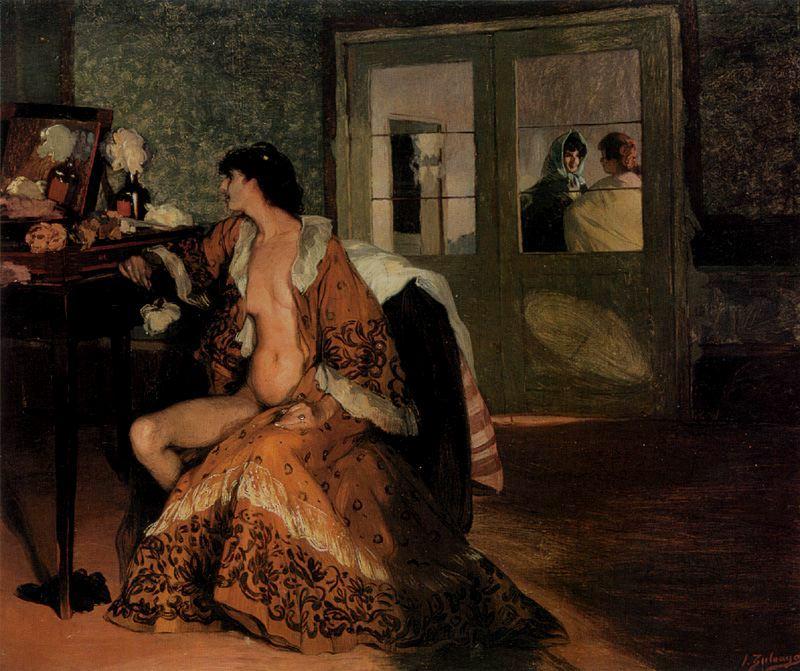
Ignacio Zuloaga, 1870 – 1945

Ignacio Zuloaga Paintings: The 100 Most Famous Works, Ranked

Ignacio Zuloaga's most famous painting is Portrait of Maurice Barrès. With Woman in Andalusian Dress (1911) and Anita Ramírez, in black (1915), it completes the three works everyone recognises. Our catalogue lists 108 works by Ignacio Zuloaga; the 100 below are the ones the world looks at most, each with its year, the museum that holds it and why it matters.

Ranked by our popularity score, which combines the searches, visits and orders for each work. Updated oktober 2026. Every masterpiece on this page can be ordered as a museum-quality, hand-painted oil reproduction or a fine art print, at the size you choose.

Portrait of Ignacio Zuloaga
Ignacio Zuloaga · 1870 – 1945
Born · died
1870 – 1945, Eibar
Movement
Spanish realism
Works in our catalogue
108
Most famous
Portrait of Maurice Barrès
Most works at
Hispanic Society Museum - Library

The 10 most famous Ignacio Zuloaga paintings

Portrait of Maurice Barrès by Ignacio Zuloaga
1

Portrait of Maurice Barrès

Oil On Canvas

The figure of Maurice Barrès occupies the left side of the canvas, a steady anchor amidst a swirling, dramatic landscape. He gazes toward a distant cityscape, his expression caught in a moment of quiet introspection. There is a certain weight to his presence, a sense of a man deeply connected to the history he contemplates. The light, diffused and soft as if filtered through an overcast sky, casts gentle shadows…

Woman in Andalusian Dress (1911) by Ignacio Zuloaga
2

Woman in Andalusian Dress

1911 · Oil On Canvas · National Gallery of Art, Washington

A woman emerges from a swirl of deep blues and teals. She is captured from the waist up, her presence anchored by the heavy textures of her attire. An orange headpiece rests upon her hair, pinned with pink and white floral accents that catch the light. Her skin glows with warmth against the cool, atmospheric clouds that churn in the background. There is a stillness in her gaze, a poised…

Julia Wainwright Robbins (1923) by Ignacio Zuloaga
7

Julia Wainwright Robbins

1923 · Oil On Canvas · Metropolitanski muzej umetnosti, New York

In this 1923 oil on canvas, Ignacio Zuloaga captures Julia Wainwright Robbins as a solitary figure. She occupies the center of the frame, a single female presence held within a quiet, dark space. Her posture is formal, defined by an aristocratic poise that commands the stillness of the composition. She holds a closed fan, a small, rigid object that anchors her hands against the soft volume of her attire.

Ignacio Zuloaga, paintings 11 to 100

Portrait of Ivan Shchukin (1869-1908) (1899) by Ignacio Zuloaga
#11

Portrait of Ivan Shchukin (1869-1908)

1899 · Ermitaž

A full-length portrait depicts a man positioned centrally against a desolate, rocky landscape. He is oriented slightly toward the viewer, maintaining a frontal posture that occupies much of…

Bring it home →
My Uncle and My Cousins (1898) by Ignacio Zuloaga
#32

My Uncle and My Cousins

1898 · Musée d'Orsay

Ignacio Zuloaga y Zabala's 1898 painting, *My Uncle and My Cousins*, offers a poignant window into the formal portraiture traditions of late 19th-century Spain. More than simply a…

Bring it home →
Sepulveda (1909) by Ignacio Zuloaga
#39

Sepulveda

1909 · National Gallery of Art

The oil on canvas titled Sepúlveda was painted in 1909. It is a work by the Spanish artist Ignacio Zuloaga, who lived from 1870 to 1945. The painting…

Bring it home →
Torero (1902) by Ignacio Zuloaga
#91

Torero

1902 · Vil·la Casals-Museu Pau Casals

In the evocative portrait titled Torero, created in 1902 by the master of Spanish realism, Ignacio Zuloaga y Zabala, we are invited into a moment of profound stillness…

Commission a hand-painted copy →

Ignacio Zuloaga's paintings by period

The subjects Ignacio Zuloaga painted most

The four subjects that return most often among these masterpieces, with the finest example of each.

Where to see Ignacio Zuloaga's paintings

The 8 museums that hold the most of the paintings on this page.

Museum City Works by Ignacio Zuloaga Paintings from this list
Hispanic Society Museum - Library, New YorkHispanic Society Museum - Library New York 12 The Penitents, My Cousin Cándida, Self-Portrait
Metropolitanski muzej umetnosti, New YorkMetropolitanski muzej umetnosti New York 4 Julia Wainwright Robbins, Alva B. Gimbel, Mountains of Calatayud
National Museum of Fine Arts, Buenos AiresNational Museum of Fine Arts Buenos Aires 4 The Witches of San Millán, Gitanilla, Return of the Harvest
Museo Nacional Centro de Arte Reina Sofía, MadridMuseo Nacional Centro de Arte Reina Sofía Madrid 3 Tipo de Segovia (Man from Segovia), Retrato de Madame Malinowska (La Rusa) (Portrait of Madame Malinowska [The Russian]), Don Placido Zuloaga in his studio
National Gallery of Art, WashingtonNational Gallery of Art Washington 2 Woman in Andalusian Dress, Sepulveda
Muzej fine arts, BostonMuzej fine arts Boston 2 My Uncle Daniel and his Family, Castilian Landscape
Ermitaž, Sankt PeterburgErmitaž Sankt Peterburg 3 Portrait of Ivan Shchukin (1869-1908)
Brooklyn Museum, BrooklynBrooklyn Museum Brooklyn 1 Anita Ramírez, in black

Ignacio Zuloaga's most famous painting of each decade

  1. 1890s
    Portrait of Ivan Shchukin (1869-1908) (1899) by Ignacio Zuloaga
    Rank 11 / 100

    Portrait of Ivan Shchukin (1869-1908)

    Age 20 – 29 · Ermitaž

    A full-length portrait depicts a man positioned centrally against a desolate, rocky landscape. He is oriented slightly toward the viewer, maintaining a frontal posture that occupies much of…

  2. 1900s
  3. 1910s
    Woman in Andalusian Dress (1911) by Ignacio Zuloaga
    No. 2 of 100

    Woman in Andalusian Dress

    Age 40 – 49 · National Gallery of Art

    A woman emerges from a swirl of deep blues and teals. She is captured from the waist up, her presence anchored by the heavy textures of her attire.…

  4. 1920s
    Julia Wainwright Robbins (1923) by Ignacio Zuloaga
    #7 of 100

    Julia Wainwright Robbins

    Age 50 – 59 · Metropolitanski muzej umetnosti

    In this 1923 oil on canvas, Ignacio Zuloaga captures Julia Wainwright Robbins as a solitary figure. She occupies the center of the frame, a single female presence held…

  5. 1930s

Questions about Ignacio Zuloaga's paintings

What is Ignacio Zuloaga's most famous painting?Show the answer

Portrait of Maurice Barrès. Next come Woman in Andalusian Dress (1911) and Anita Ramírez, in black (1915).

What are the top 10 paintings by Ignacio Zuloaga?Show the answer

Portrait of Maurice Barrès, Woman in Andalusian Dress, Anita Ramírez, in black, My cousin Candida, Alice Lolita Muth Maacha, Celestina, Julia Wainwright Robbins, Segoviano, My friends and Mrs. Philip M. Lydig (Rita H. de Alba de Acosta). The ranking above gives the year and the museum of each.

How many paintings did Ignacio Zuloaga make?Show the answer

Our catalogue lists 108 works by Ignacio Zuloaga, dated from 1898 to 1931.

Where are Ignacio Zuloaga's most famous paintings?Show the answer

Most of them are in Hispanic Society Museum - Library (New York), Metropolitanski muzej umetnosti (New York) and National Museum of Fine Arts (Buenos Aires). The table above lists the museums one by one.

When did Ignacio Zuloaga paint the most famous works?Show the answer

In 1920s: 11 of the 100 works on this page date from then, among them Julia Wainwright Robbins.

What are Ignacio Zuloaga's earliest and latest famous paintings?Show the answer

The earliest on this page is My Uncle and My Cousins (1898), the latest Carlos de Beistegui (Mexico, 1863 - Biarritz, 1953) (1931).

What did Ignacio Zuloaga paint most often?Show the answer

Portraits (8), Portraiture (7) and Landscape (6), among the 100 works on this page.

What medium did Ignacio Zuloaga use most?Show the answer

Oil On Canvas: 10 of the 100 works on this page.

Which art movement does Ignacio Zuloaga belong to?Show the answer

Spanish realism, as the paintings on this page show.

Which Ignacio Zuloaga paintings can I see at the Hispanic Society Museum - Library?Show the answer

The Penitents, My Cousin Cándida and Self-Portrait are among the 10 works on this page held by the Hispanic Society Museum - Library, New York.

Can I buy a reproduction of a Ignacio Zuloaga painting?Show the answer

Yes. Every painting on this page can be ordered as a museum-quality, hand-painted oil reproduction or a fine art print, in the size you choose, from the painting's own page.

About Ignacio Zuloaga

Življenje in zgodnji začetki Ignacija Zuloage

Ignacio Zuloaga y Zabala, rojen v baskovski vasici Eibar leta 1870, je eden najpomembnejših španskih slikarjev prelomnega obdobja med 19. in 20. stoletjem. Njegova umetniška pot ni bila usojena, temveč se je razvila iz nepričakovanega navdiha, ki ga je doživel na potovanju v Rim s svojim očetom. Zuloaga je izhajal iz družine z globokimi rokodeljskimi koreninami – njegov ded je bil kraljevi oklepar, oče pa spretni damascer – sprva se je zdel usojen bolj konvencionalni poklicnosti. Vendar ga je privlačnost umetniškega izražanja premagala in se pri osmnajstih letih potopil v živahno postimpresionistično sceno Pariza. To obdobje ni bilo posnetek, temveč absorpcija; opazoval je inovacije umetnikov kot so Ramon Casas, Gauguin in Toulouse-Lautrec, a vztrajno ohranjal jasno osredotočenost na svojo špansko dediščino.

Iskanje identitete skozi umetniško raziskovanje

Čas v Montmartru je bil za Zuloago pomemben, saj ga je izpostavil novim idejam in tehnikam. Vendar pa ga je privlačnost domovine premagala. Po nekaj letih v tujini se je vrnil v Španijo, sprva se naselil v Sevilli, nato pa našel odmev v Segoviji. Ta selitev je pomenila prelomnico – zavestno sprejemanje nacionalne identitete, ki je postalo definicija njegovega dela. Namenoma je iskal navdih pri španskih mojstrih – predvsem Velázquezu in Murillu – posvojil njihove zemeljske barvne palete in žanrske teme, hkrati pa oblikoval ekspresiven slog, edinstven za njega. To je bilo namerno umetniško izkopavanje, odkrivanje duše Španije skozi barve in platno. Njegova zgodnja dela to iskanje pristnosti dokazujejo, odmikajoč se od pariških vplivov k jasno španski estetiki.

Tematika narodnosti in človeške izkušnje

Zuloagovo delo je globoko zasidrano v upodabljanju bistva Španije – ne romantične vizije, temveč iskrene, pogosto brezkompromisne predstavitve njenih ljudi in pokrajine. Obrnil je svoj pogled k bikom, plesalcem flamenka, vaščanskim palčkom, prosjakom in strogi lepoti španske podeželja. Njegove slike niso zgolj reprezentacije; so visceralne izkušnje, ki zajamejo duh naroda s surovo iskrenostjo. Značilni element njegovega sloga je prizanesena barvna paleta – rdečkaste, črne in sive tone prevladujejo, prekinjene z živahnimi bledi tradicionalnih oblačil ali verskih oblek. Ta namerna uporaba tona ustvarja občutek drame in intenzivnosti, ki gledalca potegne v emocionalno jedro vsake scene. Njegovi portreti so še posebej prepričljivi, razkrivajo ne le fizično podobnost, temveč tudi poglobjeno razumevanje človeške psihologije, pogosto izražajo melanholijo, introspekcijo ali tiho dostojanstvo. Poleg vsakdanjega življenja svojih subjektov je Zuloaga raziskoval teme pokore in verskega žara, predvsem v delih kot sta “Cristo de la Sangre” (Kristus iz krvi) in upodobitvah bičev – odsevi globoko ukoreninjene katoliške tradicije Španije.

Priznanje in trajna zapuščina

Zuloagov talent ni ostal neopazen. Njegovo delo je bilo razstavljeno na mednarodni ravni, pridobil priznanje na prestižnih prizoriščih kot so Pariški salon, Benetka Biennale (kjer je bil sprejet leta 1901 in 1903) in Barcelona International Exposition. Pridobil je kritično pohvalo pomembnih osebnosti, kot je Miguel de Unamuno, ki je hvalil njegovo iskreno upodabljanje verskih in tragičnih vidikov Španije. Pokroviteljstvo je igralo ključno vlogo v njegovi karieri, Alice Warder Garrett pa je postala pomembna podpornica; njena podpora je na koncu vodila v ustanovitev Evergreen Museum & Library v Baltimoreju, ki hrani izjemno zbirko njegovih del. Zapuščina Ignacia Zuloage leži v njegovi sposobnosti ujame bistvo španskega življenja z neomajno realističnostjo in globoko čustveno globino. Njegova umetnost ponuja dragoceno okno v kulturno, družbeno in versko pokrajino Španije v obdobju pomembnih sprememb. Ostaja eden najpomembnejših španskih realistov svoje generacije, katerega sugestivne upodobitve nacionalne identitete in človeške izkušnje še danes močno odmevajo pri občinstvu.

All 108 works by Ignacio Zuloaga →