Honoré Daumier, 1808 – 1879

Honoré Daumier: 100 najbolj znanih slik

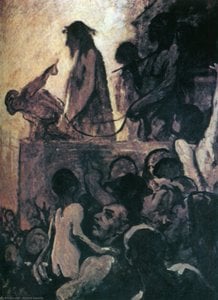
Honoré Daumier Želimo Barabo (Ecce Homo) We want Barabbas (Ecce Homo) (1852) je najbolj znano sliko avtorja Honoré Daumier, ki se nahaja v muzeju Museum Folkwang v mestu Essen. The Third-class Carriage (1860) in Unknown, maybe Hippolyte Lucien-Joseph Lucas (1807-1878), a Journalist, maybe P.Mendez de Vigo (1790-1860) a Spanish General, but Most Probably the Count Pelet de la Lozere (1785-1871), a Politician (1833) sta naslednji dve dela, ki jih svet najbolje pozna. Od 355 del umetnika Honoré Daumier v našem katalogu so tu tista 100, ki jih zbiratelji in obiskovalci muzejev najpogosteje opazujejo, vključno z letnico, muzejom in zgodbojo vsakega dela.

Uvrščeno glede na naš skoraj priljubljenosti, ki združuje število iskanj, obiskov in naročil za vsako delo. Posodobljeno oktober 2026. Vsako podobno delo na tej strani je mogoče naročiti kot muzejsko kakovostno ročno slikano oljno reprodukcijo ali umetniški natisk v izbrani velikosti.

Portret Honoré Daumier
Honoré Daumier · 1808 – 1879
Rodil se · umrl
1808 – 1879, Marseille
Gibanje
Realizem
Delo v našem katalogu
355
Najbolj znana
Honoré Daumier Želimo Barabo (Ecce Homo) We want Barabbas (Ecce Homo) (1852)
Največ del v
Musée d'Orsay

Top 10: najbolj znana slika umetnika Honoré Daumier

Honoré Daumier Želimo Barabo (Ecce Homo) We want Barabbas (Ecce Homo) (1852) avtorja Honoré Daumier
1

Honoré Daumier Želimo Barabo (Ecce Homo) We want Barabbas (Ecce Homo)

1852 · Olje na platnu · Museum Folkwang, Essen

Močna predstavitev človeškega trpljenja in socialne pravičnosti To čudovito umetniško delo zajema pretresljivo biblično sceno, ki globoko odmeva skozi teme sočutja, nepravičnosti in družbene kritike. Z videnostjo v surove, ekspresivne sloge આમ gledalca v trenutek kolektivnih čustev in moralne refleksije. Obrazi in postave, prikazane z gestično neposrednostjo, vzbujajo občutek nujnosti in človeške ranljivosti, kar delo postavlja globoko izjavo o socialnem vestništvu in duhovni empatiji. Umetniški slog in tehnika To delo,…

The Third-class Carriage (1860) avtorja Honoré Daumier
2

The Third-class Carriage

1860 · Oil On Canvas · Metropolitanski muzej umetnosti, New York

In the crowded, dimly lit confines of a mid-19th-century railway carriage, Honoré Daumier captures more than just a moment in transit; he captures the very essence of human endurance. The Third-class Carriage serves as a profound window into the burgeoning urban reality of France during the Second Empire. As the industrial revolution reshaped the landscape of Europe, Daumier turned his gaze away from the gilded salons of the aristocracy and…

Unknown, maybe Hippolyte Lucien-Joseph Lucas (1807-1878), a Journalist, maybe P.Mendez de Vigo (1790-1860) a Spanish General, but Most Probably the Count Pelet de la Lozere (1785-1871), a Politician (1833) avtorja Honoré Daumier
3

Unknown, maybe Hippolyte Lucien-Joseph Lucas (1807-1878), a Journalist, maybe P.Mendez de Vigo (1790-1860) a Spanish General, but Most Probably the Count Pelet de la Lozere (1785-1871), a Politician

1833 · Clay / Terracotta · Musée d'Orsay, Pariz

This evocative portrait captures more than just the likeness of an elderly gentleman; it arrests a moment in time, freezing the very essence of 19th-century Parisian intellectual life. The subject, whose identity is suggested by the possibilities of a journalist or politician, possesses a gaze that seems to look past the viewer, into some distant, weighty contemplation. Rendered with the unmistakable hand of Honoré Daumier, the piece transcends mere portraiture;…

Ratapoil (front view) (1850) avtorja Honoré Daumier
4

Ratapoil (front view)

1850 · Bronze · Musée d'Orsay, Pariz

Honoré Daumier's "Ratapoil (front view)," created around 1850, is more than just a bronze sculpture; it’s a potent distillation of 19th-century French social commentary and political critique. This arresting figure, rendered with remarkable dynamism and a touch of unsettling realism, offers a captivating window into the turbulent world of post-Revolutionary France – a world grappling with nascent democracy, imperial ambitions, and the pervasive inequalities of its society. The sculpture’s enduring…

Intermission at the Comédie Française (1858) avtorja Honoré Daumier
5

Intermission at the Comédie Française

1858 · Watercolor · Ermitaž, Sankt Peterburg

Honoré Daumier's “Intermission at the Comédie Française,” painted in 1858, isn’t merely a depiction of an elderly gathering; it’s a meticulously crafted observation of a specific moment frozen in time – and brimming with unspoken commentary. The artwork immediately draws the viewer into a densely packed scene: rows upon rows of men, their faces etched with age and lined with contemplation, are absorbed in reading newspapers or pamphlets within the…

Ratapoil (1850) avtorja Honoré Daumier
6

Ratapoil

1850 · Bronze · Staatliche Kunsthalle Karlsruhe, Karlsruhe

The photograph captures a pivotal moment – a frozen dance of energy and emotion rendered in the enduring medium of bronze. This exquisite reproduction offers an intimate encounter with "Ratapoil," a sculpture by the visionary artist Honoré Daumier, born in Marseille in 1808 and tragically lost in 1879. More than just a depiction of a figure, it’s a window into the social anxieties and artistic fervor that defined mid-19th century…

Scene from a Comedy (1858) avtorja Honoré Daumier
8

Scene from a Comedy

1858 · Oil On Canvas · Musée d'Orsay, Pariz

Honoré Daumier's "Scene from a Comedy," painted in 1858, isn’t merely a depiction of two figures; it’s a meticulously crafted snapshot of Parisian society and the biting social commentary that defined the artist’s career. Housed within the walls of the Musée d’Orsay, this oil on canvas offers a rare glimpse into Daumier's world – a world brimming with observation, critique, and an undeniable sense of humor laced with profound sadness.…

Ratapoil (1850) avtorja Honoré Daumier
9

Ratapoil

1850 · Acrylic On Canvas · Artizon Museum, Tokyo

Honoré Daumier's "Ratapoil," created in 1850, isn’t merely a sculpture; it’s a distilled embodiment of the anxieties and frustrations simmering beneath the surface of mid-19th century France. This arresting figure, rendered in cast iron with a deliberate roughness that mirrors its subject matter, captures a moment of profound disillusionment – a silent indictment of societal hypocrisy and the precariousness of human existence. The sculpture’s power lies not just in its…

Family on the Barricades in 1848 (1854) avtorja Honoré Daumier
10

Family on the Barricades in 1848

1854 · Oil · Národní Galerie, Praga

In the heart of Honoré Daumier’s 1854 masterpiece, Family on the Barricades in 1848, we find a moment suspended in the amber of history. This is not merely a painting of a political uprising; it is a profound psychological study of human resilience. As the Second French Revolution tore through the streets of Paris, Daumier captured the very essence of the era's turbulent spirit. The scene presents a family huddled…

Preostali del uvrstitve umetnika Honoré Daumier, od 11 do 100

The Print Collector (1865) avtorja Honoré Daumier
#11

The Print Collector

1865 · Art Institute of Chicago

Honoré Daumier's "The Print Collector" isn’t merely a depiction of a man surrounded by prints; it’s a carefully constructed tableau of introspection, a poignant meditation on knowledge, legacy,…

Prinesite si domov →
The Republic (1848) avtorja Honoré Daumier
#12

The Republic

1848 · Musée d'Orsay

Honoré Daumier’s “The Republic” (1848) isn't merely a painting; it’s a potent distillation of the anxieties and aspirations swirling within post-revolutionary France. Captured with his signature blend of…

Prinesite si domov →
Comedy scene (scene from Molière) (1862) avtorja Honoré Daumier
#13

Comedy scene (scene from Molière)

1862 · Musée d'Orsay

Honoré Daumier's 1862 painting, "Comedy Scene (Scene from Molière)," isn’t merely a depiction of a theatrical moment; it’s a vibrant snapshot of Parisian society grappling with wit, social…

Prinesite si domov →
On a Bridge at Night (1848) avtorja Honoré Daumier
#14

On a Bridge at Night

1848 · The Phillips Collection

The scene captures a moment of silent intimacy under the artificial glow of lamplight. Two figures move across a bridge, their forms defined by expressive, simplified outlines that…

Prinesite si domov →
Burden (1850) avtorja Honoré Daumier
#16

Burden

1850 · Ermitaž

In the quiet, somber depths of Honoré Daumier’s 1850 masterpiece, "Burden," we are invited into a moment of profound human endurance that transcends the boundaries of time. The…

Naročite reprodukcijo →
Street Musicians (1855) avtorja Honoré Daumier
#17

Street Musicians

1855 · Art Institute of Chicago

This expressive oil painting presents a somber scene, capturing two figures within an intimate, dimly lit environment. The composition utilizes a tight crop on the subjects, fostering a…

Naročite ročno naslikano kopijo →
The Studio (1870) avtorja Honoré Daumier
#19

The Studio

1870 · J. Paul Getty Museum

In this intimate oil on canvas, a man leans toward a seated woman within a dimly lit interior. The composition is tightly cropped, creating a sense of enclosure…

Naročite reprodukcijo →
Jean-Marie Fruchard (1788-1872), Deputy (1833) avtorja Honoré Daumier
#20

Jean-Marie Fruchard (1788-1872), Deputy

1833 · Musée d'Orsay

Honoré Daumier’s 1833 sculpture of Jean-Marie Fruchard, a deputy of the French parliament, functions as a sharp political indictment. Rather than an idealized likeness, the bust utilizes deliberate…

Load (Washerwoman) (1853) avtorja Honoré Daumier
#21

Load (Washerwoman)

1853 · Národní Galerie

In this 1853 lithograph, a woman moves through a Parisian street, her form defined by the heavy burden she carries. A large basket, filled to the brim with…

Prinesite si domov →
Two Lawyers (1860) avtorja Honoré Daumier
#24

Two Lawyers

1860 · Art Institute of Chicago

This small-scale oil painting presents two men in profile, positioned side-by-side while facing one another. The subjects are captured from the upper torso upward, creating a close-up view…

Naročite reprodukcijo →
Outside the Print–Seller's Shop (1860) avtorja Honoré Daumier
#25

Outside the Print–Seller's Shop

1860 · Dallas Museum of Art

This painting, titled Outside the Print–Seller's Shop, was created by the French artist Honoré Daumier. It offers a quiet glimpse into the social fabric of 19th-century France, capturing…

Prinesite si domov →
Exit from the Theater (1863) avtorja Honoré Daumier
#26

Exit from the Theater

1863 · Nelson-Atkins Museum of Art

The work titled Exit from the Theater is an oil on panel. It is attributed to the artist Honoré Daumier. The painting captures a street scene of theater-goers…

Prinesite si domov →
The Uprising (L (1848) avtorja Honoré Daumier
#28

The Uprising (L

1848 · The Phillips Collection

For Duncan Phillips, the jewel of his unit of works by Honoré Daumier was The Uprising. When this long forgotten painting appeared on the market, Phillips seized the…

Naročite reprodukcijo →
The Defender (1865) avtorja Honoré Daumier
#30

The Defender

1865 · Musée d'Orsay

In the quiet, somber depths of Honoré Daumier’s "The Defender," created around 1865, we are not merely spectators to a courtroom scene, but witnesses to a profound human…

Naročite ročno naslikano kopijo →
Susannah and the Elders (1853) avtorja Honoré Daumier
#33

Susannah and the Elders

1853 · Burrell Collection

A central female figure is caught in a claustrophobic embrace of shadow and light. The composition is tight, pressing the viewer into the immediate space shared by the…

Naročite reprodukcijo →
Penelopa's Dream (1842) avtorja Honoré Daumier
#34

Penelopa's Dream

1842 · Bibliothèque Nationale

Penelopa's Dream is a lithograph created by the artist Honoré Daumier. The work was produced in 1842. This specific piece belongs to the Ancient History series, a collection…

Prinesite si domov →
The Washerwoman (1863) avtorja Honoré Daumier
#36

The Washerwoman

1863 · Musée d'Orsay

Honoré Daumier’s “The Washerwoman,” painted in 1863, is more than just a depiction of a woman laboring by the Seine; it's a poignant meditation on poverty, resilience, and…

Naročite reprodukcijo →
The Beautiful Narcissus (1842) avtorja Honoré Daumier
#59

The Beautiful Narcissus

1842 · Bibliothèque Nationale

Honoré Daumier’s lithograph, "The Beautiful Narcissus," transcends mere depiction; it embodies the spirit of Realism—a courageous confrontation with societal realities tempered by profound artistic sensitivity. Created in 1842…

Prinesite si domov →
Two Singers avtorja Honoré Daumier
#66

Two Singers

Harvard Art Museums

In this oil painting, we find ourselves drawn into a quiet, private moment between two figures. A man and a woman are positioned closely together, their upper bodies…

Prinesite si domov →
The Serenade (1858) avtorja Honoré Daumier
#69

The Serenade

1858 · Scottish National Gallery

The Serenade is a painting by Honoré Daumier, created about 1858. In this work, the artist captures a strolling player singing within the setting of a garden restaurant.…

Naročite ročno naslikano kopijo →
The Print Amateur (1855) avtorja Honoré Daumier
#70

The Print Amateur

1855 · Harvard Art Museums

The Print Amateur is an oil on panel by Honoré Daumier. Created in France, this work captures a specific moment of observation. The pigment rests upon the hard,…

Prinesite si domov →
Jacques Lefévre (1777-1856), Banker and Deputy (1833) avtorja Honoré Daumier
#72

Jacques Lefévre (1777-1856), Banker and Deputy

1833 · Musée d'Orsay

Honoré Daumier's 1833 sculpture, “Jacques Lefévre (1777-1856), Banker and Deputy,” is far more than a simple bust; it’s a meticulously crafted caricature brimming with social commentary. Captured in…

The Print Collector (1862) avtorja Honoré Daumier
#73

The Print Collector

1862 · Burrell Collection

is an oil on canvas work by Honoré Daumier, dated 1865. The painting belongs to the Realism and Satirical realism movements of the 19th Century. It captures the…

Naročite reprodukcijo →
The Strong Man (1865) avtorja Honoré Daumier
#75

The Strong Man

1865 · The Phillips Collection

The painting depicts a man performing in a circus or sideshow setting. This central figure, a strongman, is positioned amidst a crowd of onlookers and performers. He is…

Naročite ročno naslikano kopijo →
Head of Pasquin (1863) avtorja Honoré Daumier
#76

Head of Pasquin

1863 · Dallas Museum of Art

Honoré Daumier’s “Head of Pasquin,” painted in 1863, is far more than a simple portrait; it's a potent distillation of social commentary and a masterful demonstration of the…

Naročite ročno naslikano kopijo →
Rue Transnonain, April 15, 1834 (1834) avtorja Honoré Daumier
#79

Rue Transnonain, April 15, 1834

1834 · Bibliothèque Nationale

Honoré Daumier's "Rue Transnonain, April 15, 1834" isn’t merely a depiction of an event; it’s a visceral scream frozen in lithograph ink. Published six months after the brutal…

Prinesite si domov →
Theater Audience (1856) avtorja Honoré Daumier
#80

Theater Audience

1856 · Narodni muzej zahodne umetnosti

Theater Audience is an oil painting by the French artist Honoré Daumier. The work was created about 1856-60. Daumier was a male artist born in 1808 and he…

Naročite reprodukcijo →
Don Quixote Reading (1866) avtorja Honoré Daumier
#81

Don Quixote Reading

1866 · National Museum Cardiff

In this oil on canvas, Honoré Daumier presents us with a quiet, intense moment of absorption. The work, titled Don Quixote Reading, captures the titular character lost within…

Prinesite si domov →
Avant l (1865) avtorja Honoré Daumier
#84

Avant l

1865

Honoré Daumier’s “Avant l’audience” (Before the Hearing), painted in 1865, is a deceptively simple yet profoundly resonant work that captures a pivotal moment of restrained tension and intellectual…

Naročite reprodukcijo →
Don Quixote and Sancho Panza (1864) avtorja Honoré Daumier
#89

Don Quixote and Sancho Panza

1864 · Burrell Collection

The composition centers on the physical and psychological distance between two travelers moving through a rugged, mountainous landscape. In the foreground, Sancho Panza is seen from behind, riding…

Naročite reprodukcijo →
Don Quixote and Sancho Panza (1870) avtorja Honoré Daumier
#90

Don Quixote and Sancho Panza

1870 · Courtauld Gallery

Don Quixote and Sancho Panza is an oil painting by the artist Honoré Daumier. Dated 1866, this work is categorized within the movements of Realism, Satire, and Narrative.…

Prinesite si domov →
The Reader avtorja Honoré Daumier
#91

The Reader

The quiet intensity of The Reader meets the viewer through the focused gaze of its subject. Painted by Honoré Daumier, this work captures a moment of profound stillness.…

Naročite reprodukcijo →
Street Scene (1864) avtorja Honoré Daumier
#92

Street Scene

1864 · Museum Boijmans Van Beuningen

The shadows of a mid-19th-century urban environment emerge through Street Scene, a work by the French painter Honoré Daumier. Created about 1864, this piece captures a fleeting moment…

Naročite ročno naslikano kopijo →
To the Street (1850) avtorja Honoré Daumier
#97

To the Street

1850 · The Phillips Collection

In the evocative monochrome of Honoré Daumier’s To the Street, we are transported back to the mid-19th century, a period defined by the rapid pulse of urban transformation.…

Prinesite si domov →
Three Lawyers (1857) avtorja Honoré Daumier
#98

Three Lawyers

1857 · The Phillips Collection

In the evocative monochrome of Honoré Daumier’s "Three Lawyers," we are invited into a world where the gravity of the law meets the biting wit of social critique.…

Naročite ročno naslikano kopijo →
Mother (1855) avtorja Honoré Daumier
#100

Mother

1855 · Narodni muzej v Srbiji

Executed in 1855, Mother by Honoré Daumier presents a portrait of disquiet. This work functions as a genre painting, utilizing a depiction of a mother and child to…

Prinesite si domov →

Slike umetnika Honoré Daumier po obdobjih

Motivi, ki jih je Honoré Daumier naslikal največ

Četiri teme, ki se najpogosteje pojavljajo med temi mojstrovinami, s najboljšim primerom za vsako izmed njih.

Kje si lahko ogledate slike avtorja Honoré Daumier

8 muzejev, ki vsebujo največ slik na tej strani.

Muzej Mesto Sloga Honoré Daumier Slike iz tega seznama
Musée d'Orsay, ParizMusée d'Orsay Pariz 33 Unknown, maybe Hippolyte Lucien-Joseph Lucas (1807-1878), a Journalist, maybe P.Mendez de Vigo (1790-1860) a Spanish General, but Most Probably the Count Pelet de la Lozere (1785-1871), a Politician, Ratapoil (front view), Ratapoil (rear view)
Burrell Collection, GlasgowBurrell Collection Glasgow 9 The Good Samaritan, Susannah and the Elders, The Miller, His Son and the Donkey
The Phillips Collection, Washington, D.C.The Phillips Collection Washington, D.C. 8 On a Bridge at Night, The Uprising (L, The Strong Man
Art Institute of Chicago, ChicagoArt Institute of Chicago Chicago 4 The Print Collector, Street Musicians, Two Lawyers
National Museum Cardiff, CardiffNational Museum Cardiff Cardiff 8 Head of a Man, A Third Class Carriage, Don Quixote Reading
Rhode Island School of Design Museum of Art, ProvidenceRhode Island School of Design Museum of Art Providence 4 Second-Class Carriage, Mme Pipelet, the Concierge, Au Palais de Justice (At the Law Courts)
Bibliothèque Nationale, ParizBibliothèque Nationale Pariz 3 Penelopa's Dream, The Beautiful Narcissus, Rue Transnonain, April 15, 1834
Harvard Art Museums, CambridgeHarvard Art Museums Cambridge 3 Scapin, Two Singers, The Print Amateur

Honoré Daumier skozi desetletja: eno vrhunsko delo za vsako obdobje

  1. 1830s
  2. 1840s
    The Republic (1848) avtorja Honoré Daumier
    Rang 12 / 100

    The Republic

    Starost 32 – 41 · Musée d'Orsay

    Honoré Daumier’s “The Republic” (1848) isn't merely a painting; it’s a potent distillation of the anxieties and aspirations swirling within post-revolutionary France. Captured with his signature blend of…

  3. 1850s
  4. 1860s
    The Third-class Carriage (1860) avtorja Honoré Daumier
    2. od 100

    The Third-class Carriage

    Starost 52 – 61 · Metropolitanski muzej umetnosti

    In the crowded, dimly lit confines of a mid-19th-century railway carriage, Honoré Daumier captures more than just a moment in transit; he captures the very essence of human…

  5. 1870s
    The Studio (1870) avtorja Honoré Daumier
    #19 od 100

    The Studio

    Starost 62 – 71 · J. Paul Getty Museum

    In this intimate oil on canvas, a man leans toward a seated woman within a dimly lit interior. The composition is tightly cropped, creating a sense of enclosure…

Slike umetnika Honoré Daumier: pogosta vprašanja

Katero je najbolj znano sliko avtorja Honoré Daumier?Prikaži odgovor

Honoré Daumier Želimo Barabo (Ecce Homo) We want Barabbas (Ecce Homo) (1852), Museum Folkwang, Essen. Nato sledeta The Third-class Carriage (1860) in Unknown, maybe Hippolyte Lucien-Joseph Lucas (1807-1878), a Journalist, maybe P.Mendez de Vigo (1790-1860) a Spanish General, but Most Probably the Count Pelet de la Lozere (1785-1871), a Politician (1833).

Pri kateri dobi je Honoré Daumier naslikal Honoré Daumier Želimo Barabo (Ecce Homo) We want Barabbas (Ecce Homo)?Prikaži odgovor

44 let: delo Honoré Daumier Želimo Barabo (Ecce Homo) We want Barabbas (Ecce Homo) iz leta 1852, pri čemer je Honoré Daumier rodil/a v 1808.

Katera je 10 najbolj znanih slik umetnika Honoré Daumier?Prikaži odgovor

Honoré Daumier Želimo Barabo (Ecce Homo) We want Barabbas (Ecce Homo), The Third-class Carriage, Unknown, maybe Hippolyte Lucien-Joseph Lucas (1807-1878), a Journalist, maybe P.Mendez de Vigo (1790-1860) a Spanish General, but Most Probably the Count Pelet de la Lozere (1785-1871), a Politician, Ratapoil (front view), Intermission at the Comédie Française, Ratapoil, Ratapoil (rear view), Scene from a Comedy, Ratapoil in Family on the Barricades in 1848. Zgornja lestica prikazuje leto in muzej za vsako od njih.

Koliko slik avtorja Honoré Daumier je na voljo?Prikaži odgovor

V našem katalogu je navedenih 355 del avtorja Honoré Daumier, datiranih od 1832 do 1870.

Kje lahko vidim najbolj znana dela umetnika Honoré Daumier?Prikaži odgovor

Večina njih se nahaja v Musée d'Orsay (Pariz), Burrell Collection (Glasgow) in The Phillips Collection (Washington, D.C.). Zgornja tabela navaja muzeje posamezno.

V katerem obdobju je Honoré Daumier naslikal svoja najbolj znana dela?Prikaži odgovor

V obdobju 1850s: 34 od 100 del na tej strani izvira iz tega obdobja, med katerimi je Honoré Daumier Želimo Barabo (Ecce Homo) We want Barabbas (Ecce Homo).

Kaj je najstarejše in najstarejšo znano sliko avtorja Honoré Daumier?Prikaži odgovor

Najstarejšo delo na tej strani je iz Count Antoine-Maurice-Apollinaire d'Argout (1782-1858), Minister and Peer of France (1832), najnovejše pa iz The Studio (1870).

Katere teme je slika Honoré Daumier?Prikaži odgovor

People (18), Satire (15) in Man (13), med 100 dela na tej strani.

Na čem in s čim je Honoré Daumier sliko naslikal?Prikaži odgovor

Oil On Canvas: 15 od 100 del na tej strani.

Kateri umetniški slog predstavlja umetnost avtorja Honoré Daumier?Prikaži odgovor

Realizem, kot to pokažejo slike na tej strani.

Kakšna dela umetnika Honoré Daumier ima v svoji zbirki Musée d'Orsay?Prikaži odgovor

Unknown, maybe Hippolyte Lucien-Joseph Lucas (1807-1878), a Journalist, maybe P.Mendez de Vigo (1790-1860) a Spanish General, but Most Probably the Count Pelet de la Lozere (1785-1871), a Politician, Ratapoil (front view) in Ratapoil (rear view) so med 19 dela na tej strani, ki jih hrani Musée d'Orsay, Pariz.

Kje lahko kupim reprodukcijo Honoré Daumier?Prikaži odgovor

Da. Vsako sliko na tej strani lahko naročite kot muzejsko kakovostno ročno naslikano oljno reprodukcijo ali umetniški natisk v izbrani velikosti neposredno s strani posamezne slike.

Honoré Daumier: biografija

Življenje in zgodnji razvoj Honoréja Daumierja

Honoré-Victorin Daumier se je rodil leta 1808 v Marseillu, njegovo življenje pa je bilo tesno povezano s burnimi dogodki 19. stoletja Francije. Njegova mladost, zaznamovana pesniškimi ambicijami očeta in kasnejšim preselitvijo družine v Pariz leta 1814, ga je potopila v mesto, polno umetniške energije. Čeprav je bil prvotno usmerjen k pravni karieri, se je mladi Daumier nagibal k likovni umetnosti. Učil se je pri Alexandre Lenoirju, vpijal klasične vplive in hkrati cenil dramatično chiaroscuro Rubensa, ter izpopolnjeval svoje spretnosti na Académie Suisse. Ta temeljna usposabljanje bi bilo ključno za oblikovanje njegovega značilnega sloga – močne mešanice realizma in ekspresivne grafike. Vendar Daumierja ni definirala samo umetniška tehnika, temveč predvsem občutljivost do družbene nepravičnosti in politične absurdnosti okoli njega. Preselitev v Pariz je bila prelomnica, saj se je tu začela oblikovati njegova vizija sveta, ki ga bo kasneje tako ostro kritiziral skozi umetnost.

Ostre pero: Karikatura in družbena kritika

Daumierjeva kariera se je resnično razplamtela po Revoluciji leta 1830, dogodku, ki je za vedno spremenil potek francoske zgodovine in hkrati ustvaril plodno podlago za njegov naraščajoči satirični talent. Hitro se je uveljavil kot mojster litografije, sprva anonimno prispeval k različnim publikacijam, preden je pridobil sloves s svojim delom pri *Le Charivari*, neodvisnemu stripovskem časopisu Charlesa Philipona. Tu je Daumierjev genij resnično zacvetel. Njegove karikature niso bile le humorne upodobitve; to so bili ostre obsodbe buržoazije, pravosodnega sistema in politične elite. Brez strahu je posmehoval kralju Ludviku Filipu in si leta 1832 prislužil šestmesečno zaporno kazen za še posebej jedko karikaturo. To izkušnjo ga ni utišalo, temveč okrepilo njegovo odločenost, da bi razkrival hipokrizijo in izzival avtoritete prek umetnosti. Njegove litografije so postale vizualni manifesti, ki so ujeli duh disidentstva in ponujale kritičen komentar na družbene bolezni njegovega časa. Obseg njegove produkcije v tem obdobju je osupljiv – tisoče litografij, ki so služile kot priljubljena zabava in močne politične izjave. Njegova dela so bila pogosto provokativna, a so obenem odražala globoko razumevanje človeške narave in družbenih dinamik.

Onkraj karikature: slikarstvo in vizionarski kip

Čeprav je Daumier najbolj znan po litografiji, bi bilo omejevanje njega samo na področje karikature resna krivica. Bil je tudi predan slikar in kipar, čeprav mu je priznavanje za ta dela prišlo kasneje v življenju. Njegova slikanja, ki pogosto prikazujejo prizore vsakdanjega pariškega življenja – tretjerazredni vagon, pralke, odvetnike – so prežeta z globokim občutkom realizma in empatije. To niso idealizirane upodobitve, temveč neomajne predstavitve trdote in boja. Mojstrsko je uporabljal ohlapno črtanje in dramatično osvetlitev za prenašanje čustev in vzdušja, kar je napovedovalo nekatere tehnike, ki so jih kasneje sprejeli impresionisti. Njegovo kiparstvo, večinoma ustvarjeno iz gline (mnoga dela so ostala nezapeljana med njegovim življenjem), razkriva podobno zavezanost ujemanju človeške oblike z iskrenostjo in čustveno globino. Te skulpture, odkrite po njegovi smrti, dokazujejo izjemno nadarjenost za modeliranje in sposobnost prenesti psihološko kompleksnost skozi fizično gesto. Njegova dela so bila pogosto kritizirana zaradi njihovega nekonvencionalnega sloga, vendar je Daumier vztrajal pri svoji viziji in ustvaril edinstven opus, ki odseva njegovo globoko človečnost.

Trajna zapuščina: vpliv in zgodovinski pomen

Vpliv Honoréja Daumierja na umetnostno zgodovino je nesporna dejstvo. Premostil je vrzel med romantizmom in realizmom, utiral pot prihodnjim generacijam umetnikov, ki so si prizadevali prikazati svet tako kot je – z vsemi pomanjkljivostmi. Njegova neomajna družbena kritika je vplivala na umetnike, kot sta Gustave Courbet in Édouard Manet, njegova inovativna uporaba litografije pa je revolucionirala grafiko. Njegovo delo še danes odmeva, opominja nas na moč umetnosti, da izzove avtoritete, razkrije nepravičnost in priča o človeškem stanju. Pomembna zbirka njegovih slik in kipov je v Musée d'Orsay v Parizu, obiskovalcem pa ponuja vpogled v svet, ki ga je tako živo upodobil. Njegove litografije so široko dostopne prek zbirk, kot so tiste na WahooArt, kar zagotavlja, da njegova satirična genialnost še naprej spodbuja razmislek in navdihuje dialog. Daumier ni bil samo umetnik; bil je kronist svojega časa – vizualni pesnik, ki je uporabil svoj talent, da bi dal glas tistim, ki so bili brez glasu, in držal oblast odgovorno. Njegova zapuščina ostaja kot dokaz trajne relevantnosti umetnosti kot sile za družbene spremembe.

Vsa dela avtorja Honoré Daumier: 355 →