Georges Rouault, 1871 – 1958

The 100 Most Famous Paintings by Georges Rouault

The painting that made Georges Rouault famous is Head of Christ. Head of Christ 1 and The Breton Wedding (1937) follow it in the hearts of collectors and museum visitors. Of the 268 works by Georges Rouault in our catalogue, these 100 are the most admired, each presented with its date, its museum and what sets it apart.

Ranked by our popularity score, which combines the searches, visits and orders for each work. Updated oktober 2026.

Portrait of Georges Rouault
Georges Rouault · 1871 – 1958
Born · died
1871 – 1958, 19. pariško okrožje
Movement
Fauvism
Works in our catalogue
268
Most famous
Head of Christ
Most works at
Art Institute of Chicago

Georges Rouault: the ten masterpieces

Head of Christ by Georges Rouault
1

Head of Christ

Oil On Panel

The face emerges from a deep, saturated blue background. It is a man's countenance, fixed with an intense and focused gaze that meets the viewer directly. His eyes are wide, open, and heavy with a quiet, introspective weight. A beard provides a rough texture to his features, grounding the ethereal color of the backdrop in something physical and tactile. On the left side of the face, a small bird rests,…

Head of Christ 1 by Georges Rouault
2

Head of Christ 1

Oil On Panel

In this portrait, the face of Christ emerges from a profound, saturated blue, a space that offers no horizon and no sense of physical depth. The subject's countenance is fixed with an intense, focused gaze that meets the viewer directly, creating an immediate sense of intimacy and confrontation. There is a heavy, introspective weight in the eyes, which appear wide and open, as if carrying the gravity of existence itself.…

The Breton Wedding (1937) by Georges Rouault
3

The Breton Wedding

1937 · Oil On Canvas

Georges Rouault’s “The Breton Wedding” is not merely a depiction of a rural ceremony; it's a profound meditation on faith, community, and the quiet dignity of everyday life. Painted in 1937, this canvas pulsates with an intensely personal vision, born from Rouault’s own devout Catholic beliefs and his deep empathy for the marginalized. The scene unfolds within a church or cathedral – a space traditionally imbued with solemnity – yet…

The old king (1937) by Georges Rouault
4

The old king

1937 · Oil On Canvas

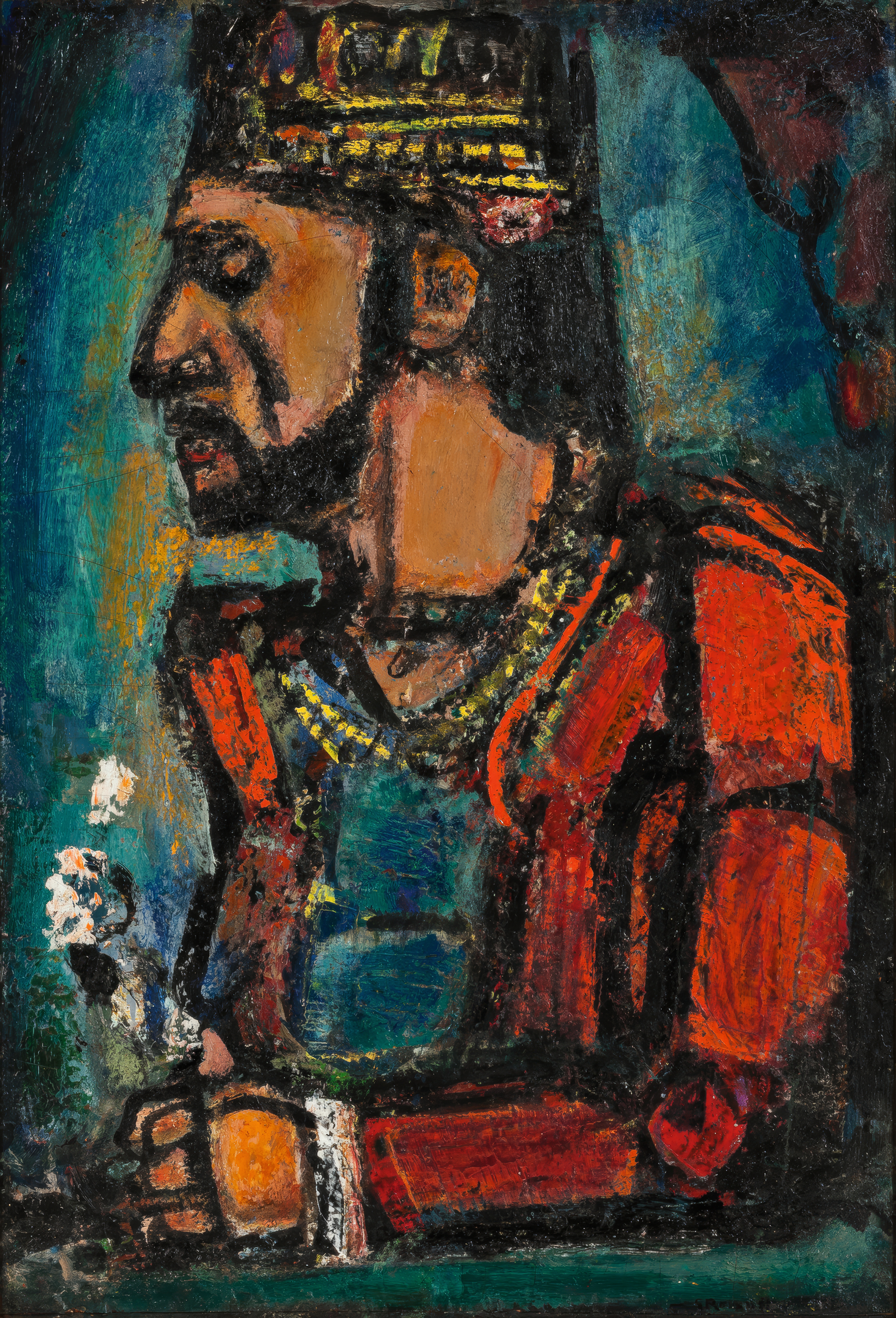
In the quiet, heavy atmosphere of Georges Rouault’s 1937 masterpiece, The Old King, one encounters a profound meditation on the human condition. The painting presents a solitary monarch, captured in profile, whose very presence seems to vibrate with an introspective melancholy. Draped in rich, crimson robes that catch the light with a somber intensity, the figure gazes inward, his expression etched with a deep, palpable sadness. This is not merely…

Jesus on the cross as forgotten there by Georges Rouault
5

Jesus on the cross as forgotten there

Acrylic On Canvas

Georges Rouault’s “Jesus on the Cross as Forgotten There”: A Descent Into Spiritual Darkness The artwork presents a haunting meditation on faith and suffering, embodied in Georges Rouault's monumental print, "Jesus on the Cross as Forgotten There." Created in 1946 during the Second World War, amidst the pervasive anxieties of occupation and loss, this piece transcends mere depiction; it plunges into the abyss of existential despair, mirroring the artist’s own…

Femme Affranchie, A Quatorze Heures, Chante Midi by Georges Rouault
6

Femme Affranchie, A Quatorze Heures, Chante Midi

Acrylic

Georges Rouault’s Femme Affranchie: A Portrait of Resilience Amidst Darkness The Denver Art Museum houses Georges Rouault's “Femme Affranchie, à Quatorze Heures, Chante Midi” (Woman Freed at Noon), a hauntingly beautiful engraving from his seminal Miserere et Guerre series completed in 1923. This artwork transcends mere visual representation; it embodies Rouault’s deeply felt empathy for the vulnerable and his unwavering commitment to exploring profound spiritual themes—a legacy born from witnessing…

The Judges (1908) by Georges Rouault
7

The Judges

1908 · Oil · Statens Museum For Kunst, Kopenhagen

In this 1908 oil painting, three seated figures occupy a shallow, darkened space. The composition is arranged horizontally, with the figures positioned in a way that fills the frame, creating a sense of enclosure. The lighting is low-key, emerging from an indistinct source to illuminate only specific portions of the subjects, such as the pale, ghostly whites of facial features and the edges of clothing. The rest of the scene…

Hollow dream by Georges Rouault
8

Hollow dream

Oil On Canvas

The artwork Hollow dream is an oil painting on canvas that presents a portrait of a person, likely male, rendered in an expressionistic style. The composition is a vertical frame that is tightly focused on the head and shoulders, with the subject facing forward and slightly turned toward the viewer's left. The figure fills most of the frame against a dark, undefined background.

More Georges Rouault masterpieces, 11 to 100

Bouquet II (1938) by Georges Rouault
#13

Bouquet II

1938

Georges Rouault: Bouquet II – A Meditation on Suffering and Beauty Georges Rouault’s “Bouquet II,” painted in 1929, stands as a poignant testament to the artist's unwavering commitment…

Christ by Georges Rouault
#14

Christ

The painting is a portrait of Jesus with his head bowed down. The background features a sky that appears to be blue in color.

Away the smile of Reims by Georges Rouault
#15

Away the smile of Reims

A single figure occupies the center of the frame, a presence carved from darkness and light. The face is elongated, pulled by invisible forces into a mask of…

The Three Judges (1928) by Georges Rouault
#18

The Three Judges

1928 · Art Institute of Chicago

The Three Judges is an oil and gouache work on paper, mounted on cardboard and backed with canvas, created by the French artist Georges Rouault. The piece was…

Dolls, puppets fire hall and the ''Bride'' by Georges Rouault
#19

Dolls, puppets fire hall and the ''Bride''

The air feels heavy, thick with the scent of old dust and greasepaint. In this claustrophobic corner of a theatrical world, three figures huddle together, their presence casting…

Legendary Landscape (1935) by Georges Rouault
#20

Legendary Landscape

1935

The artwork is a vertically oriented oil painting on canvas that presents a stylized, dreamlike landscape. The composition features a simplified architectural structure, possibly a church or monastery,…

'Man of myrrh' by Georges Rouault
#22

'Man of myrrh'

The artwork presents a somber and emotionally charged scene depicting what appears to be a biblical or allegorical narrative. The composition is centered around a reclining figure, presumably…

Pierrot (1910) by Georges Rouault
#24

Pierrot

1910

is a work by the French artist Georges Rouault, executed in 1910. Born in Paris, France, in 1871, Rouault remained connected to his home city until his death…

Grotesque (1917) by Georges Rouault
#25

Grotesque

1917

Completed in 1917, Georges Rouault’s Grotesque is a profound exploration of human vulnerability and spiritual resilience. Created against the backdrop of the escalating anxieties of World War I,…

Crucifixion by Georges Rouault
#26

Crucifixion

The painting depicts a crucifixion scene where the central figure of Jesus Christ is shown on the cross. He is rendered with an elongated torso and contorted limbs,…

Two Women's Heads (1902) by Georges Rouault
#27

Two Women's Heads

1902

The painting depicts two women's heads positioned within the frame. On the left side, a woman with long hair is shown looking toward something in front of her,…

The holy face by Georges Rouault
#28

The holy face

The artwork presents a stylized and emotionally charged depiction of a human face, likely intended to represent Christ or a holy figure. The composition is centered around the…

Project for the reincarnation of Father Ubu 3 by Georges Rouault
#29

Project for the reincarnation of Father Ubu 3

Georges Rouault's “Project for the Reincarnation of Father Ubu 3” presents not merely a depiction, but an immersion into a world sculpted by anxiety and unsettling satire. This…

Christ and the Fisherman by Georges Rouault
#30

Christ and the Fisherman

Fine Arts Museums of San Francisco

Christ and the Fisherman is an oil painting by Georges Rouault. Created in France, the work emerged around 1937. The artist applied oil to paper, which was then…

Eternally scourged by Georges Rouault
#31

Eternally scourged

In this somber composition, we find ourselves face to face with a figure caught in a moment of profound exhaustion. The subject is positioned slightly off-center, its body…

King Ubu 1 by Georges Rouault
#34

King Ubu 1

The artwork presents a stylized and somewhat grotesque depiction of a seated figure, identified by the title as King Ubu. The composition is dominated by this central figure,…

The Superman (1916) by Georges Rouault
#35

The Superman

1916

In the heavy, somber atmosphere of 1916, as the Great War tore through the heart of Europe, Georges Rouault captured something far more profound than a mere portrait;…

The Dwarf (1937) by Georges Rouault
#36

The Dwarf

1937 · Art Institute of Chicago

In this 1937 work, The Dwarf, Georges Rouault presents a figure that occupies the periphery of social visibility. The artist, a Frenchman, turned his attention toward those living…

Dancer for the Ballets Russes by Georges Rouault
#37

Dancer for the Ballets Russes

Georges Rouault's "Dancer for the Ballets Russes" is a striking portrait that encapsulates the spirit of early 20th-century artistic innovation. Created likely around 1929, this artwork offers a…

Pierrot 2 by Georges Rouault
#38

Pierrot 2

Georges Rouault's 'Pierrot 2' isn’t merely a depiction of the iconic commedia dell’arte figure; it’s an immersion into a world steeped in sorrow, isolation, and a profound spiritual…

Twilight or Ile de France by Georges Rouault
#39

Twilight or Ile de France

Georges Rouault’s “Twilight or Ile de France” is a captivating exploration of light, color, and human emotion, firmly rooted in the heart of the Fauvist movement. Painted in…

Night Fall by Georges Rouault
#40

Night Fall

The artwork presents a stylized and emotionally charged scene depicting figures in what appears to be a coastal or rural setting at night. It carries a somber and…

'... when the night came. The moon rose' by Georges Rouault
#41

'... when the night came. The moon rose'

In the hauntingly beautiful tableau titled '... when the night came. The moon rose,' Georges Rouault invites us into a world where the boundaries between the physical landscape…

The blind man sometimes consoles the light by Georges Rouault
#42

The blind man sometimes consoles the light

Georges Rouault's “The Blind Man Sometimes Consoles the Light” is not merely a depiction of two figures; it’s an immersion into a world steeped in sorrow, faith, and…

Nude with arms raised (combed) by Georges Rouault
#43

Nude with arms raised (combed)

In the quiet, heavy atmosphere of Georges Rouault’s 1937 masterpiece, Nude with Arms Raised (combed), one does not merely observe a figure; one encounters a soul in the…

Dura Lex Sed Lex by Georges Rouault
#44

Dura Lex Sed Lex

“Dura lex sed lex” – "The law is hard, but it is the law" – this stark and profoundly moving portrait by Georges Rouault transcends a simple depiction…

Georges Rouault's paintings by period

Early 20th Century

1907 – 1910 · 3 works in this list

The subjects Georges Rouault painted most

The four subjects that return most often among these masterpieces, with the finest example of each.

Where to see Georges Rouault's paintings

The 7 museums that hold the most of the paintings on this page.

Museum City Works by Georges Rouault Paintings from this list
Art Institute of Chicago, ChicagoArt Institute of Chicago Chicago 2 The Three Judges, The Dwarf
The Phillips Collection, Washington, D.C.The Phillips Collection Washington, D.C. 3 Verlaine
Statens Museum For Kunst, KopenhagenStatens Museum For Kunst Kopenhagen 1 The Judges
Fine Arts Museums of San Francisco, San FranciscoFine Arts Museums of San Francisco San Francisco 1 Christ and the Fisherman
Kraljevski muzej lepih umetnosti v Antwerpu, AntverpKraljevski muzej lepih umetnosti v Antwerpu Antverp 1 Newspaper Seller
Narodna galerija Kanade, OttawaNarodna galerija Kanade Ottawa 1 Christ on the Cross
Chimei Museum, TainanChimei Museum Tainan 1 Profile of a Woman

Georges Rouault, decade by decade: the defining painting of each

  1. 1900s
    The Judges (1908) by Georges Rouault
    Rank 7 / 100

    The Judges

    Age 29 – 38 · Statens Museum For Kunst

    In this 1908 oil painting, three seated figures occupy a shallow, darkened space. The composition is arranged horizontally, with the figures positioned in a way that fills the…

  2. 1910s
  3. 1920s
    The Three Judges (1928) by Georges Rouault
    No. 18 of 100

    The Three Judges

    Age 49 – 58 · Art Institute of Chicago

    The Three Judges is an oil and gouache work on paper, mounted on cardboard and backed with canvas, created by the French artist Georges Rouault. The piece was…

  4. 1930s
    The Breton Wedding (1937) by Georges Rouault
    #3 of 100

    The Breton Wedding

    Age 59 – 68

    Georges Rouault’s “The Breton Wedding” is not merely a depiction of a rural ceremony; it's a profound meditation on faith, community, and the quiet dignity of everyday life.…

Georges Rouault's masterpieces: questions and answers

Which painting is Georges Rouault best known for?Show the answer

Head of Christ. Next come Head of Christ 1 and The Breton Wedding (1937).

What are Georges Rouault's ten greatest paintings?Show the answer

Head of Christ, Head of Christ 1, The Breton Wedding, The old king, Jesus on the cross as forgotten there, Femme Affranchie, A Quatorze Heures, Chante Midi, The Judges, Hollow dream, The Poulot or partner, Red Zone and Landscape from the Bible, Christ and the fishermen. The ranking above gives the year and the museum of each.

How many works did Georges Rouault paint?Show the answer

Our catalogue lists 268 works by Georges Rouault, dated from 1902 to 1938.

In which museums can I see Georges Rouault's masterpieces?Show the answer

Most of them are in Art Institute of Chicago (Chicago), The Phillips Collection (Washington, D.C.) and Statens Museum For Kunst (Kopenhagen). The table above lists the museums one by one.

When did Georges Rouault paint the masterpieces?Show the answer

In 1900s: 5 of the 100 works on this page date from then, among them The Judges.

What are the first and last famous paintings of Georges Rouault?Show the answer

The earliest on this page is Two Women's Heads (1902), the latest Bouquet II (1938).

What were Georges Rouault's favourite subjects?Show the answer

Suffering (13), Darkness (11) and Portrait (7), among the 100 works on this page.

Which technique did Georges Rouault favour?Show the answer

Oil On Canvas: 11 of the 100 works on this page.

What art movement is Georges Rouault part of?Show the answer

Fauvism and Expressionism, as the paintings on this page show.

Which masterpieces by Georges Rouault hang at the Art Institute of Chicago?Show the answer

The Three Judges and The Dwarf are among the 2 works on this page held by the Art Institute of Chicago, Chicago.

The life of Georges Rouault

Življenje, izklesano v pariških sencah

Georges Rouault, rojen v Parizu leta 1871 sredi burnih časov Pariške komune, je živel življenje globoko vklesano z revščino in duhovnim iskanjem. Njegova zgodnja leta so bila preživeta dobesedno v sencah – njegova družina se je med bombardiranjem mesta skrivala v kleti, dogodek, ki bi odmeval skozi njegovo umetniško vizijo. Ta ponižna začetek, skupaj z globoko katoliškim vzgojem, ki ga je gojila mati, mu je vlil globoko sočutje do marginaliziranih in trpečih, teme, ki bi postale osrednje v njegovem opusu. Ni bil usojen formalni akademski privilegiji; namesto tega se je pri štirinajstih letih podal v učništvo steklarja, obrt, ki je globoko oblikovala njegov estetski občutek. Živahne barve in drzne linije, inherentne vitražem, so postale temelj njegovega zrelega sloga – značilna uporaba temnih kontur, ki uokvirjajo svetle barvne polja, kar spominja na srednjeveško umetnost. Ta zgodnji vdor ni bil le tehničen; bil je duhoven, vlil mu je spoštovanje do pripovedne moči svetlobe in slike. Hkrati se je posvetil formalnemu usposabljanju na École des Beaux-Arts, kjer je postal predan učenec Gustava Moreaua, katerega simbolistični nagib je dodatno spodbudil Rouaultovo nagnjenje k čustveno nabitim temam.

Od objemov fauvizma do ekspresionistične globine

Rouaultova umetniška pot ni bila pot takojšnje prepoznave ali enostavne kategorizacije. Čeprav ga je sprva vplival simbolizem, se je v zgodnjem 20. stoletju znašel v orbiti nastajajočega fauvističnega gibanja. Povezal se s kolegi umetniki, kot sta Henri Matisse in Albert Marquet, sodeloval na razstavah z njimi, vendar ga je njegova temperament vedno usmerjal k bolj somberni in introspektivni poti kot čisto estetskim raziskavam njegovih vrstnikov. Žive barve fauvizma so služile kot vzmetna deska, a je Rouault hitro presegel njihove omejitve in v svoje platna vlil čustveno intenzivnost, ki je napovedovala ekspresionizem. Začel se je osredotočati na predmete, ki jih pogosto spregledajo ali so neprimerni za umetniško pozornost: prostitutke, klovne, sodnike in zapornike. To niso bili le prikazi družbenih izobčenih; to so bile ganljive alegorije na človeško stanje – raziskovanje greha, odkupitve in ​​inherentne dostojanstva v trpljenju. Njegove karakterizacije, pogosto groteskne a globoko sočutne, so odmevale z naraščajočim občutkom nemira in odtujenosti v moderni družbi, kar je vplivalo na generacijo ekspresionističnih slikarjev, ki so želeli izraziti notranje pretrese s pomočjo popačenih oblik in ostrih barv.

Moralni kompas na platnu in tiskovini

Prva svetovna vojna je bila ključni trenutek za Rouaulta, ki je utrdil njegovo zavezanost verski veri in poglobil moralno težo njegove umetnosti. V tem obdobju se je večinoma umaknil iz javnih razstav in se posvetil intenzivnim osebnim projektom, kot je serija *Miserere* – monumentalni cikel jedkanic, ki prikazuje prizore človeškega trpljenja, navdihnjen s Psalmi. Ta dela, ustvarjena več kot desetletje, so morda njegov najmočnejši in trajni dosežek. Same plošče so bile ponovno obdelane, kar odraža Rouaultovo neusmiljeno iskanje čustvene resnice in duhovnega razumevanja. Ni ga zanimala le reprezentacija; želel je ujeti surovo bistvo človeške izkušnje – bolečino, obup, a tudi žarek upanja, ki vztraja celo v najtemnejših kotičkih obstoja. Poleg *Miserere* so njegove slike še naprej raziskovale podobne teme, pogosto s figurami, osamljenimi in obremenjenimi s svojimi okoliščinami, vendar prežetimi tiho dostojanstvom. Njegovi prikazi klovnov na primer niso bili zgolj komični; to so bile tragične figure, ki uteleljajo absurdnost in osamljenost življenja.

Zapuščina strasti in duhovnega odmeva

Umetniška zapuščina Georgesa Rouaulta sega daleč onkraj njegovih tehničnih inovacij ali stilskih povezav. Bil je globoko veren umetnik, ki je uporabljal svoje obrt za moralno raziskovanje in sočutno povezavo. Njegovo delo je izzivalo konvencionalne predstave o lepoti in sprejemalo grdoto in trpljenje kot integralni vidik človeške izkušnje. Zavrnil je zgolj dekorativno v korist umetnosti, ki se sooča s svojimi gledalci z neprijetnimi resnicami o sebi in svoji družbi. Pozneje v življenju je prejel naročila za verska dela, vključno z dizajnom za balet Sergeja Djagileva *Mrzlični sin*, kar je dodatno utrdilo njegov ugled kot edinstveno pobožnega umetnika. Radoveden in morda tragičen dodatek k njegovi karieri je dejstvo, da je Rouault pozneje v življenju uničil približno 300 svojih slik – dejanje, ki ga je vodila samokritika in neusmiljeno iskanje umetniške popolnosti. Ta dramatična gesta poudarja intenzivnost njegovega ustvarjalnega procesa in njegovo trdno zavezanost izražanju svoje notranje vizije. Rouault je umrl v Parizu leta 1958 in za seboj pustil delo, ki še danes odmeva pri občinstvu – pričevanje o trajni moči umetnosti, rojene iz sočutja, vere in neomajnem pogledu na kompleksnost človeškega srca. Njegove slike niso zgolj podobe; to so okna v dušo.

All 268 works by Georges Rouault →