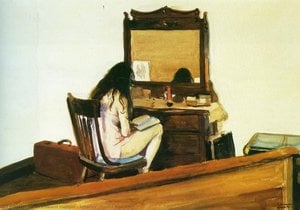
Edward Hopper, 1882 – 1967

The 100 Most Famous Paintings by Edward Hopper

The painting that made Edward Hopper famous is Nighthawks, Čeznočnji pogled v večerjo (1942); it hangs in the Art Institute of Chicago, Chicago. Automat (small) and Hiša ob železnici (1925) follow it in the hearts of collectors and museum visitors. Of the 366 works by Edward Hopper in our catalogue, these 100 are the most admired, each presented with its date, its museum and what sets it apart.

Ranked by our popularity score, which combines the searches, visits and orders for each work. Updated oktober 2026.

Portrait of Edward Hopper
Edward Hopper · 1882 – 1967
Born · died
1882 – 1967, Upper Nyack
Movement
Sodobni realizem
Works in our catalogue
366
Most famous
Nighthawks, Čeznočnji pogled v večerjo (1942)
Most works at
MoMA - Muzej moderne umetnosti

Edward Hopper: the ten masterpieces

Nighthawks, Čeznočnji pogled v večerjo (1942) by Edward Hopper
1

Nighthawks, Čeznočnji pogled v večerjo

1942 · Olje na platnu · Art Institute of Chicago, Chicago

Nighthawks: A Study in Urban Loneliness Edward Hopper’s *Nighthawks*, completed in 1942 amidst the anxieties of wartime America, remains one of the most iconic images in American art—a haunting portrayal of solitude and disconnection within a bustling city environment. More than just a depiction of a diner at night, it's a meticulously crafted tableau that speaks to universal themes of human experience, capturing a moment frozen in time with remarkable…

Automat (small) by Edward Hopper
2

Automat (small)

Acrylic On Canvas · Des Moines Art Center, Des Moines

Edward Hopper’s “Automat” (small), a deceptively simple depiction of a woman seated alone at a cafe table, is a masterclass in conveying the profound sense of solitude that characterized much of 20th-century American life. Painted during a period of rapid urbanization and social change, this work resonates with a quiet melancholy that speaks to the alienation inherent in modern existence. Hopper’s ability to capture fleeting moments of human experience –…

Hiša ob železnici (1925) by Edward Hopper
3

Hiša ob železnici

1925 · Olje na platnu · MoMA - Muzej moderne umetnosti, New York City

Uvod v Edwarda Hopperja in njegovo delo Edward Hopper, svetovno znani ameriški umetnik, je slaven po svojih čarobnih oljah, ki so pogosto zajemale moderno življenje na začetku 20. stoletja. Egedno od njegovih najbolj izstopajočih del je "Hiša ob železnici", ki je trenutno shranjena v Museum of Modern Art (New York, United States). To sliko, ustvarjeno leta 1925, odlikuje Hopperjev edinstven slog in izjemna sposobnost, da v gledalcu vzbuditi občutek izolacije…

Film v Njujorku (1939) by Edward Hopper
4

Film v Njujorku

1939 · Akril na platnu · MoMA - Muzej moderne umetnosti, New York City

SlikaEdward Hopper je ustvaril poudajljivo oljno sliko na platnu v letu 1939. Trenutno je izpostavljena v prestižnem Muzeju moderne umetnosti (MoMA) v mestu New York, Združenih državah Amerike. To slikovno delo je edinstven dokaz Hopperjeve sposobnosti ujetja same essence urbanega življenja, ki pogosto poudarja teme izolacije in razmišljanja. Kompozicija in simbolikaSlika prikazuje žensko postalko samo pred rdečim zaslonom v teatru. Je zauzeta v svojem svetu, ali gleda nekaj v roki…

untitled (5560) by Edward Hopper
5

untitled (5560)

Oil On Canvas · MoMA - Muzej moderne umetnosti, New York City

Edward Hopper's untitled (5560) is far more than a mere depiction of a roadside service station; it is a distilled essence of the American experience, a moment frozen in time that speaks volumes about human connection and the profound weight of isolation. Painted during the transformative years between 1942 and 1945, this monochrome masterpiece captures a scene familiar to the mid-century traveler—the late-night glow of artificial light illuminating a sparsely…

Early sunday morning Whitney Museum of American (1930) by Edward Hopper
6

Early sunday morning Whitney Museum of American

1930 · Oil On Canvas · Whitney Museum of American Art, New York

Early Sunday Morning: A Portrait of Quietude Edward Hopper’s “Early Sunday Morning,” painted in 1930, isn't merely a depiction of a New York City street; it’s an arresting distillation of the anxieties and aspirations inherent in the American psyche during the Depression era. Executed in oil paint on canvas, this iconic piece exemplifies Hopper’s signature style – American Scene Painting—characterized by stark realism combined with a palpable sense of solitude…

Avtomat (1927) by Edward Hopper
7

Avtomat

1927 · Olje na platnu

Edward Hopperjeva slika "Automat" (1927) je ikonična ameriška realistična mojstrovina, ki s preprostostjo in globino razkriva temo samotnosti in notranjega življenja. Slike ne prikazuje le tipičnega prizora zgodnjega 20. stoletja – ženske, ki sedi v avtomatu, obliki samopostrežne restavracije – ampak tudi poglobljeno raziskovanje človeške izoliranosti v modernem svetu. Hopperjev mojstrski prikaz svetlobe in sence ustvarja atmosfero tišine in melanholije, ki je značilna za njegovo delo.

Nedelja (1926) by Edward Hopper
8

Nedelja

1926 · Olje na platnu · The Phillips Collection, Washington, D.C.

Nedelja: Pogled v samotno urbano življenje Edward Hopperjeva "Nedelja" iz leta 1926 ni le slika; je subtilen prikaz človeške osamljenosti in kontemplacije, ki se odvija na ozadju zgodnjega 20. stoletja. Ta mojstrski prikaz New Realizma nas potopi v tiho urbano sceno, kjer samotni mož sedi na lesenem klopčku pred zaprtimi izložbenimi vitrinami. Slika je poglobljena raziskava človeške narave, ki jo Hopper s prefinjenostjo upodablja skozi svetlobo in senco ter skromno…

Čop Suey (1929) by Edward Hopper
10

Čop Suey

1929 · Olje na platnu

Delo "Čop Suey", ki ga je Edward Hopper ustvaril leta 1929, je očarljiva oljna slika, ki gledalca povabi v intimen, a hkrati izoliran svet restavracije iz 20. let. Ta vrhunsko mazlinje utripati Hopperjev prepoznaven slog, kjer se ameriški realizem prepletá z subtilnimi ekspresionističnimi vplivi, da prikliče občutek nostalgije in tihe introspekcije.

More Edward Hopper masterpieces, 11 to 100

Urad ponoči (1940) by Edward Hopper
#11

Urad ponoči

1940

Edward Hopper's "Office at Night," painted in 1940, isn’t merely a depiction of an office scene; it's a profound exploration of the human condition within the burgeoning modernity…

Summertime (1943) by Edward Hopper
#12

Summertime

1943

Edward Hopper’s “Summertime”: A Moment Suspended in Urban Tranquility Edward Hopper's "Summertime," painted in 1943 during the tumultuous backdrop of World War II, transcends a simple depiction of…

Sonce v kavarni (1958) by Edward Hopper
#13

Sonce v kavarni

1958 · Yale University Art Gallery

Hopperovo delo Sonce v kavarni (1958) predstavlja vrhunsko prikazovanje mestne osamljenosti, ustvarjeno z natančnostjo in čustveno globino, ki definita njegov ikonski slog. Ta olje na platnu, dimenzij 102…

Ljudje na Soncu (1960) by Edward Hopper
#14

Ljudje na Soncu

1960

Edward Hopper’s “People in the Sun,” completed in 1960, stands as an enduring emblem of American realism infused with a profound sense of solitude—a characteristic that defines Hopper’s…

Jutro na Kipu Kodu (1950) by Edward Hopper
#15

Jutro na Kipu Kodu

1950

Edward Hopper's "Cape Cod Morning" is more than just a painting; it’s an invitation into a moment suspended in time, a quiet contemplation captured with masterful realism and…

Komnati za turistike (1945) by Edward Hopper
#16

Komnati za turistike

1945 · Yale University Art Gallery

Obrazec ameriškega realizma "Komnati za turistike" (1945) je čarobno umetniško del Edwarda Hopperja, mojstra, ki je znan po svojih ganljivih prikazih sodobnega ameriškega življenja. Ta slika je vrhunsko…

nighthawks (1942) by Edward Hopper
#17

nighthawks

1942 · Art Institute of Chicago

A Window Into Loneliness: Exploring Edward Hopper’s Nighthawks Edward Hopper's "Nighthawks," completed in 1942 during the tumultuous backdrop of World War II, transcends mere representation; it embodies a…

Vare C by Edward Hopper
#18

Vare C

predstavlja ključen primer Hopperjeve fascinacije nad samotnimi figuro v gibanju. Slika prikazuje damo, ki sedi sama v železniškem predeli; njena glava je usmerjena proti knjigi, še večji del…

Dva komedanta (1965) by Edward Hopper
#19

Dva komedanta

1965

Edward Hopperjeva slika iz leta 1965, “Dva komedanta”, ni le prikaz dveh figurev na prizorišču; je skrbno zasnovana meditacija o osamljenosti, prehodnosti predstave in tišini dramatičnih trenutkov v…

New York Movie, MoMA, NY (1939) by Edward Hopper
#21

New York Movie, MoMA, NY

1939

Cinematična tišina: Edward Hopperjevo *New York Movie* (1939) New York Movie*, ki se nahaja v prestižni zbirki Muzeja sodobne umetnosti (MoMA), predstavlja klasičen primer Hopperjeve izjemne sposobnosti zajema…

Summer Evening (1947) by Edward Hopper
#22

Summer Evening

1947

A Portrait of Quietude: Exploring Edward Hopper’s “Summer Evening” Edward Hopper's "Summer Evening" isn’t merely a depiction of a scene; it’s an exquisitely crafted meditation on human experience—a…

Hotel room (1931) by Edward Hopper
#23

Hotel room

1931

The Poignant Stillness of a Private Moment In Edward Hopper’s 1931 masterpiece, Hotel Room, the viewer is invited into a sanctuary of profound introspection. The scene is deceptively…

Excursion into Philosophy by Edward Hopper
#24

Excursion into Philosophy

A Quiet Drama: Unveiling Edward Hopper’s “Excursion into Philosophy” Edward Hopper's "Excursion into Philosophy" is a profoundly evocative work that encapsulates the core tenets of American Realism, offering…

The Cat Boat (1922) by Edward Hopper
#25

The Cat Boat

1922 · Smithsonian American Art Museum

Edward Hopper's “The Cat Boat,” created in 1922, stands as a quintessential emblem of American Modernism—a deceptively simple scene imbued with profound psychological depth. More than just depicting…

Rooms By The Sea (1951) by Edward Hopper
#26

Rooms By The Sea

1951

Rooms By The Sea: A Portrait of Quiet Contemplation Edward Hopper’s “Rooms by the Sea” transcends mere depiction; it's a distillation of mood, an embodiment of American Modernism’s…

Reclining Nude (1927) by Edward Hopper
#27

Reclining Nude

1927

Introduction Reclining Nude, a watercolour painting by Edward Hopper, is a quintessential example of the artist's unique style and contribution to the New Realism movement. Created in 1927,…

Rooms by the Sea (1951) by Edward Hopper
#28

Rooms by the Sea

1951

The Painting: A Representation of Serenity "CITE>Edward Hopper's 'Rooms by the Sea' (1951) is a masterpiece that embodies the essence of stillness and contemplation. The painting, available for…

House At Dusk (1935) by Edward Hopper
#29

House At Dusk

1935

The Painting: An Overview "CITE>Edward Hopper:CITE>'s House At Dusk, created in 1935, is a quintessential example of the artist's ability to capture the essence of American life through…

Zdravarna (1927) by Edward Hopper
#30

Zdravarna

1927 · Muzej fine arts

Tiho trenutek v mestu: Raziskovanje Hopperjeve "Zdravarne" (1927) “Zdravarna”, ki jo je leta 1927 naslikal ameriški mojster Edward Hopper, je ganljiva predstavitev urbanega življenja – odličen posnetek trenutka,…

Sun on Prospect Street (Gloucester, Massachusetts) (1934) by Edward Hopper
#31

Sun on Prospect Street (Gloucester, Massachusetts)

1934

Edward Hopper's "Sun on Prospect Street" isn't merely a depiction of a Gloucester street scene; it’s a distilled essence of early 20th-century American experience. Painted in 1934, during…

Woman in the Sun (1961) by Edward Hopper
#32

Woman in the Sun

1961

A Moment Frozen in Light: Edward Hopper’s “Woman in the Sun” Edward Hopper's "Woman in the Sun," painted in 1961, isn’t merely a depiction of a nude figure;…

Second Story Sunlight (1960) by Edward Hopper
#33

Second Story Sunlight

1960

A Moment Suspended: Unveiling Edward Hopper’s “Second Story Sunlight” Edward Hopper's 1960 oil on canvas, *Second Story Sunlight*, is a quintessential example of American Realism at its most…

Night Windows (1928) by Edward Hopper
#34

Night Windows

1928 · MoMA - Muzej moderne umetnosti

A Window Into Solitude: Exploring Edward Hopper’s Night Windows Edward Hopper, a name synonymous with the quiet contemplation of modern existence, wasn't merely capturing landscapes; he was distilling…

New York Office (1962) by Edward Hopper
#35

New York Office

1962

Edward Hopper’s “New York Office,” painted in 1962, transcends mere depiction; it embodies the very essence of modern solitude—a feeling profoundly familiar to viewers grappling with the complexities…

Office in a Small City (1953) by Edward Hopper
#36

Office in a Small City

1953

In the vast gallery of American Realism, few works possess the haunting, cinematic stillness found in Edward Hopper’s 1953 masterpiece, Office in a Small City. To gaze upon…

Mestne strehe (1932) by Edward Hopper
#37

Mestne strehe

1932

Tiho trenutek mestnega obstoja Hoperovo delo “City Roofs” (1932) ni le prikaz mestne pokrajine; je pretretljiva meditacija o modernem življenju, osamljenosti in subtilni lepoti, ki jo najdemo v…

Self-Portrait (1930) by Edward Hopper
#38

Self-Portrait

1930

This oil on canvas painting depicts a man wearing a brown hat and a blue shirt. He is shown with a serious expression, looking directly at the viewer.…

Hiše Monhegan, Maine by Edward Hopper
#39

Hiše Monhegan, Maine

Uvod v ameriški realizem Edward Hopper, eden najbolj izstopajočih ameriških realističnih slikarjev, je znan po svojih čarobnih oljnih slikah, ki prikazujejo urbane in podeželske prizore. Njegov edinstven slog…

Four Lane Road by Edward Hopper
#40

Four Lane Road

Edward Hopper's "Four Lane Road," painted in 1956, isn’t merely a depiction of a roadside scene; it’s a distilled essence of the American experience – a poignant meditation…

Woman at Cafe Table (1907) by Edward Hopper
#41

Woman at Cafe Table

1907 · Whitney Museum of American Art

Woman at Cafe Table: A Portrait of Urban Isolation Edward Hopper’s “Woman at Cafe Table,” painted in 1906-1907, stands as a quintessential emblem of New Realism and embodies…

First Row Orchestra (1951) by Edward Hopper
#42

First Row Orchestra

1951 · Hirshhorn Museum and Sculpture Garden

A Portrait of Quiet Observation: Exploring Edward Hopper’s “First Row Orchestra” Edward Hopper's "First Row Orchestra," painted in 1951, transcends mere depiction; it embodies the very essence of…

House by the Railroad by Edward Hopper
#43

House by the Railroad

In his 1925 masterpiece, House by the Railroad, Edward Hopper presents a scene that captures a profound sense of isolation through a meticulously controlled interplay of light and…

untitled (3714) by Edward Hopper
#44

untitled (3714)

Edward Hopper's "Untitled (3714)," painted in 1942, isn’t merely a depiction of a diner interior; it’s a distilled essence of modern American loneliness. This deceptively simple scene—an elderly…

el palacio (1946) by Edward Hopper
#45

el palacio

1946

Edward Hopper’s 1946 painting, “El Palacio,” isn’t merely a depiction of a city street; it’s a carefully constructed tableau of urban solitude and the quiet anxieties of modern…

the city (1927) by Edward Hopper
#46

the city

1927

The City, painted by Edward Hopper in 1927, is a striking black and white depiction of early 20th-century American urban life. This artwork isn't merely a representation of…

rooms by the sea by Edward Hopper
#47

rooms by the sea

Edward Hopper’s Rooms by the Sea is a painting from 1951 that depicts an interior space with a doorway opening toward the ocean. The scene features a room…

The Camel's Hump (1931) by Edward Hopper
#49

The Camel's Hump

1931

Edward Hopper's "The Camel’s Hump," painted in 1931, isn’t merely a depiction of a mountain range; it’s a distilled essence of American loneliness and the quiet drama unfolding…

the el station by Edward Hopper
#50

the el station

In the quiet, heavy atmosphere of Edward Hopper’s “The El Station,” we are invited into a moment suspended in time, where the bustling energy of the American metropolis…

Dawn in Pennsylvania (1942) by Edward Hopper
#51

Dawn in Pennsylvania

1942

A Solitary Glimpse: Dawn in Pennsylvania by Edward Hopper Edward Hopper’s *Dawn in Pennsylvania*, painted in 1942, isn't merely a depiction of a railroad station; it’s a distilled…

Corn Hill (1930) by Edward Hopper
#52

Corn Hill

1930

Edward Hopper's "Corn Hill," painted in 1930, isn’t merely a depiction of a rural landscape; it’s a poignant meditation on isolation and the quiet dignity of human existence…

tramp steamer (1908) by Edward Hopper
#53

tramp steamer

1908

A Storm-Tossed Soul: Edward Hopper’s “Tramp Steamer” Edward Hopper's "Tramp Steamer," painted in 1908, isn’t merely a depiction of a ship at sea; it’s a profound meditation on…

Self Portrait, , Whitney Museum of American (1930) by Edward Hopper
#54

Self Portrait, , Whitney Museum of American

1930

Edward Hopper's "Self Portrait," painted in 1930, isn’t merely a depiction of an artist; it’s a distilled essence of the anxieties and quietude that defined much of early…

Rocks at the Fort Gloucester (1924) by Edward Hopper
#55

Rocks at the Fort Gloucester

1924

Edward Hopper's 1924 painting, “Rocks at the Fort Gloucester,” is more than just a landscape; it’s a quiet meditation on human presence within the vastness of nature and…

Morning sun, Columbus Museum of Art, Columbus, (1952) by Edward Hopper
#56

Morning sun, Columbus Museum of Art, Columbus,

1952

A Window into Quietude: Exploring Edward Hopper’s “Morning Sun” Edward Hopper's "Morning Sun," painted in 1952, isn’t merely a depiction of a room; it’s an encapsulation of the…

Study of a Seated Woman (1899) by Edward Hopper
#57

Study of a Seated Woman

1899

Edward Hopper's "Study of a Seated Woman," rendered in 1899, isn’t merely a depiction of a figure; it’s a distilled essence of late 19th-century American introspection. This intimate…

Portrait Of Orleans by Edward Hopper
#58

Portrait Of Orleans

WahooArt offers exquisite hand-painted reproductions of Edward Hopper's "Portrait of Orleans," allowing you to bring this iconic work of American art into your home or office. Each reproduction…

sun empty room by Edward Hopper
#59

sun empty room

Edward Hopper's "Sun in an Empty Room," painted in 1963, isn’t merely a depiction of a vacant room; it’s a distilled essence of modern American isolation and the…

The Long Leg (1930) by Edward Hopper
#60

The Long Leg

1930

A Quiet Drama on the Waves: Edward Hopper’s *The Long Leg* (1930) Edward Hopper's *The Long Leg*, painted in 1930, is more than just a seascape; it’s a…

Bridle Path (1939) by Edward Hopper
#61

Bridle Path

1939

Bridle Path: A Portrait of Quietude in Modern America Edward Hopper’s “Bridle Path,” painted in 1939, stands as a quintessential emblem of American Realism—a genre that sought to…

night windows by Edward Hopper
#62

night windows

In the quietude of a dimly lit room, where the boundaries between the interior soul and the external world begin to blur, lies the profound essence of Edward…

Hotel by a Railroad (1952) by Edward Hopper
#63

Hotel by a Railroad

1952

Edward Hopper's "Hotel by a Railroad," painted in 1952, isn’t merely a depiction of an interior scene; it’s a carefully constructed meditation on loneliness, isolation, and the subtle…

Queensborough-Bridge (1913) by Edward Hopper
#64

Queensborough-Bridge

1913

In the vast landscape of American modernism, few images capture the quiet tension of urban existence as poignantly as Edward Hopper’s Queensborough Bridge. Painted in 1913, this monumental…

paris street by Edward Hopper
#65

paris street

In the quiet corners of Edward Hopper’s “Paris Street,” we encounter more than just a cityscape; we find a profound meditation on the human condition. Painted in 1926,…

cape cod morning by Edward Hopper
#66

cape cod morning

In the quietude of an early summer morning, Edward Hopper captures a moment that feels both profoundly intimate and hauntingly distant. Cape Cod Morning is not merely a…

sunday by Edward Hopper
#67

sunday

The Painting and Its Context Sunday, a painting by Edward Hopper, is a quintessential representation of modern American life in the early 20th century. Created in 1926, this…

Evening Wind by Edward Hopper
#68

Evening Wind

Edward Hopper’s “Evening Wind,” executed in 1930, stands as a quintessential emblem of American Modernism—a deceptively simple image brimming with psychological depth and masterful artistic execution. More than…

brez naslova (7523) by Edward Hopper
#69

brez naslova (7523)

Slika prikazuje množično družbeno druženje, verjetno večernji dogode, na katerem so prisotni posamezniki iz višjih družbenih slojev. Kompozicija je namerno gostota, polna figur, ki so zapletene v pogovore…

People in the Sun (1960) by Edward Hopper
#70

People in the Sun

1960

Edward Hopper's People in the Sun, completed in 1960, serves as a profound meditation on the human experience, capturing a sense of quietude and the pervasive feeling of…

The lee shore, private (1941) by Edward Hopper
#71

The lee shore, private

1941

Edward Hopper's "The Lee Shore," painted in 1941, isn’t merely a depiction of a coastal scene; it’s a distilled essence of American loneliness and the subtle anxieties simmering…

Rocks and Sea (1919) by Edward Hopper
#72

Rocks and Sea

1919 · Whitney Museum of American Art

A Moment Frozen in Azure The sea air feels heavy and salt-laden as the eye meets the deep, blue expanse of this landscape. In this 1919 scene, the…

Self Portrait by Edward Hopper
#73

Self Portrait

Edward Hopper's "Self Portrait," painted between 1925 and 1930, isn’t merely a depiction of an artist; it’s a profound meditation on isolation, introspection, and the quiet dignity of…

Sheridan Theatre by Edward Hopper
#74

Sheridan Theatre

Edward Hopper’s Sheridan Theatre, painted in 1937, isn't merely a depiction of an interior scene; it’s a carefully constructed tableau of loneliness and unspoken narratives. The painting immediately…

Freight Car at Truro by Edward Hopper
#75

Freight Car at Truro

In the vast, sweeping landscape of American art, few images capture the heavy, cinematic silence of a moment quite like Edward Hopper’s Freight Car at Trurol. Painted in…

Lighthouse at Two Lights (1929) by Edward Hopper
#76

Lighthouse at Two Lights

1929

Edward Hopper’s Lighthouse at Two Lights, completed in 1929, presents a striking visual meditation on the interplay between light and shadow. The composition features a tall lighthouse situated…

summer interior (1909) by Edward Hopper
#77

summer interior

1909

Edward Hopper’s Summer Interior, painted in 1909, presents a scene of profound stillness within a domestic setting. The composition centers on a young woman positioned on the floor…

cape cod evening by Edward Hopper
#78

cape cod evening

In the quiet corners of American Modernism, few images resonate with as much profound, whispered intensity as Edward Hopper’s Cape Cod Evening. At first glance, the painting presents…

rooms for tourists by Edward Hopper
#80

rooms for tourists

A Quiet American Narrative: Exploring Edward Hopper’s “Rooms for Tourists” Rooms for Tourists, painted in 1945 by the master of American Realism, Edward Hopper, is a captivating study…

South Carolina Morning by Edward Hopper
#81

South Carolina Morning

Edward Hopper's "South Carolina Morning," painted in 1955, is a poignant depiction of an African American woman named Dinah standing before her home in Charleston, South Carolina. The…

Intermission (small) by Edward Hopper
#82

Intermission (small)

Edward Hopper’s Solitary Stage: Unpacking “Intermission” Edward Hopper's "Intermission" (1963) isn’t merely a painting; it’s a distilled moment of American solitude, a poignant tableau captured with the artist’s…

untitled (7096) by Edward Hopper
#83

untitled (7096)

Edward Hopper’s “Untitled (7096),” a painting rendered in the twilight hours, isn’t merely a depiction of a pharmacy storefront; it’s a distilled essence of 20th-century American loneliness. Completed…

Eleven AM by Edward Hopper
#84

Eleven AM

Edward Hopper, a master of American realism, possessed an uncanny ability to distill the essence of modern life – its quiet desperation, its pervasive loneliness, and its fleeting…

New York Pavements, (1924) by Edward Hopper
#85

New York Pavements,

1924

Edward Hopper's "New York Pavements," painted in 1924, stands as a quintessential emblem of American Modernism—a deceptively simple depiction that speaks volumes about the anxieties and quiet contemplations…

Lighthouse and Building, Portland by Edward Hopper
#86

Lighthouse and Building, Portland

Edward Hopper’s Luminous Solitude: Exploring “Lighthouse and Building” Edward Hopper's "Lighthouse and Building," painted in 1927, isn’t merely a depiction of a coastal scene; it’s a masterful distillation…

Circle Theatre by Edward Hopper
#87

Circle Theatre

In the quiet, heavy atmosphere of Edward Hopper’s "Circle Theatre," we are invited to witness more than just a street corner in a bustling metropolis; we are invited…

Room in Brooklyn (1932) by Edward Hopper
#88

Room in Brooklyn

1932 · Muzej fine arts

Edward Hopper's "Room in Brooklyn," painted in 1932, isn’t merely a depiction of an interior space; it’s a distilled essence of American loneliness and the quiet contemplation that…

Seven A.M. (1948) by Edward Hopper
#90

Seven A.M.

1948

In the quiet, early hours of a mid-century morning, Edward Hopper’s "Seven A.M." invites us into a space where time seems to hold its breath. Painted in 1948,…

The City (1927) by Edward Hopper
#91

The City

1927

A Quiet Vision of Urban Life: Edward Hopper’s “The City” (1927) Subject and Composition: “The City” presents a strikingly composed street corner scene, a quintessential example of Edward…

First Row Orchestra (1951) by Edward Hopper
#92

First Row Orchestra

1951

A Moment Frozen in Time: Edward Hopper’s “First Row Orchestra” Edward Hopper's "First Row Orchestra," painted in 1951, isn’t merely a depiction of an evening at the theater;…

House with big pine by Edward Hopper
#93

House with big pine

The painting depicts a white house featuring a black roof and a large chimney positioned on its side. Two windows are visible within the structure. The setting includes…

Valley Of The Seine (1908) by Edward Hopper
#94

Valley Of The Seine

1908

Edward Hopper's "Valley Of The Seine," painted in 1908, isn’t merely a landscape; it’s a distilled essence of early 20th-century America – a poignant tableau of solitude and…

Ryder's House (1933) by Edward Hopper
#95

Ryder's House

1933

Edward Hopper’s “Ryder’s House,” completed in 1933, stands as a quintessential emblem of American Realism during the Depression era. More than just a depiction of a simple farmhouse…

Intermission by Edward Hopper
#96

Intermission

Edward Hopper’s Intermission, painted in 1963, isn't merely a depiction of a theater lobby; it’s a meticulously crafted tableau of human isolation and the poignant beauty of unspoken…

Gas, Moma, NY (1940) by Edward Hopper
#97

Gas, Moma, NY

1940

Edward Hopper’s “Gas,” painted in 1940 and currently residing at MoMA (Museum of Modern Art), isn't merely a depiction of a roadside gas station; it’s a masterful distillation…

Cape Cod Morning (1950) by Edward Hopper
#98

Cape Cod Morning

1950

In the vast landscape of American modernism, few images resonate with as much profound stillness as Edward Hopper’s 1950 masterpiece, Cape Cod Morning. This striking canvas serves as…

Room for tourists, Yale University Art Gallery, (1945) by Edward Hopper
#99

Room for tourists, Yale University Art Gallery,

1945

A Quiet American Night: Exploring Edward Hopper’s “Room for Tourists” “Room for Tourists,” painted in 1945 by master realist Edward Hopper, is more than just a depiction of…

Eleven A.M. (1926) by Edward Hopper
#100

Eleven A.M.

1926

Edward Hopper’s “Eleven A.M.” (1926) is more than just a depiction of a woman in a room; it’s a meticulously crafted meditation on the quiet loneliness inherent within…

Edward Hopper's paintings by period

The subjects Edward Hopper painted most

The four subjects that return most often among these masterpieces, with the finest example of each.

Where to see Edward Hopper's paintings

The 8 museums that hold the most of the paintings on this page.

Museum City Works by Edward Hopper Paintings from this list
MoMA - Muzej moderne umetnosti, New York CityMoMA - Muzej moderne umetnosti New York City 4 Hiša ob železnici, Film v Njujorku, untitled (5560)
Whitney Museum of American Art, New YorkWhitney Museum of American Art New York 10 Early sunday morning Whitney Museum of American, Woman at Cafe Table, Rocks and Sea
Art Institute of Chicago, ChicagoArt Institute of Chicago Chicago 3 Nighthawks, Čeznočnji pogled v večerjo, nighthawks, Interior (Model Reading)
Yale University Art Gallery, HartfordYale University Art Gallery Hartford 3 Sonce v kavarni, Komnati za turistike
Muzej fine arts, BostonMuzej fine arts Boston 3 Zdravarna, Room in Brooklyn
Hirshhorn Museum and Sculpture Garden, Washington, D.C.Hirshhorn Museum and Sculpture Garden Washington, D.C. 3 First Row Orchestra
Smithsonian American Art Museum, Washington, D.C.Smithsonian American Art Museum Washington, D.C. 2 The Cat Boat
Des Moines Art Center, Des MoinesDes Moines Art Center Des Moines 1 Automat (small)

Edward Hopper, decade by decade: the defining painting of each

  1. 1890s
    Study of a Seated Woman (1899) by Edward Hopper
    No. 57 of 100

    Study of a Seated Woman

    Age 8 – 17

    Edward Hopper's "Study of a Seated Woman," rendered in 1899, isn’t merely a depiction of a figure; it’s a distilled essence of late 19th-century American introspection. This intimate…

  2. 1900s
    Woman at Cafe Table (1907) by Edward Hopper
    #41 of 100

    Woman at Cafe Table

    Age 18 – 27 · Whitney Museum of American Art

    Woman at Cafe Table: A Portrait of Urban Isolation Edward Hopper’s “Woman at Cafe Table,” painted in 1906-1907, stands as a quintessential emblem of New Realism and embodies…

  3. 1910s
    Queensborough-Bridge (1913) by Edward Hopper
    No. 64 of 100

    Queensborough-Bridge

    Age 28 – 37

    In the vast landscape of American modernism, few images capture the quiet tension of urban existence as poignantly as Edward Hopper’s Queensborough Bridge. Painted in 1913, this monumental…

  4. 1920s
    Hiša ob železnici (1925) by Edward Hopper
    #3 of 100

    Hiša ob železnici

    Age 38 – 47 · MoMA - Muzej moderne umetnosti

    Uvod v Edwarda Hopperja in njegovo delo Edward Hopper, svetovno znani ameriški umetnik, je slaven po svojih čarobnih oljah, ki so pogosto zajemale moderno življenje na začetku 20.…

  5. 1930s
    Film v Njujorku (1939) by Edward Hopper
    Rank 4 / 100

    Film v Njujorku

    Age 48 – 57 · MoMA - Muzej moderne umetnosti

    SlikaEdward Hopper je ustvaril poudajljivo oljno sliko na platnu v letu 1939. Trenutno je izpostavljena v prestižnem Muzeju moderne umetnosti (MoMA) v mestu New York, Združenih državah Amerike.…

  6. 1940s
    Nighthawks, Čeznočnji pogled v večerjo (1942) by Edward Hopper
    No. 1 of 100

    Nighthawks, Čeznočnji pogled v večerjo

    Age 58 – 67 · Art Institute of Chicago

    Nighthawks: A Study in Urban Loneliness Edward Hopper’s *Nighthawks*, completed in 1942 amidst the anxieties of wartime America, remains one of the most iconic images in American art—a…

  7. 1950s
    Sonce v kavarni (1958) by Edward Hopper
    #13 of 100

    Sonce v kavarni

    Age 68 – 77 · Yale University Art Gallery

    Hopperovo delo Sonce v kavarni (1958) predstavlja vrhunsko prikazovanje mestne osamljenosti, ustvarjeno z natančnostjo in čustveno globino, ki definita njegov ikonski slog. Ta olje na platnu, dimenzij 102…

  8. 1960s
    Ljudje na Soncu (1960) by Edward Hopper
    No. 14 of 100

    Ljudje na Soncu

    Age 78 – 85

    Edward Hopper’s “People in the Sun,” completed in 1960, stands as an enduring emblem of American realism infused with a profound sense of solitude—a characteristic that defines Hopper’s…

Edward Hopper's masterpieces: questions and answers

Which painting is Edward Hopper best known for?Show the answer

Nighthawks, Čeznočnji pogled v večerjo (1942), Art Institute of Chicago, Chicago. Next come Automat (small) and Hiša ob železnici (1925).

How old was Edward Hopper when painting Nighthawks, Čeznočnji pogled v večerjo?Show the answer

60 years old: Nighthawks, Čeznočnji pogled v večerjo dates from 1942 and Edward Hopper was born in 1882.

What are Edward Hopper's ten greatest paintings?Show the answer

Nighthawks, Čeznočnji pogled v večerjo, Automat (small), Hiša ob železnici, Film v Njujorku, untitled (5560), Early sunday morning Whitney Museum of American, Avtomat, Nedelja, Gas and Čop Suey. The ranking above gives the year and the museum of each.

How many works did Edward Hopper paint?Show the answer

Our catalogue lists 366 works by Edward Hopper, dated from 1899 to 1965.

In which museums can I see Edward Hopper's masterpieces?Show the answer

Most of them are in MoMA - Muzej moderne umetnosti (New York City), Whitney Museum of American Art (New York) and Art Institute of Chicago (Chicago). The table above lists the museums one by one.

When did Edward Hopper paint the masterpieces?Show the answer

In 1920s: 15 of the 100 works on this page date from then, among them Hiša ob železnici.

What are the first and last famous paintings of Edward Hopper?Show the answer

The earliest on this page is Study of a Seated Woman (1899), the latest Dva komedanta (1965).

What were Edward Hopper's favourite subjects?Show the answer

Solitude (46), Isolation (34) and Urban landscape (25), among the 100 works on this page.

Which technique did Edward Hopper favour?Show the answer

Oil On Canvas: 35 of the 100 works on this page.

What art movement is Edward Hopper part of?Show the answer

Sodobni realizem and American realism, as the paintings on this page show.

Which masterpieces by Edward Hopper hang at the MoMA - Muzej moderne umetnosti?Show the answer

Hiša ob železnici, Film v Njujorku and untitled (5560) are among the 4 works on this page held by the MoMA - Muzej moderne umetnosti, New York City.

The life of Edward Hopper

Tišina ameriške scene

Edward Hopper se je rodil v Upper Nyack, v Združenih državah Amerike. Njegova zgodnja leta so bila prebožana z opazovanjem sveta z neomagnočnim pogledom, kar je bila navada, ki se je začela že s otroškimi skici, ki so bile skrbno datirane in podpisane. Čeprav so mu starši predlagali praktično pot v komercialni ilustraciji, je njegova pozornost ostala usmerjena na likovno umetnost. Študiral je na School of Art v New Yorku pod mentorjem William Merritt Chase in Robert Henri. Ta obdobje mu je podalo tehnično znanje, potrebno za prikazovanje sveta brez okrasitev in v njegovi resničnosti. Ni težil po prehodnihčihčih črtah impresionistov, ki jih je srečal v Parizu. Namesto tega je razvil način opazovanja, ki je predlagal mir trenutka pred gibanjem množice.

Njegovo del se pogosto osredotoča na vsakdanjost. Poglel je na hiše, gostilnice, pisarne in hotelske sobe. Odstril je nepotrebne podrobnosti, da bi odkril globoko čustveno resnico scene. V delu House by the Railroad (1925) preprosta kompozicija razkriva občutek skrivnostnosti in izolacije. Svetlobo in senco ni uporabljal le za opis prostora, temveč za ustvarjanje vzdušja. Natančen prikaz sence na steni ali način, kako svetloba obišče okno, sta postala njegov način komuniciranja psihološkega stanja njegovih subjektov.

Svetloba in urbani notranji prostor

Način, na katerik se svetloba vstopi v prostor, je v njegovih slikah osrednji lik. V delu Nighthawks (1942) ostra fluorescentna svetloba nočne gostilnice razreže temnost zapuščene urbane ulice. Figure znotraj so fizično blizu, vendar se zdajo izgubljene v lastnih mislih, odtujene drug od drugega. Ta občutek anonimnosti v preobhodnem mestu je postal ponavljajoča se tema. Uporabil je napetost biti sam v javnem prostoru, občutek, ki odmeva v delih, kot sta Automat in Office in a Small City. Zanimala ga je interakcija umetne svetlobe z naravno temnotijo noči.

Njegova žena, Josephine Nivison Hopper, je bila nprava prisotnost. Bila je so umetnica in pogosto mu je služila kot model. Njena prisotnost je čutna v karakterizaciji mnogih njegovih ženskih postaci. Skupaj sta živela skromno, poletja pa so pogosto preživeli v Novem Engleskem, kar je vplivalo na pokrajine, ki jih je slikal. Njegovi prikazi ameriške pokrajine, tako ruralne kot urbane, pogosto poudarjajo določeno krhkost ali praznino. Ne glede na to, ali gre za obcestno bencinsko postajalo v delu Gas (1940) ali tiho sobo v hotelu, je tema vedno stičišče fizičnega prostora in zasebne, notranje izkušnje.

Dediščevo opazovanja

Hopperjev vpliv sega v vizualni jezik filma in literature. Njegova sposobnost ustvarjanja psihološke napetosti skozi kompozicijo je bila opazljena pri številnih tistih, ki pregledujejo način, kako se zgodbe pripovedujejo skozi slike. Njegove slike ostajajo v pomembnih muzejih po vsem svetu, v zbirkah, kot sta Whitney Museum of American Art in Museum of Fine Arts v Bostonu. Ni ciljal na velike zgodovinske narative. Svojo tematiko je našel v tihih kotičkih vsakdanjega življenja, kjer je preoblikoval preprosto okno ali preobitega tujca v študijo človeške kondicije. Njegovo del ostaja študija tišine, ki obstaja med ljudmi.

All 366 works by Edward Hopper →