BREZPLAČNO POSVETOVANJE O UMETNOSTI

x

1861 - 1936

Ključne informacije

  • Works on APS: 32
  • Nationality: United States of America
  • Movements: impressionism
  • Copyright status: Public domain
  • Creative periods: mature period
  • Lifespan: 75 years
  • Več…
  • Top-ranked work: Lili Butler in Claude Monet's Garden
  • Top 3 works:
    • Lili Butler in Claude Monet's Garden
    • The Cards Players
    • Lili Butler Reading at the Butler House, Giverny
  • Art period: 19th Century
  • Born: 1861, Columbus, United States of America
  • Died: 1936
  • Color intensity: vivid

Umetniški kviz

Pri vsakem vprašanju je na voljo le eden pravilen odgovor.

Vprašanje 1:
Theodore Earl Butler is most known for being an artist associated with which movement?
Vprašanje 2:
Butler's life and work were deeply intertwined with that of which famous artist?
Vprašanje 3:
Butler solidified his place within the Impressionist movement by marrying into which family?
Vprašanje 4:
What was a common subject matter in Butler's paintings?
Vprašanje 5:
Butler received an honorable mention at the Paris Salon in 1888 for which painting?

A Life Immersed in Impressionism

Theodore Earl Butler, born in Columbus, Ohio, in 1861, embarked on a journey that would inextricably link his name to the heart of the French Impressionist movement. While often remembered as the husband of Suzanne Hoschedé-Monet, Claude Monet’s stepdaughter and frequent model, Butler was far from simply an associate; he was a gifted painter in his own right, deeply influenced by, yet distinct within, the artistic milieu of Giverny. His story is one of transatlantic artistic exchange, familial connection, and a dedication to capturing the fleeting beauty of everyday life. Butler’s early artistic inclinations were nurtured locally in Columbus under the guidance of Albert C. Fauley before he ventured east to New York City in 1882, enrolling at the Art Students League. There, he studied with William Merritt Chase, a pivotal figure who championed Impressionist principles within the American art world. This foundational training instilled in him a commitment to capturing light and atmosphere, setting the stage for his eventual immersion into the Parisian avant-garde.

Parisian Studies and the Allure of Giverny

The pull of Europe proved irresistible, and Butler soon found himself in Paris, diligently honing his skills at various private academies, including La Grande-Chaumière and Académie Julian. He absorbed the influences of established masters like Jean-Léon Gérôme while also developing an appreciation for the more unconventional vision of James Abbott McNeill Whistler. His talent began to garner recognition with an honorable mention at the Paris Salon in 1888 for “La Veuve” (The Widow), a work that hinted at the sensitivity and observational skill he would further refine. However, it was his arrival in Giverny in 1888 that truly defined his artistic trajectory. The village, already becoming synonymous with Claude Monet’s revolutionary paintings, offered an environment of unparalleled creative energy. He quickly integrated into the community, befriending Monet and becoming a regular presence at Hotel Baudy, the favored lodging for artists drawn to Giverny's idyllic charm. This proximity fostered not only a deep friendship but also a profound artistic dialogue that would shape Butler’s style for years to come.

A Family Within the Movement

Butler’s life took an even more significant turn in 1892 with his marriage to Suzanne Hoschedé, Monet's stepdaughter and a beloved figure frequently depicted in Monet’s canvases. This union cemented his place within the inner circle of Impressionism, granting him unique access to Monet’s techniques, philosophies, and daily life. He became a vital link between the American artists flocking to Giverny and the master himself, facilitating an exchange of ideas that enriched both communities. Following Suzanne's untimely death in 1899, Butler continued to reside in Giverny, later marrying her sister, Marthe Hoschedé, further solidifying his connection to the family and the artistic legacy they represented. This period saw a shift in his subject matter; he increasingly focused on intimate depictions of his children, Jimmy and Lilly, creating tender series like “The Bath” and “After the Bath,” capturing fleeting moments of childhood innocence with remarkable sensitivity.

Artistic Style and Legacy

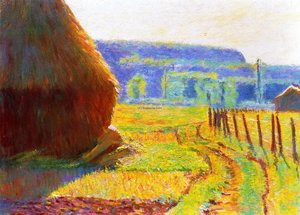
Butler’s artistic style was deeply rooted in Impressionism, characterized by vibrant colors, loose brushstrokes, and a dedication to portraying the ephemeral effects of light. However, his work also reveals subtle Post-Impressionist tendencies, particularly in his use of color and composition, hinting at influences from artists like Édouard Vuillard and Pierre Bonnard. He wasn’t afraid to experiment with techniques reminiscent of Pointillists Georges Seurat and Paul Signac, adding layers of complexity to his canvases. His subjects were often drawn from the domestic sphere – scenes of family life, friends gathered in conversation, or quiet moments of contemplation – alongside landscapes depicting the picturesque French countryside and iconic Giverny landmarks like the church, haystacks, and grain stacks. Theodore Earl Butler’s contribution to American Impressionism is significant. He not only helped popularize the movement but also provided a unique perspective on domesticity within its context. His intimate portrayals of family life offer valuable insights into the social fabric of the era, while his landscapes capture the enduring beauty of Giverny. Today, his works are celebrated for their technical skill, emotional resonance, and historical importance, ensuring that his place in art history is secure. He died in 1936 leaving behind a legacy as an artist who beautifully bridged two worlds – American ambition and French Impressionist innovation.