A Legacy Rooted in American Realism: The Life and Art of Richard William Hubbard
Richard William Hubbard, a name synonymous with the evocative power of American realism, stands as a pivotal figure bridging the traditions of 19th-century landscape painting with the burgeoning Arts & Crafts movement. While biographical details remain somewhat elusive, his artistic output speaks volumes about a life deeply immersed in nature and dedicated to capturing its fleeting beauty. Born into an era captivated by the grandeur of the Hudson River School, Hubbard absorbed their reverence for the American wilderness but ultimately forged his own path, one characterized by a more intimate and nuanced portrayal of the natural world. He is particularly celebrated for his association with the Roycroft community, where he flourished as both artist and artisan, embodying the movement’s ideals of handcrafted excellence and artistic integrity.
From Hudson River Reverie to Arts & Crafts Intimacy
Hubbard's early influences are readily apparent in his work. The sweeping vistas and dramatic lighting reminiscent of artists like Frederic Church and Albert Bierstadt initially shaped his approach to landscape painting. However, he gradually moved away from the overtly theatrical compositions favored by these masters, opting instead for scenes that felt more personal and immediate. This shift coincided with his involvement with Elbert Hubbard’s Roycroft community in East Aurora, New York. Founded on principles of simplicity, craftsmanship, and a rejection of industrial mass production, Roycroft provided an environment where artists could thrive outside the constraints of commercial pressures. Here, Hubbard found kindred spirits who shared his commitment to quality and authenticity. He wasn't merely *painting* landscapes; he was crafting experiences, imbuing each work with a sense of tranquility and reverence for the natural world. His watercolors, in particular, demonstrate a remarkable sensitivity to light and atmosphere, capturing the subtle nuances of color and form that often go unnoticed.
The Roycroft Years: A Synthesis of Art and Life
At Roycroft, Hubbard wasn’t solely focused on easel painting. He actively participated in the community's diverse artistic endeavors, contributing to book illustrations, decorative arts, and other handcrafted items. This holistic approach to artmaking—where form followed function and beauty was integrated into everyday life—became a defining characteristic of his work. His landscapes often adorned the walls of Roycroft’s Inn and dining rooms, creating an immersive environment that celebrated the natural world.
This integration of art into daily living reflects Hubbard's belief in the transformative power of aesthetics and its ability to elevate the human spirit. He wasn’t simply decorating spaces; he was cultivating a lifestyle centered around beauty, simplicity, and connection with nature. The influence of Japanese woodblock prints, popular during this period, can also be detected in his compositions—particularly in their emphasis on flattened perspective and carefully considered negative space.
Themes and Techniques: Capturing the Essence of Nature
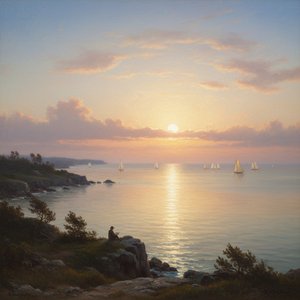
Hubbard’s subject matter primarily revolved around landscapes – serene forests, tranquil riverscapes, and picturesque rural scenes. He possessed an exceptional ability to capture the *mood* of a place, conveying not just its visual appearance but also its underlying atmosphere. His technique was characterized by meticulous detail, delicate brushwork, and a masterful use of watercolor washes.
He often employed a layering technique, building up color gradually to create depth and luminosity. While he occasionally worked in oil, watercolor remained his preferred medium, allowing him to achieve the subtle gradations of tone and atmospheric effects that were central to his artistic vision. Recurring motifs include trees – symbols of strength, resilience, and connection to the earth – and bodies of water, representing fluidity, change, and the passage of time. His portraits, though less numerous than his landscapes, share a similar sensitivity to character and atmosphere, revealing a deep understanding of human psychology.
Historical Significance and Enduring Appeal
Richard William Hubbard’s legacy extends beyond his beautiful paintings and handcrafted objects. He represents a crucial link between the grand traditions of 19th-century American realism and the progressive ideals of the Arts & Crafts movement. His work embodies a reverence for nature, a commitment to craftsmanship, and a belief in the transformative power of art.
- He helped define the aesthetic sensibility of the Roycroft community.
- His landscapes continue to resonate with viewers today, offering a glimpse into a bygone era of tranquility and natural beauty.
- Hubbard’s emphasis on handcrafted excellence remains relevant in an age of mass production.
As a key figure in American art history, Hubbard's contributions deserve continued recognition and appreciation. His paintings are not merely representations of the natural world; they are invitations to connect with its enduring beauty and find solace in its timeless rhythms. He stands as a testament to the power of art to inspire, uplift, and remind us of our connection to the earth.