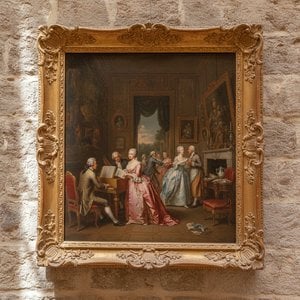
A Life Dedicated to Narrative: The World of Philip Richard Morris
Philip Richard Morris, born in Devonport in 1836 and passing away in London in 1902, was a painter whose career traced a fascinating path through the evolving artistic sensibilities of Victorian England. Initially destined for his father’s iron-foundry trade, Morris's burgeoning passion for art led him to London at the age of fourteen. A pivotal moment arrived when William Holman Hunt championed his talent, securing permission for evening drawing classes at the British Museum and, crucially, entry into the prestigious Royal Academy Schools in 1855. This formal training provided a foundation upon which Morris would build a distinctive style, one deeply rooted in narrative and observation. He further honed his skills with a travelling studentship that allowed him to immerse himself in the artistic landscapes of Italy and France, remaining abroad until 1864. These years were formative, exposing him to diverse influences and solidifying his commitment to painting scenes imbued with meaning and emotional resonance.
Early Influences and the Holman Hunt Connection
The impact of William Holman Hunt is undeniable when considering Morris’s early work. Hunt's meticulous realism and dedication to moral and religious themes profoundly shaped Morris’s initial artistic direction. Paintings from this period often reflect a similar seriousness, exploring allegorical representations of rural life and biblical narratives. However, Morris wasn’t merely an imitator; he possessed a unique sensitivity that allowed him to infuse his work with a gentle lyricism not always present in Hunt's more austere compositions. He skillfully blended realism with a growing impressionistic sensibility, creating scenes that were both detailed and evocative. This ability to capture the fleeting beauty of everyday life, coupled with underlying symbolic weight, became a hallmark of his style. His early success led to election as an Associate of the Royal Academy in 1877 – a testament to his rising reputation, though it’s noted this coincided with a period of declining health that would subtly alter the course of his career.
From Genre and Maritime Scenes to Portraiture
While Morris initially gained recognition for his genre and maritime paintings—particularly those allegorical depictions of rural life—his artistic interests broadened over time. He wasn't limited to one subject matter; he demonstrated a remarkable versatility, turning his attention towards religious works heavily influenced by Hunt, and eventually embracing portraiture in the later stages of his career. This shift wasn’t abrupt but rather a natural evolution driven by personal circumstances and changing aesthetic preferences. His portraits, while fewer in number than his earlier genre scenes, reveal a keen eye for character and an ability to capture not just physical likeness but also the inner life of his sitters. Feeding Time, The Foster Sisters, and As You Like It exemplify this range, showcasing his mastery of light, composition, and emotional depth.
Personal Life and Legacy
Morris’s personal life also played a role in shaping his artistic trajectory. His marriage to Catherine Sargeantson in 1878 brought him domestic happiness and a growing family – two sons and three daughters. However, the untimely death of Catherine in 1886 marked a poignant turning point. The subsequent marriages of his daughters—Florence Mariane to archaeologist Alexander Keiller and Gladys Hill Morris to sportsman, journalist, and editor Bertram Fletcher Robinson—demonstrate connections to prominent figures of the era. These relationships likely broadened his social circle and provided new perspectives that subtly influenced his work. Despite resigning from the Royal Academy in 1900, a decision perhaps linked to his declining health, Morris continued to paint until his death in 1902, succumbing to bladder disease and heart failure in London. His legacy lies not only in the beauty and narrative power of his paintings but also in his ability to bridge the gap between realism and impressionism, creating works that continue to resonate with viewers today.
Historical Significance and Rediscovery
Philip Richard Morris occupies a unique position within Victorian art history. He wasn’t a revolutionary like Hunt or Whistler, yet he was a highly skilled and respected painter who successfully navigated the changing artistic landscape of his time. His work provides valuable insight into the social and cultural values of the 19th century, offering glimpses into rural life, religious beliefs, and the evolving role of women in society. While perhaps not as widely recognized as some of his contemporaries, Morris’s paintings are increasingly appreciated for their technical brilliance, emotional depth, and narrative complexity. The ongoing rediscovery of his work—through exhibitions, publications, and online platforms like WahooArt.com—ensures that his contribution to Victorian art will continue to be celebrated by generations to come.