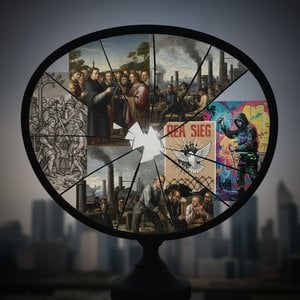
A Life Forged in Dystopia: The Art of Norman Catherine
Norman Catherine emerged as a significant voice in South African contemporary art during the tumultuous 1970s, and his work continues to resonate powerfully today. Born in East London in 1949, Catherine’s artistic journey began with a foundational two years at the EL Technical College Art School before largely embracing self-taught exploration. This independence fostered an idiosyncratic style that would become his hallmark – a potent blend of dark humor, social commentary, and raw emotionality. He currently resides near Hartbeespoort Dam, a location that seems to echo the complex landscapes reflected in his art: both beautiful and unsettling, hinting at hidden depths beneath a seemingly tranquil surface. His early years were marked by experimentation with diverse materials – oil on wood, bone, wire, found objects – establishing a precedent for his innovative approach to form and texture.
The Fook Island Collaboration & Early Development
Catherine’s career took a pivotal turn through his close collaboration with Walter Battiss, the celebrated South African artist, beginning in 1973. This partnership centered around the fantastical “Fook Island” concept—a fictional realm that served as a vehicle for exploring themes of identity, colonialism, and cultural appropriation. The influence of Battiss is palpable in Catherine’s early work, particularly his embrace of playful imagery and vibrant color palettes. However, Catherine quickly developed a distinct voice, moving beyond mere imitation to create art that reflected the unique socio-political realities of South Africa during apartheid. His first solo exhibition in Johannesburg in 1969 signaled the arrival of an artist unafraid to confront difficult subjects with both cynicism and exuberance. Throughout the 1980s, Catherine’s style underwent a series of transformations, from airbrush paintings to frenzied mixed media works, wire sculptures, and ultimately, the “primitive-futuristic” paintings that would define his pre-millennial period.
Themes of Violence, Pathology & the Human Psyche
Catherine's art is deeply rooted in an exploration of the darker aspects of the human condition. History, horror, crime, conflict, psychoses, and politics are not merely subjects but *nutrients* that fuel his creative process. His work vacillates between the macabre and the comic, often presenting unsettling imagery alongside a playful aesthetic. This juxtaposition is deliberate—a means of confronting uncomfortable truths while simultaneously acknowledging the absurdity of existence. He masterfully conveys a cynical vision through a dynamic interplay of light and shadow, oscillating between internal hallucinatory realms and literal commentary on the material world. His paintings are populated by anthropomorphic beasts, distorted figures, and fragmented landscapes that evoke a sense of unease and alienation.
Major Achievements & International Recognition
Norman Catherine’s prolific output has garnered widespread recognition both in South Africa and internationally. His work is included in major public and private collections, including the Museum of Modern Art (MoMA) and the Brooklyn Museum in New York. In 1993, he was honored with an invitation to exhibit at the 45th Venice Biennale, representing South Africa on a global stage. This marked a significant milestone in his career, solidifying his position as a leading figure in contemporary African art. A retrospective exhibition at the Johannesburg Art Gallery (JAG) in 2006 further cemented his legacy, showcasing the breadth and depth of his artistic journey.
A Lasting Legacy: Catherine’s Influence on South African Art
Norman Catherine's impact extends beyond his own prolific body of work. He has served as a significant influence on generations of younger artists, inspiring them to challenge conventions and explore difficult subjects with honesty and originality. His innovative use of materials, combined with his distinctive visual style, has left an indelible mark on the South African art landscape. His ability to blend dark cynicism with exuberant humor, coupled with his unflinching exploration of the human psyche, continues to captivate audiences worldwide. Catherine’s work serves as a powerful reminder of the enduring power of art to confront uncomfortable truths and provoke meaningful dialogue about the complexities of our world.
His idiosyncratic vision has secured his place at the forefront of South African contemporary art.
Catherine’s art imbibes a dystopian vision of the socio-political landscape that informs his psyche.
Avtorji WahooArt.com
Kviz o umetnosti
Pri vsakem vprašanju je na voljo le eden pravilen odgovor.
Vprašanje 1:
In what year did Norman Catherine hold his first solo exhibition?
Vprašanje 2:
Which of the following media is NOT typically used by Norman Catherine in his artwork?
Vprašanje 3:
What themes frequently inspire Norman Catherine's artistic creations?
Vprašanje 4:
With whom did Norman Catherine collaborate on the 'Fook Island' concept?
Vprašanje 5:
Where does Norman Catherine currently live and work?
Explore the powerful history of social commentary in art! Discover key artists like Hogarth & Daumier, movements from Realism to American Social Realism, and how art reflects—and challenges—society. Expert insights at WahooArt.
Explore the captivating world of Vladimir Makovsky, a leading Russian realist painter. Discover his insightful depictions of 19th-century life, social commentary & legacy with WahooArt.
Explore the satirical world of William Hogarth, pioneering British painter & engraver. Discover his iconic works like *A Rake's Progress* and insightful social commentary on 18th-century London life.