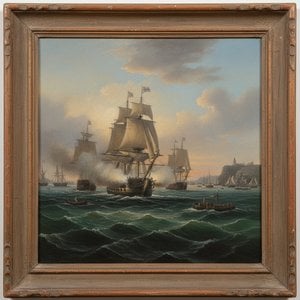
A Life Painted by the Sea: The Story of Mario Zhekov
Mario Zhekov, a name synonymous with the Bulgarian seascape, was more than just a painter; he was a chronicler of the coast, a man whose life became inextricably interwoven with the rhythms and moods of the sea. Born in Stara Zagora in 1898, his artistic journey began not amidst idyllic landscapes but within the walls of the State Industrial Art School in Sofia – today’s National Art Academy. However, fate, as it often does, had a different course charted for him. Mobilized in 1917 and subsequently captured during wartime, Zhekov's talent unexpectedly became his salvation. A French officer, captivated by his nascent artistic skill, facilitated his studies at the Paris School of Painting instead of confinement within a prisoner-of-war camp. This pivotal moment irrevocably altered the trajectory of his life, setting him on a path that would lead him to become Bulgaria’s most celebrated marine artist.
From Parisian Studios to the Balkan Shores
The years following his release from captivity were marked by restless exploration and artistic immersion. Zhekov didn't remain confined to the academic structures of Paris; instead, he embarked on a period of extensive travel throughout France, Italy, Greece, Turkey, and Macedonia. These journeys weren’t merely geographical shifts but profound encounters with diverse light, color palettes, and coastal atmospheres. He became a member of the Society of South-Bulgarian Artists in 1920, participating in numerous group exhibitions alongside independent shows in Sofia and other Bulgarian cities. Yet, despite gaining recognition within artistic circles, Zhekov’s true calling lay not in bustling urban centers but along the serene expanse of the seashore. He dedicated two-thirds of his life to painting *en plein air*, relentlessly pursuing the elusive qualities of light reflecting on water – a pursuit that would define his entire oeuvre.
The Mariner's Brush: Style and Influences
Zhekov’s work is characterized by its predominantly marine theme, focusing intensely on seascapes and coastal landscapes. While deeply rooted in realism, his paintings reveal subtle influences from Impressionism, particularly in his attempts to capture the fleeting effects of light and atmosphere. However, Zhekov wasn't a mere imitator; he infused his canvases with a unique sensibility, incorporating elements of Symbolism and Expressionism that lent depth and emotional resonance to his depictions of the sea. He sought not simply to *represent* the ocean but to convey its power, mystery, and ever-changing moods. His landscapes often extend beyond purely coastal scenes, encompassing views of towns like Tarnovo, Tryavna, Karlovo, and Plovdiv, as well as mountain ranges such as Stara Planina, Rhodopes, and Rila – all viewed through the lens of his distinctive artistic vision.
Recognition and a Legacy Undimmed
The 1930s and early 40s marked the peak of Zhekov’s creative maturity. He traveled extensively along the French coast, Balchik, Varna, Nessebar, and Sozopol, constantly seeking new perspectives and refining his technique. In 1936, he received a prestigious prize at an international exhibition-competition in Leipzig, solidifying his reputation on the European art scene. His popularity soared, leading to solo exhibitions in Prague, Budapest, and Bucharest. Despite this acclaim, Zhekov faced challenges during the later years of his life. The prevailing artistic climate in Bulgaria favored Social Realism, a style that didn’t align with his more nuanced and emotionally driven approach. Consequently, he was often excluded from major exhibitions organized by the Union of Bulgarian Artists. Nevertheless, his work continued to resonate with audiences, particularly in Dubrovnik where he enjoyed significant popularity. Zhekov passed away in Sofia in 1955, leaving behind a rich artistic legacy that continues to captivate and inspire. Today, Mario Zhekov is rightfully regarded as one of Bulgaria’s greatest mariners, an artist whose life was inextricably bound to the sea – a sea he painted with passion, skill, and enduring devotion.