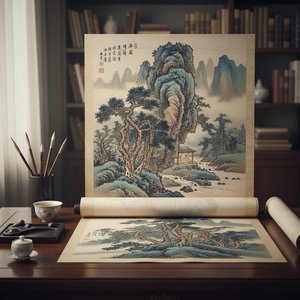
The Whispering Brush of Ju Lian: A Contemporary Voice in the Tradition of Chinese Ink
Ju Lian, a name increasingly resonant within circles appreciating contemporary Chinese ink painting, represents a fascinating bridge between centuries-old techniques and a distinctly modern sensibility. While biographical details remain intentionally sparse – Ju Lian prefers to allow the work itself to speak – his artistic journey is deeply rooted in the rich heritage of China’s literati tradition, particularly the evocative style of Bada Shanren (1626–1705). Emerging from WahooArt as a featured artist, Ju Lian has quickly garnered attention for paintings that possess both an immediate emotional impact and a profound understanding of historical form. He is not simply replicating the past; he’s channeling it, reinterpreting its language for a new audience.
Echoes of Masters: Influences and Early Development
The influence of Bada Shanren is undeniable in Ju Lian's work. Bada Shanren, a Ming dynasty scholar-official who became a monk after political disillusionment, infused his paintings with a poignant sense of loneliness, rebellion, and philosophical contemplation. His signature subjects – birds, fish, orchids, bamboo – were rendered with bold brushstrokes, often deliberately “awkward” or incomplete, conveying a feeling of raw emotion and spiritual depth. Ju Lian doesn’t merely copy Bada Shanren's motifs; he internalizes the *spirit* of his work—the expressive power of suggestion, the deliberate use of negative space, and the ability to imbue seemingly simple subjects with complex meaning. Beyond Bada Shanren, a deep engagement with the broader tradition of Song dynasty landscape painting is evident in Ju Lian’s compositions, particularly in his handling of mist and mountains, creating scenes that feel both monumental and intimately personal. This foundation in classical techniques allows him to move beyond imitation into genuine innovation.
Themes and Symbolism: A Dialogue with Nature
Ju Lian's paintings frequently feature animals – tigers, oxen, cranes, monkeys – rendered with a remarkable economy of line and wash. These are not naturalistic depictions; they are symbolic representations steeped in Chinese cultural lore. The tiger, for example, often embodies courage, power, and protection, but also carries connotations of untamed wilderness and potential danger. His celebrated “Tiger-teasing Monk” series is particularly compelling, depicting a playful interaction between a monk and a majestic tiger, suggesting themes of enlightenment, control over primal instincts, and the harmonious relationship between humanity and nature. The reclining ox, another recurring motif, symbolizes diligence, patience, and the quiet strength found in rural life. Floral paintings – orchids, bamboo, plum blossoms – are equally significant, each flower carrying specific symbolic weight related to virtue, resilience, and longevity. Ju Lian’s landscapes, often shrouded in mist, evoke a sense of tranquility and spiritual contemplation, inviting viewers to lose themselves within the natural world.
He masterfully uses these symbols not as didactic statements but as evocative prompts for personal reflection.
Technique and Style: The Art of Suggestion
Ju Lian’s technique is characterized by a remarkable control of ink wash – varying the density and saturation to create subtle gradations of tone and texture. He employs both *xieyi* (freehand brushwork) and *gongbi* (detailed brushwork), often blending the two approaches within a single painting. His brushstrokes are confident, fluid, and seemingly effortless, yet they reveal a deep understanding of anatomy, perspective, and composition.
What truly sets his work apart is his ability to create atmosphere and mood through suggestion. He leaves large areas of blank space – *liu bai* – allowing the viewer’s imagination to fill in the details, creating a sense of depth and mystery. This deliberate restraint is not a lack of skill but rather a conscious artistic choice rooted in the literati tradition, where paintings were often intended as starting points for contemplation and poetic inspiration. The use of color is equally restrained, typically employing muted tones that complement the ink wash and enhance the overall sense of harmony.
Historical Significance and Contemporary Relevance
Ju Lian’s work occupies a unique position within the contemporary art world. He represents a revival of interest in traditional Chinese painting techniques, but he is not simply recreating the past. He is actively engaging with it, reinterpreting its language for a modern audience. His paintings resonate with viewers because they tap into universal themes – the relationship between humanity and nature, the search for spiritual meaning, the importance of inner peace.
- His ability to blend classical technique with contemporary sensibility makes his work accessible to both seasoned collectors and newcomers to Chinese art.
- The intentional ambiguity of his symbolism invites personal interpretation, fostering a deeper connection between the viewer and the artwork.
- Ju Lian’s commitment to preserving the spirit of the literati tradition ensures that this ancient art form continues to thrive in the 21st century.
As he continues to develop his artistic voice, Ju Lian is poised to become a leading figure in the contemporary Chinese ink painting movement, offering a compelling vision of beauty, tranquility, and spiritual depth.