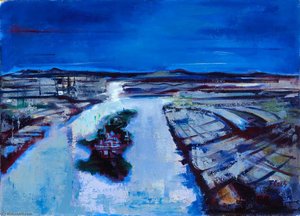
Joseph Floch: A Master of Timeless Landscapes
Born in Vienna, Austria, on November 5th, 1894, Joseph Floch’s artistic journey was one shaped by both profound personal experiences and a deep engagement with the evolving currents of European art. While his early life unfolded within the Austro-Hungarian Empire, marked by a growing dissatisfaction with its political landscape, it was the tumultuous years following World War I that ultimately propelled him toward a new beginning in Paris – a city that would become central to his creative identity.
Floch’s formal artistic training began at the Vienna Academy of Fine Arts between 1913 and 1918, where he studied under figures like Franz Rumpler. This foundational period instilled in him a rigorous understanding of traditional techniques and composition. However, his artistic sensibilities quickly transcended these established boundaries. The war years, coupled with a growing sense of displacement, fueled a restless spirit and a desire to escape the confines of Vienna – a city he increasingly viewed as stifling his artistic aspirations. As he himself famously lamented in his diary, “Vienna is the city of music, painting takes second place.”
- Early Influences: Floch’s artistic development was profoundly influenced by the Impressionists and Post-Impressionists, particularly Cézanne, Van Gogh, and Marées. His travels through Holland, Dalmatia, and Italy exposed him to diverse landscapes and artistic traditions, broadening his visual vocabulary and informing his unique style.
- The Hagenbund: From 1919 to 1938, Floch was a member of the Hagenbund, a conservative Viennese artist society. While this association provided recognition and exhibition opportunities, it also represented a degree of artistic constraint for him – a desire to move beyond the established norms of the group.
- Parisian Embrace: Moving to Paris in 1925 marked a pivotal moment in Floch’s career. He quickly established himself within the vibrant Parisian art scene, gaining patronage from prominent figures like B. Weill and exhibiting at prestigious salons such as the Salon des Tuileries and the Salon d'Automne.
A Style Defined by Realism and Harmony
Floch’s artistic style is characterized by a remarkable level of detail and realism, yet tempered with an underlying sense of serenity and timelessness. He primarily focused on landscape and figure painting, often depicting monumental compositions featuring individuals – frequently nudes – in simple, evocative poses. These figures are presented not as dramatic subjects but rather as integral parts of the landscape, contributing to a harmonious and balanced visual experience.
His color palette is consistently subdued, favoring muted tones that evoke a sense of quiet contemplation. He skillfully employed light and shadow to create depth and atmosphere, drawing inspiration from the works of Cézanne and Van Gogh, particularly their ability to capture the essence of nature through carefully observed details and expressive brushwork. Floch’s paintings are not merely representations of scenes; they are invitations to a meditative state, reflecting a deep appreciation for beauty and tranquility.
Migration and American Recognition
The rise of Nazism in Europe prompted Floch to seek refuge in the United States in 1941. He embraced his new life in New York City, becoming an American citizen in 1951. During his time in America, he continued to exhibit his work and received numerous awards and accolades, solidifying his reputation as a respected artist.
- Exhibitions: Floch’s paintings have been showcased at various prestigious venues throughout his career, including the Pennsylvania Academy of Fine Arts (PAFA), the Washington County Museum of Art (TMA), and the Belvedere Museum in Vienna.
- Recognition: He received several awards, including the Brevoort-Eickmeyer Prize from Columbia University in 1955 and was named a Chevalier by the Fraternal Order of Arts & Letters in 1962.
Legacy and Enduring Influence
Joseph Floch’s artistic legacy extends beyond his individual works; it resides in his ability to capture the essence of place and evoke profound emotional responses through his meticulous realism and harmonious compositions. His paintings offer a glimpse into a world of timeless beauty, reflecting both the artist's personal journey and the broader cultural landscape of the 20th century.
His work continues to be exhibited and appreciated in museums across the United States, France, Austria, and Israel, ensuring that his contribution to American art remains firmly established. The Leo Baeck Institute holds a significant collection of his works, offering valuable insights into his artistic development and career trajectory. Floch’s paintings are not simply beautiful images; they are windows into a soul deeply connected to the natural world and imbued with a quiet sense of grace.