The Soul of the Scottish Canvas: The Life and Legacy of John Henry Lorimer
In the golden age of late Victorian and Edwardian painting, few artists captured the quiet dignity of domesticity and the architectural grandeur of Scotland with as much grace as John Henry Lorimer. Born in Edinburgh in 1856 into a family of profound intellectual prestige, Lorimer was destined for a life shaped by both academic rigor and creative passion. As the son of James Lorimer, a distinguished professor at Edinburgh University, his early years were steeped in the scholarly atmosphere of Scotland’s capital. This foundation of discipline and observation would later become the bedrock of his artistic technique, allowing him to approach his subjects with a meticulous eye for detail and a deep respect for the historical weight of his surroundings.
Lorimer’s formal training was as much a journey through tradition as it was an exploration of modern light. Educated at the Edinburgh Academy and later at Edinburgh University, he sought refinement through the prestigious halls of the Royal Scottish Academy. Under the mentorship of masters such as Frank McTaggart and William Chalmers, Lorimer began to master the delicate balance between classical realism and the emerging influence of Impressionism. His brushwork learned to dance with light, capturing not just the physical form of a subject but the very atmosphere that enveloped it. This period of development was further enriched by his extensive travels across Europe; from the sun-drenched landscapes of Spain and Italy to the vibrant, culturally diverse vistas of Algeria, Lorimer absorbed a global visual vocabulary that he would later weave into the fabric of his Scottish scenes.
A Symbiosis of Art and Architecture
One of the most enchanting aspects of Lorimer’s career was the profound creative synergy he shared with his brother, the celebrated architect Robert Lorimer. Their relationship transcended mere familial bond, evolving into a collaborative legacy that helped define the aesthetic of their era. Nowhere is this more evident than in the magnificent restoration of Kellie Castle. While Robert worked to transform the dilapidated ruin into a triumph of architectural heritage, John was there to breathe life into its walls through his paintings. His depictions of the castle and its surrounding estates were not merely records of stone and mortar, but poetic celebrations of a revitalized Scottish identity.
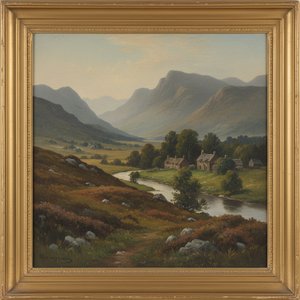
This partnership allowed John Henry Lorimer to explore themes of permanence and nostalgia. Through his eyes, we see the intersection of man-made grandeur and the natural world. His ability to render the textures of ancient masonry alongside the soft, ephemeral light of a domestic interior created a sense of timelessness that remains captivating to modern viewers. This unique position—at the heart of both architectural revival and genre painting—ensured his place in the historical narrative of Scottish art.
Mastery of Portraiture and Genre Scenes
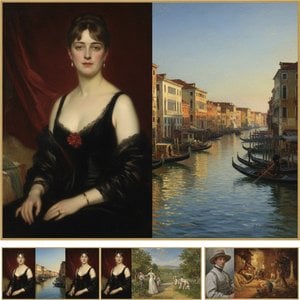
Beyond the grand landscapes and architectural studies, Lorimer was a master of the human narrative. He possessed a rare ability to capture the psychological depth of his sitters, making him a sought-after portraitist for some of the most notable figures of his time. His portraits, including those of Lyon Playfair and the pioneering surgeon Joseph Lister, are characterized by a profound sense of character and dignity. He did not merely paint faces; he painted legacies.
In his genre paintings, Lorimer turned his attention to the intimate rhythms of everyday life. These works often feature:
- Domestic Intimacy: Scenes that evoke the warmth and quietude of the Scottish home.
- Lyrical Realism: A technique that combines precise anatomical and structural accuracy with a soft, emotive light.
- Cultural Documentation: Capturing the social nuances and fashions of the late 19th century.
The sheer volume of his contributions to the art world is evidenced by his frequent exhibitions at the Royal Scottish Academy and the Royal Academy in London. With over one hundred works showcased at the former, Lorimer established himself as a pillar of the Scottish art community. His death in 1936 marked the end of an era, yet his influence persists through the enduring beauty of his canvases, which continue to serve as windows into a vanished world of elegance, tradition, and profound artistic devotion.
Vprašanja in odgovori
Ali obstaja celoten seznam umetnin umetnika John Henry Lorimer?
Vsa dela umetnika John Henry Lorimer na platformi ta spletna stran si lahko ogledate na njegovi strani Vsi umetniški slogi.
Ali lahko dela umetnika John Henry Lorimer brskam po barvni paleti?
Stran Po barvnih paletah grupirá dela umetnika John Henry Lorimer po njihovih barvnih paletah.
V katerem zgodovinskem obdobju je delal/a John Henry Lorimer?
John Henry Lorimer je delal v obdobju 19th Century. To obdobje umetnikovo dejavnost umešča v zgodovinski okvir.