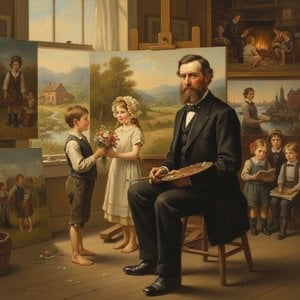
John Gutmann: A Singular Vision of American Life
John H. Gutmann (1905 – 1998) stands as a fascinating figure in the landscape of mid-century American art, blending photographic realism with painterly observation to create images that resonate with both immediacy and profound thoughtfulness. Born in Breslau, Germany—then part of the Austro-Hungarian Empire—Gutmann’s formative years instilled within him an appreciation for meticulous detail and a sensitivity to social realities, influences that would profoundly shape his artistic trajectory. He pursued formal training at Staatliche akademie für kunst und kunstgewerbe breslau, honing his skills in drawing and painting before relocating to Berlin in 1927 where he earned a postgraduate degree at preussisches schukollegium for hohere erziehung.
The burgeoning Weimar Republic witnessed Gutmann’s artistic experimentation, yet it was the looming shadow of Nazism that ultimately propelled him toward emigration. In 1933, he fled Germany, arriving in San Francisco with a Rolleiflex camera and securing a contract with Presse-photo—a pivotal moment marking the beginning of his photographic career. This early work demonstrated Gutmann’s distinctive approach: a “worm’s-eye view,” capturing scenes from everyday life with remarkable precision and capturing the essence of American culture during the Jazz Age. He eschewed grand narratives, favoring instead intimate portraits of ordinary people—a stylistic choice that would become characteristic of his oeuvre.
Gutmann's artistic output spanned both photography and painting, demonstrating a versatility rarely found in artists of his era. His paintings often depicted landscapes and interiors with muted palettes and subtle tonal gradations, reflecting the influence of Expressionist techniques while maintaining an unwavering commitment to realism. Notably, Gutmann collaborated closely with Arnold Schönberg, producing a striking black-and-white portrait that exemplifies his masterful use of lighting and composition—a testament to his ability to distill complex emotions into visual form. This collaboration underscores Gutmann’s engagement with the intellectual currents of his time and highlights his dedication to capturing human experience with unflinching honesty.
Throughout his career, Gutmann consistently sought to portray marginalized communities and individuals whose voices were often unheard. His photographs documented the lives of migrant workers, ethnic minorities, and impoverished families—subjects he approached with empathy and respect—resulting in images that powerfully conveyed social commentary alongside aesthetic beauty. He wasn’t merely documenting; he was interpreting, offering a unique outsider perspective on American society during periods of significant upheaval.
Gutmann's legacy extends beyond his individual artworks. His commitment to photographic realism—particularly his pioneering use of the Rolleiflex camera—established him as an innovator within the field and influenced subsequent generations of photographers. Furthermore, his unwavering focus on portraying human dignity and vulnerability cemented his place as a champion of social justice and artistic integrity. John Gutmann’s work continues to inspire artists today with its quiet contemplation and profound engagement with the complexities of human existence.