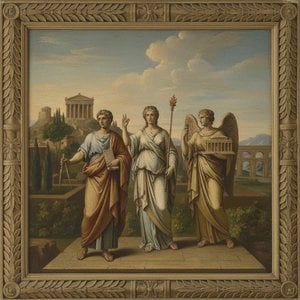
A Luminary of Dutch Neoclassicism: Johannes van Dregt
Johannes van Dregt, a name perhaps less immediately recognizable than some of his contemporaries, nevertheless occupies a significant position within the landscape of late 18th and early 19th-century Dutch art. Born in Amsterdam in 1761, Van Dregt flourished during a period of immense societal upheaval and artistic transition, bridging the gap between the waning Rococo style and the burgeoning Neoclassical movement. While biographical details remain somewhat sparse, piecing together his career reveals a dedicated artist deeply influenced by classical ideals, historical narratives, and a commitment to civic virtue. His work, often large-scale history paintings and allegorical compositions, served not merely as aesthetic objects but as visual embodiments of Dutch patriotism and moral principles in the wake of the Batavian Republic and subsequent French occupation.Early Life and Artistic Training
Van Dregt’s artistic journey began with an apprenticeship under the renowned painter Cornelis Kruseman, a prominent figure in Amsterdam's art world. Kruseman instilled in him a solid foundation in drawing, composition, and traditional painting techniques. However, it was Van Dregt’s subsequent studies at the Amsterdam Academy that truly shaped his artistic sensibilities. Here, he immersed himself in the study of classical sculpture and literature, absorbing the principles of balance, harmony, and idealized form that would become hallmarks of his mature style. The influence of French Neoclassicism, particularly the works of Jacques-Louis David, is readily apparent in Van Dregt’s early attempts at historical painting. He quickly distinguished himself as a talented student, winning several awards for his drawings and paintings, signaling a promising future within the artistic community.The Rise of Civic History Painting
The political climate of the late 18th century profoundly impacted Van Dregt's artistic direction. The establishment of the Batavian Republic in 1795, followed by French rule, created a demand for art that celebrated Dutch national identity and promoted republican ideals. This need found expression in *civic history painting*, a genre dedicated to depicting scenes from Dutch history that emphasized themes of heroism, sacrifice, and resistance against tyranny. Van Dregt became a leading practitioner of this style, producing monumental canvases that glorified key moments in the struggle for Dutch independence. His most celebrated work, Allegory of Freedom (1790), exemplifies this trend. The painting is not a literal depiction of a historical event but rather an allegorical representation of liberty, personified by a female figure holding a staff adorned with the Dutch flag. This piece, and others like it, were commissioned by patriotic societies and displayed in public buildings as symbols of national pride.Technique and Style: A Blend of Tradition and Innovation
Van Dregt’s technique was characterized by meticulous detail, precise draftsmanship, and a restrained color palette. He employed a smooth, polished brushstroke that lent his figures a sculptural quality, reminiscent of classical statuary. While deeply rooted in the traditions of Dutch Golden Age painting—particularly the works of Rembrandt and Frans Hals—Van Dregt also embraced Neoclassical principles of clarity, order, and idealized form. His compositions were carefully balanced, often featuring dramatic lighting effects to highlight key figures and emphasize emotional intensity. He was a master of portraying human anatomy and expression, imbuing his characters with dignity and gravitas. His ability to seamlessly blend these disparate influences—the realism of the Dutch masters and the idealism of Neoclassicism—set him apart from many of his contemporaries.Legacy and Historical Significance
Although Van Dregt’s popularity waned somewhat after the restoration of the monarchy in 1813, his contribution to Dutch art remains significant. He played a crucial role in shaping the visual language of Dutch patriotism during a period of profound political change. His civic history paintings served as powerful tools for promoting national identity and fostering a sense of collective memory. Furthermore, his work exemplifies the complex interplay between art, politics, and ideology in the late 18th and early 19th centuries. Today, Van Dregt’s paintings are held in prominent museums throughout the Netherlands, serving as enduring reminders of a turbulent era and the artists who sought to capture its spirit on canvas.- Key Influences: Cornelis Kruseman, Jacques-Louis David, Dutch Golden Age Masters (Rembrandt, Frans Hals)
- Major Themes: Dutch Patriotism, Civic Virtue, Historical Allegory, Republican Ideals
- Signature Style: Meticulous Detail, Precise Draftsmanship, Restrained Color Palette, Blend of Realism and Idealism