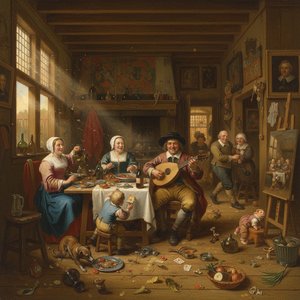
A Quiet Observer of Dutch Landscape
Jan Dasveldt (1770 – 1855) emerged from the bustling artistic milieu of Amsterdam during the late Enlightenment, establishing himself as a significant figure in Dutch watercolor painting. Trained by Hendrik Stokvisch, a respected artist of his time, Dasveldt honed his skills and developed a distinctive style characterized by meticulous detail and an unwavering focus on capturing the tranquil beauty of the Dutch countryside.
- Early Life & Training: Born in Amsterdam, Dasveldt’s formative years were spent under Stokvisch's tutelage, absorbing principles of observation and artistic precision.
- Membership in the Koninklijke Academie voor Beeldende Kunsten: In 1840, he joined the Royal Academy of Fine Arts, marking a pivotal moment in his career and solidifying his position within the established artistic community.
Unlike many of his contemporaries who pursued grand historical narratives or dramatic theatrical productions, Dasveldt favored landscapes and portraits—often rendered with remarkable subtlety—that conveyed an atmosphere of contemplative serenity. His watercolors weren’t merely representations of scenery; they were imbued with a palpable sense of stillness and harmony.
Dasveldt's Watercolor Technique & Artistic Vision
Dasveldt’s technique was notable for its careful layering of washes—a hallmark of watercolor painting—allowing him to achieve luminous effects and subtle tonal gradations. He meticulously studied the interplay of light and shadow, striving to faithfully reproduce the nuances of natural illumination. This dedication to realism combined with an innate sensitivity to color created images that resonate with a timeless quality.
- Layered Washes: Dasveldt skillfully employed multiple washes to build up depth and texture in his watercolors.
- Observation & Detail: He possessed an exceptional eye for detail, capturing minute variations in foliage, water reflections, and architectural features with astonishing accuracy.
Notable Works & Influences
Among Dasveldt’s most celebrated paintings is “Siberian Greyhound,” a captivating watercolor depicting a noble animal amidst a picturesque Dutch landscape—a testament to his ability to fuse artistic vision with scientific observation.
Legacy & Historical Significance
Jan Dasveldt’s contribution to Dutch watercolor art is undeniable. He stands as a symbol of quiet artistic excellence—a reminder that beauty can be found in understated observation and masterful execution. His paintings continue to inspire admiration for their tranquility, precision, and enduring connection to the natural world.