A Scholar in Many Forms: The Life and Legacy of Henry Noel Humphreys
Henry Noel Humphreys, born in Birmingham in 1810, was a figure remarkably difficult to categorize—a testament to the breadth of his intellectual curiosity and artistic skill. He wasn’t simply an illustrator or a naturalist; he was a polymath who seamlessly blended meticulous observation with scholarly pursuit, leaving behind a legacy that spans entomology, numismatics, medieval manuscripts, and the very art of writing itself. His early education at King Edward's School laid a foundation for a life dedicated to learning, but it was his subsequent studies in Italy that truly ignited his passion for the past—particularly the exquisite beauty and intricate detail of illuminated manuscripts.
Humphreys’s journey wasn’t confined to a single discipline. While he established himself as a capable illustrator through detailed botanical and zoological works, his interests quickly expanded. He became deeply fascinated by the origins and evolution of writing, leading him to explore ancient Greek and Roman coins, archaeology, and the techniques employed in early printing. This multifaceted approach wasn’t merely academic; it informed his artistic practice, imbuing his illustrations with a sense of historical context and scholarly precision.
The Intersection of Art and Scholarship
Humphreys's work is defined by its meticulous detail and dedication to accuracy. His entomological texts, for example, weren’t simply collections of pretty pictures; they were the result of careful observation and scientific study. He sought not just to depict insects but to understand their life cycles and place within the natural world. This same commitment to authenticity characterized his numismatic studies, where he meticulously reproduced ancient coins, offering a visual record of lost civilizations. However, it was perhaps in his exploration of medieval manuscripts that Humphreys’s artistic talents truly shone.
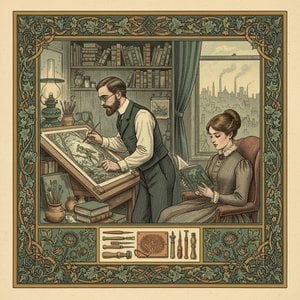
He wasn't content with simply copying these historical treasures; he sought to understand the techniques employed by the original illuminators—the preparation of pigments, the delicate application of gold leaf, and the intricate calligraphy. This understanding led him to experiment with chromolithography, a relatively new printing technique at the time, in an attempt to recreate the luminosity and detail of medieval illumination. His book, *The Illuminated Books of the Middle Ages*, stands as a testament to this ambition—a lavishly illustrated volume that brought the beauty of these ancient works to a wider audience.
A Pioneer of Victorian Gothic Revival
Humphreys’s work was deeply rooted in the aesthetic sensibilities of the Victorian era, particularly the Gothic Revival movement. He admired the craftsmanship and artistry of the medieval period, believing it represented a higher standard of artistic excellence than the mass-produced goods of his own time. This admiration manifested itself not only in his subject matter but also in his book design.
He became renowned for his elaborate pierced papier-mâché bindings—intricate designs that mimicked the look of hand-carved ebony or cast iron. These bindings, created by J. Jackson & Son, were a labor-intensive process and reserved for special editions, transforming books into objects of art in their own right. While challenging to store and prone to damage, they embodied the Victorian desire for tactile beauty and artistic ornamentation.
Major Works and Lasting Influence
Humphreys’s prolific output included a diverse range of publications, each reflecting his unique blend of scholarship and artistry. *A Record of the Black Prince* combined historical passages with stunning illuminations, while *British Moths and Their Transformations* showcased his skill as an entomological illustrator. His work on ancient coins, archaeology, and the art of writing further cemented his reputation as a polymath.
His most significant contribution may lie in his efforts to revive interest in medieval illumination. By meticulously reproducing these works and experimenting with new printing techniques, he made them accessible to a wider audience and inspired a renewed appreciation for the artistry of the past. He died on June 10th, 1879, leaving behind a body of work that continues to fascinate and inspire—a testament to the power of curiosity, dedication, and a lifelong pursuit of knowledge.
Selected Publications
- A Record of the Black Prince. A Series of original passages from the chroniclers relating to the career and exploits of Edward the Black Prince; enriched with highly-wrought illuminations from different Manuscripts referring to the history of the period.
- British Moths and Their Transformations.
- The Illuminated Books of the Middle Ages: a Series of Magnificent Specimens, of the size of the originals, from the finest illuminated MSS. From the 4th to the 17th Century.
- The Origin and Progress of Writing.
- and many more...
Vprašanja in odgovori
Ali lahko obiščem virtualni muzej del Henry Noel Humphreys?
3D muzej umetnika Henry Noel Humphreys je stran, ki v virtualni trodimenzionalni galeriji prikazuje umetnikova dela.
Ali lahko dela umetnika Henry Noel Humphreys pregledam po umetnostnim smernicam?
Umetnostne smernice, v katerih je delal Henry Noel Humphreys, si lahko ogledate na strani Vsi umetnostni slogi umetnika, ki dela dela razvrščena po umetnostnim smernicam.
V katerem zgodovinskem obdobju je delal/a Henry Noel Humphreys?
Henry Noel Humphreys je delal v obdobju 19th Century. To obdobje umetnikovo dejavnost umešča v zgodovinski okvir.
Koliko so priljubljena dela umetnika Henry Noel Humphreys?
Za umetnika Henry Noel Humphreys obstaja stran Statistika, ki prikazuje statistiko o umetnikovih delih na platformi ta spletna stran.
Kakšne čustva izražajo dela umetnika Henry Noel Humphreys?
Stran umetnikovega Soba razpoloženj prikazuje dela umetnika Henry Noel Humphreys, razvrščena glede na njihovo vzdušje.
Kje so dela umetnika Henry Noel Humphreys, razvrščena po tematikah?
Stran Atlas motivov prikazuje dela umetnika Henry Noel Humphreys razvrščena po temah.
Kako se je umetnost umetnika Henry Noel Humphreys skozi čas razvijala?
Kronološki pregled dela umetnika Henry Noel Humphreys je na njegovi strani Kronika, kjer se dela pojavljajo v vrstnem redu nastanka, razdeljena po poglavjih.
Kje in leta je se rodil/a Henry Noel Humphreys?
Henry Noel Humphreys se je rodil/a v Birmingham leta 1810.