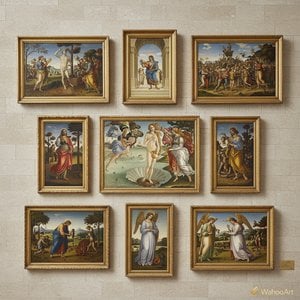
Gian Giacomo Caprotti (Salai): The Silent Companion of Leonardo
Gian Giacomo Caprotti, commonly known as Salai, remains an enigmatic figure in the annals of Renaissance art. Born around 1480 in Orano, Italy—a location shrouded in historical uncertainty—his life unfolded primarily within the orbit of Leonardo da Vinci’s workshop from approximately 1490 until his untimely death in 1524. Unlike many artists of his era who achieved fame through patronage or prolific output, Salai's artistic legacy rests largely on his association with Da Vinci and a singular contribution to one of history’s most celebrated paintings: Saint John the Baptist.
Early Life and Artistic Apprenticeship
Details surrounding Caprotti’s formative years are scarce, reflecting the limitations of archival records during the Renaissance. However, evidence suggests he hailed from humble origins—a fact that underscores the remarkable trajectory of his artistic journey. Entering Da Vinci's household as a boy, Salai swiftly ascended to become one of Leonardo’s most trusted pupils and confidantes. This relationship wasn’t merely professional; it was deeply personal, fostering an intimacy rarely seen amongst artists of the time. Da Vinci recognized Salai’s talent—particularly his aptitude for tempera painting—and nurtured his artistic development with unwavering dedication.
Collaboration with Leonardo da Vinci: A Master-Student Bond
The partnership between Caprotti and Da Vinci was transformative, shaping not only Salai's technique but also his worldview. Together they tackled ambitious projects, including the monumental Last Supper, where Salai served as a crucial assistant in preparing for the painting’s execution. Crucially, he is widely believed to be the model for Saint John the Baptist—a portrait that embodies Da Vinci’s masterful understanding of human anatomy and psychological nuance. This commission cemented Caprotti's reputation as Da Vinci’s foremost student and solidified his place within the artistic landscape of Florence.
Artistic Style and Technique: Tempera Mastery
Salai’s distinctive style is characterized by a profound sensitivity to color and texture, achieved primarily through the medium of tempera paint—a technique favored for its luminosity and permanence. Unlike oil paints, which require extended drying times, tempera pigments bind directly to the substrate (usually wood), resulting in vibrant hues that retain their brilliance across centuries. His Saint John the Baptist exemplifies this approach perfectly, capturing the saint’s serene gaze and muscular physique with remarkable precision. The painting's subtle gradations of color—particularly in the drapery—demonstrate Salai’s meticulous attention to detail and his ability to convey emotion through visual cues.
Influence and Legacy: Echoes of Da Vinci
Salai’s artistic output, though relatively limited compared to contemporaries like Raphael or Michelangelo, nonetheless exerted considerable influence on subsequent artists. His work stands as a testament to Da Vinci's stylistic vision—a fusion of anatomical realism and expressive idealism—and reflects the broader humanist ideals prevalent during the High Renaissance. Artists such as Giovanni Antonio Boltraffio and Raffaello Sanzio da Urbino acknowledged Salai’s mastery, adopting techniques reminiscent of Da Vinci’s own approach. Ultimately, Gian Giacomo Caprotti (Salai) remains a poignant reminder that artistic brilliance can emerge from unexpected sources—a silent companion whose contribution to one of art history's greatest achievements continues to inspire awe and admiration.