Étienne Carjat: A Parisian Chronicler of Artistic Souls
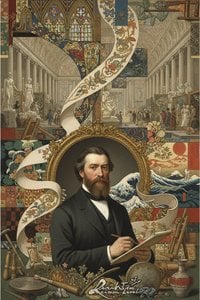
Étienne Carjat (1828-1906) was a French journalist, caricaturist, and photographer whose prolific output captured the vibrant intellectual landscape of late 19th-century Paris. Born in Fareins, Ain, he emerged as a prominent voice within the burgeoning bohemian circles that championed artistic experimentation and social critique—a milieu profoundly shaped by figures like Baudelaire and Rimbaud. His career spanned decades, marked by collaborations with influential publications such as *Le Diogène* and *Le Boulevard*, where his satirical sketches cemented his reputation for astute observation and unflinching commentary on contemporary society.
- Early Life & Journalism: Carjat’s formative years were spent honing his journalistic skills, immersing himself in the debates surrounding Impressionism and Realism. He quickly established a distinctive style characterized by dramatic chiaroscuro—a technique borrowed heavily from Rembrandt—that conveyed emotion and psychological depth.
- Photographic Pioneer: Beyond caricature, Carjat possessed an undeniable talent for photography. Though much of his photographic archive remains elusive after being sold in 1923, he produced stunning portraits documenting the faces of artists, writers, and intellectuals of his time. His images offer invaluable glimpses into Parisian life during a period of rapid transformation.
- The Rimbaud Portrait: Arguably Carjat’s most celebrated achievement is his portrait of Arthur Rimbaud—taken in October 1871 shortly after the Siege of Paris. This image, now housed at the National Gallery of Art, exemplifies Carjat's masterful use of light and shadow to convey Rimbaud’s rebellious spirit and enigmatic gaze. It remains a cornerstone of Impressionist iconography.
- Notable Subjects & Artistic Style: Carjat’s subjects encompassed an impressive roster of literary luminaries—including Alexandre Dumas fils, Jean Richepin, and Gustave Dore—as well as prominent artists like Henri Rousseau and Georges Seurat. His artistic style consistently prioritized expressive realism, prioritizing psychological nuance over mere visual accuracy.
- Legacy & Influence: Étienne Carjat’s contribution to Parisian art history extends beyond individual portraits. He helped establish *Le Boulevard*, a publication dedicated to fostering intellectual discourse and promoting avant-garde ideas. His work continues to inspire artists today, demonstrating the enduring power of observation and artistic conviction.
His influence can be seen in the stylistic choices of subsequent generations of portrait painters who sought to emulate his dramatic lighting and psychological insight. Carjat’s legacy resides not only in his visual creations but also in his role as a chronicler of an era defined by artistic innovation and social upheaval—a testament to his enduring significance within the cultural history of France.