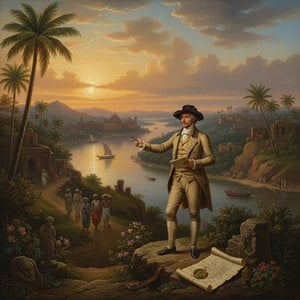
Daniël Dupré: A Dutch Master of Light and Landscape
Daniël Dupré (1751-1817) stands as a quietly significant figure in 18th and early 19th century Dutch art, a painter whose meticulous landscapes and architectural scenes offer a serene window into the world of his time. Born in Amsterdam, he spent his life primarily within the city’s artistic circles, honing his skills under the tutelage of Jurriaan Andriessen at the esteemed Stadstekenacademie. Dupré wasn't a flamboyant innovator; rather, he possessed an exceptional ability to capture the subtle nuances of light and atmosphere, transforming familiar Dutch scenes – rolling fields, canals reflecting the sky, and stately buildings – into works imbued with a remarkable sense of realism and tranquility. His art speaks not of grand gestures or dramatic narratives, but of quiet observation and a deep appreciation for the beauty of everyday life.
Early Life and Artistic Training
Daniël Dupré’s early years were rooted in Amsterdam, a city renowned for its artistic heritage. While details about his childhood are somewhat sparse – largely gleaned from biographical notes – it's clear that he was immersed in the vibrant cultural environment of the Dutch Republic. His formal training at the Stadstekenacademie provided him with a solid foundation in drawing and painting techniques, essential skills for any aspiring artist. Crucially, his mentorship under Jurriaan Andriessen exposed him to established artistic principles and likely influenced his approach to composition and detail. Beyond Amsterdam, Dupré embarked on a journey of artistic exploration, venturing into Germany and Italy – specifically visiting Düsseldorf, Rome, and Mannheim. These travels were not merely vacations; they represented a deliberate effort to broaden his artistic horizons, absorbing the influences of various European styles and techniques. The Italian experience, in particular, would have exposed him to the classical ideals that continued to shape Dutch art during this period.
Subject Matter and Technique
Dupré’s oeuvre is predominantly characterized by two recurring themes: landscapes and architectural scenes. He frequently depicted the picturesque countryside surrounding Amsterdam – vast fields of grain, meandering canals, and charming villages bathed in sunlight. His landscapes are not romanticized visions; they are grounded in meticulous observation, capturing the subtle shifts in color and texture that define the Dutch terrain. Equally compelling are his depictions of buildings – stately manors, churches, and civic structures – rendered with a remarkable attention to detail. Dupré’s technique is distinctly precise and controlled. He employed watercolor as his primary medium, skillfully layering washes of color to create atmospheric effects and subtle gradations of tone. His use of light is particularly noteworthy; he masterfully manipulated shadows and highlights to evoke a sense of depth and realism. He was also proficient in engraving, producing detailed prints that served as both independent works of art and preparatory studies for his paintings.
Influences and Historical Context
Dupré’s work is firmly rooted within the broader context of 18th-century Dutch painting. The *vedute* tradition – a fascination with capturing urban vistas – was gaining momentum across Europe, and Dupré undoubtedly drew inspiration from this trend. However, he tempered these influences with his distinctly Dutch sensibility, prioritizing accuracy and realism over dramatic embellishment. The Enlightenment’s emphasis on reason and observation also shaped his artistic approach, encouraging him to meticulously document the world around him. Furthermore, the rise of the middle class in the Netherlands fueled a demand for paintings that depicted scenes of domestic comfort and rural beauty – themes that Dupré frequently addressed in his work.
Legacy and Significance
Daniël Dupré’s contribution to Dutch art may not be as widely celebrated as some of his more flamboyant contemporaries, but his meticulous landscapes and architectural studies hold a significant place in the nation's artistic heritage. His works offer a valuable glimpse into the visual culture of 18th-century Holland, revealing a deep appreciation for the beauty of the natural world and the dignity of everyday life. His dedication to detail and mastery of watercolor technique are particularly noteworthy, establishing him as a skilled and accomplished artist within his time. Today, Dupré’s paintings can be found in prominent collections such as the Städel Museum in Frankfurt, testament to their enduring artistic merit. His art serves as a reminder that beauty and significance can often be found in the quietest of observations.