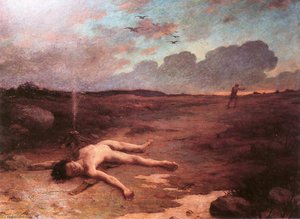
The Quiet Pioneer: The Life and Legacy of Claude Émile Schuffenecker
In the vibrant, often tumultuous tapestry of the late nineteenth-century Parisian art scene, certain names shine with an almost blinding brilliance, while others linger in the soft, atmospheric shadows. Claude Émile Schuffenecker (1851–1934) belongs to that evocative second group—a figure whose brushstrokes helped define the edges of Post-Impressionism even as he remained somewhat obscured by the monumental shadows of his contemporaries. Born in Haute-Saône, France, Schuffenecker’s journey was one of profound resilience and artistic devotion. Following the early loss of his father, a tailor from Alsace, his path was shaped by economic necessity and a disciplined upbringing. Before fully committing to the easel, he worked within the practical world of commerce, assisting in his uncle’s coffee and chocolate roasting business. This grounded, industrious spirit would later manifest in his meticulous approach to color and composition, providing a stable foundation for his experimental explorations in light and form.
Schuffenecker’s artistic soul was forged in the crucible of Parisian bohemianism, where he found kindred spirits in the likes of Paul Gauguin and Odilon Redon. His education at the Académie Colarossi allowed him to refine his technical prowess, but it was his deep, intellectual connection with Gauguin that truly catalyzed his creative evolution. The two men shared more than just a studio space; they shared a reverence for the Old Masters and a mutual desire to push beyond the fleeting impressions of Monet toward something more structural and symbolic. This period of intense camaraderie saw Schuffenecker participating in pivotal moments of art history, most notably the Volpini Exhibition, an event that served as a crucial platform for the avant-garde. Through these connections, he also became an early supporter of Vincent van Gogh, positioning himself at the very heart of a movement that would forever alter the course of modern art.
A Vision of Light and Atmosphere
The work of Schuffenecker is characterized by a delicate balance between the observational accuracy of Impressionism and the emotive, flattened planes of Post-Impressionism. His landscapes often serve as windows into a serene, almost dreamlike reality. In pieces such as In the Woods, one can observe his mastery of pastel and oil to create a sense of depth through soft, rhythmic brushwork. He possessed a unique ability to capture the way light filters through foliage or rests upon the surface of water, as seen in his evocative depictions of the Meudon region. His compositions often invite the viewer into a quiet, contemplative space, where the boundaries between the physical world and psychological mood begin to blur.
Beyond the landscape, Schuffenecker’s oeuvre includes portraits that delve into the interiority of his subjects, reflecting a profound interest in human emotion. His technique often utilized:
- Atmospheric Subtlety: A focus on the weight and texture of air and light to create mood.
- Color Harmony: An intentional use of palette to evoke specific emotional responses, influenced by his studies with Gauguin.
- Structural Composition: A move away from purely spontaneous strokes toward more deliberate, organized forms that suggest a lasting permanence.
Historical Significance and the Collector's Eye
While Schuffenecker may not have achieved the global celebrity of the masters he befriended, his historical significance is multifaceted. He was not merely a painter but an active participant in the ecosystem of art through his roles as an art teacher and a dedicated collector. His eye for talent and his commitment to fostering new movements helped sustain the momentum of the Post-Impressionist era. By documenting and supporting the works of his peers, he contributed to the very fabric of the Parisian avant-garde.
Today, Schuffenecker’s legacy is being rediscovered by scholars and enthusiasts alike who recognize the quiet strength in his vision. His ability to navigate the transition from the naturalism of the mid-century to the expressive freedom of the new century marks him as a vital link in the chain of modern art history. To study Schuffenecker is to witness the evolution of a movement, seeing through his eyes the shifting light of a world on the brink of profound change.