A Singular Vision: The Life and Work of Carlo Mollino
Carlo Mollino, born in Turin in 1905, was a figure who defied easy categorization—an architect, designer, photographer, writer, skier, pilot, and educator whose multifaceted existence embodied the spirit of the Italian Renaissance polymath reborn in the modern era. His life wasn’t simply *lived* but actively designed, each pursuit informing and enriching his creative output. The son of Eugenio Mollino, a prolific engineer responsible for over 300 structures in Turin, Carlo inherited not only a practical understanding of building techniques but also an environment steeped in architectural discourse. This early exposure proved foundational, fostering a deep respect for craftsmanship alongside a burgeoning desire to transcend purely functional considerations. He graduated from the Royal Superior School of Architecture in Turin in 1931, and initially collaborated with his father, gaining invaluable experience overseeing construction projects and mastering the intricacies of technical drawing—skills he would later employ with meticulous precision in his own work.
Early Influences and the Seeds of a Unique Aesthetic
Mollino’s architectural journey began to truly take shape in the 1930s, a period marked by the rise of Rationalism. However, unlike many of his contemporaries who embraced the austere geometries and industrial aesthetic of the movement, Mollino sought a more expressive path. A pivotal moment came during a trip to Berlin in 1931 where he encountered the work of Erich Mendelsohn, whose dynamic forms resonated deeply with him. This encounter sparked an interest in Expressionism, which would become a crucial undercurrent in his early designs. The Farmers’ Federation building in Cuneo (1933-35) stands as a testament to this burgeoning aesthetic—a structure that subtly hints at the organic complexity and narrative ambition that would come to define his mature work. Simultaneously, Mollino began exploring literary avenues, publishing “The Life of Oberon” in *Casabella*, an architectural journal. This fictional short story wasn’t merely a diversion; it was a personal manifesto outlining his vision for architecture as a form of expressive language—a space shaped not only by practical needs but also by imagination and storytelling. He believed that the act of design itself should be a creative performance, imbued with personality and emotion.
War Years, Teaching, and Expanding Horizons
The tumultuous years of World War II saw Mollino turn his attention to writing, producing *Message from the Darkroom* (1949), a volume of photographic history and criticism that revealed a keen eye for composition and a fascination with capturing fleeting moments. He also penned *Introduction to Downhill Skiing* (1950), demonstrating his passion for sport and his ability to analyze and articulate complex technical processes. In 1949, Mollino began teaching at the Faculty of Architecture in Turin, a role he held until his death in 1953. This period allowed him to refine his pedagogical approach, encouraging students to embrace experimentation and challenge conventional norms. His lectures weren’t simply about architectural principles; they were explorations of form, space, and the human experience. He wasn't interested in imposing a rigid style but rather fostering individual expression and critical thinking.
Masterworks: Casa Miller, Casa Devalle, and Beyond
The post-war era witnessed the creation of Mollino’s most celebrated works—structures that continue to captivate audiences with their innovative designs and organic forms. Casa Miller (1936) is perhaps his most iconic residential project, a testament to his ability to create spaces that are both functional and deeply personal. The interior is characterized by its fluid lines, custom-designed furniture, and a playful use of light and shadow. Casa Devalle (1939-40) further exemplifies this approach, showcasing Mollino’s surrealist sensibilities and his mastery of cold-moulded wood—a technique he employed to create sinuous, sculptural forms. Beyond residential design, Mollino tackled a diverse range of projects, including the Società Ippica Torinese (1937-40), an equestrian complex that seamlessly integrated functionality with artistic expression, and the Teatro Regio in Turin (1965-73), a project he considered one of his most significant achievements. He also indulged his passion for engineering by designing cars, including the DaMolNar which competed at Le Mans in 1955, and later record-breaking vehicles that remained as models—testaments to his relentless pursuit of innovation.
A Lasting Legacy: Innovation, Organic Forms, and a Singular Aesthetic
Carlo Mollino’s untimely death in 1973 marked the end of an extraordinary career. However, his legacy continues to resonate today, inspiring architects, designers, and artists around the world. He was a true original—a figure who refused to be confined by stylistic conventions or disciplinary boundaries. His work is characterized by its organic forms, meticulous attention to detail, and a deep understanding of materials. He believed that architecture should be more than just shelter; it should be an experience—a space that engages the senses and evokes emotion. Mollino’s ability to manipulate volumes, his passion for storytelling, and his unwavering commitment to individual expression have cemented his place as one of the most strikingly original creators of mid-century Italian architecture, design, and photography. He stands as a reminder that true creativity lies in embracing complexity, challenging norms, and pursuing a singular vision with uncompromising dedication.
Avtorji WahooArt.com
Kviz o umetnosti
Pri vsakem vprašanju je na voljo le eden pravilen odgovor.
Vprašanje 1:
In what city was Carlo Mollino born?
Vprašanje 2:
Besides being an architect, what other professions did Carlo Mollino practice?
Vprašanje 3:
What was the name of Mollino's famous short story published in Casabella magazine?
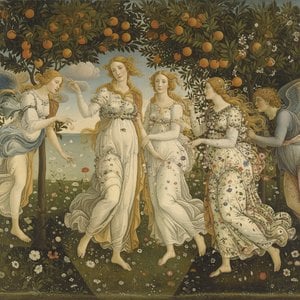
Explore the ethereal beauty of Sandro Botticelli's masterpieces. Delve into the profound symbolism, mythological grace, and technical mastery that define the Italian Renaissance through an expert art-historical lens.
Embark on a sophisticated journey through Italian Baroque art. Discover the dramatic interplay of light and emotion in Caravaggio’s masterpieces and explore how to bring this timeless grandeur into your collection with expert art insights.
Transform your family's history into a timeless masterpiece. WahooArt specializes in luxury, large-scale custom group portrait commissions for 10+ people. Hand-painted by master artists using traditional oil techniques to create an enduring legacy for your home or organization.