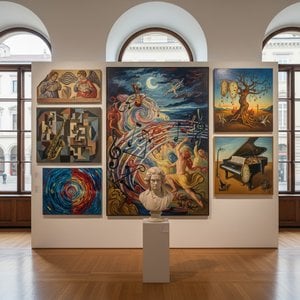
Raymond Saunders: A Weaver of Urban Rhythms
Raymond Saunders (1934–2025) emerged as a significant figure in American art during the latter half of the 20th century, forging a distinctive visual language rooted in meticulous observation and a profound engagement with the urban landscape. His work, often described as assemblage painting, transcends simple representation, instead offering layered narratives woven from fragments of everyday life – signs, doors, architectural details, and found objects – arranged within expressive fields of color and line. Saunders’s career spanned over six decades, marked by a consistent dedication to exploring the complexities of American identity through a uniquely personal and deeply considered artistic process.
Born in Pittsburgh, Pennsylvania, in 1934, Saunders' early life was profoundly shaped by his mentor, Joseph C. Fitzpatrick, the director of art for Pittsburgh’s public schools. Fitzpatrick recognized Saunders’s exceptional talent and provided him with invaluable opportunities, including scholarships to the Pennsylvania Academy of Fine Arts in Philadelphia and courses at the Barnes Foundation through the University of Pennsylvania. This formative experience instilled in Saunders a rigorous artistic training combined with an appreciation for the power of visual communication. He further honed his skills at the Carnegie Institute of Technology (now Carnegie Mellon University), earning a BFA, followed by an MFA from the California College of Arts and Crafts in Oakland. These diverse educational paths—from public school programs to prestigious art institutions—contributed significantly to the breadth and depth of his artistic vision.
Saunders’s artistic journey took a pivotal turn in 1967 with the publication of *Black Is a Color*, a powerful response to Ishmael Reed's controversial article on the Black Arts Movement. This text, delivered as a pamphlet, challenged Reed’s reductive portrayal of Black artists and their work, arguing for a separation of identity from artistic categorization. Saunders’s assertion—that “we get clear of these degrading limitations, and recognize the wider reality of art, where color is the means, not the end”—became a cornerstone of his artistic philosophy. This commitment to challenging conventional notions of representation and embracing multiplicity of meaning would inform much of his subsequent work.
The 1960s witnessed the emergence of Saunders’s signature style – assemblage painting. He began collecting discarded signs, doors, and architectural fragments from the streets of Pittsburgh and Oakland, meticulously assembling them within expansive canvases dominated by bold color fields and dynamic lines. These works are not merely collages; they are carefully constructed narratives that invite prolonged contemplation. Saunders' process involved layering these found objects with paint, creating a rich tapestry of visual information—a deliberate juxtaposition of the familiar and the unexpected. His use of color was particularly striking, often employing vibrant hues to heighten the emotional impact of his compositions. The influence of artists like Frank Stella and Brice Marden, who were experimenting with non-representational abstraction at the time, can be discerned in Saunders’s exploration of color and form.
The Language of Urban Fragments
Saunders' approach to assemblage painting was deeply rooted in his observations of the urban environment. He wasn’t simply collecting objects; he was actively engaging with the rhythms and textures of city life. His work reflects a fascination with signage—the ubiquitous signs that guide, inform, and sometimes mislead us through the streets. Doors, too, became recurring motifs, representing entryways to both physical and metaphorical spaces. These seemingly mundane elements were transformed into potent symbols within his paintings, imbued with layers of meaning.
The process of assembling these fragments was itself a significant aspect of Saunders’s artistic practice. He would spend considerable time observing the streets, carefully selecting objects that resonated with him—not necessarily for their aesthetic qualities alone, but for the stories they seemed to hold. He often worked directly on site, creating preliminary sketches and studies before returning to his studio to construct the final composition. This direct engagement with the urban landscape informed his understanding of the relationships between people, places, and objects.
Critical Recognition and Institutional Exhibitions
Despite initially working largely outside the mainstream art world, Saunders’s work gradually gained recognition throughout the 1960s and 70s. His first solo exhibitions were held at the Terry Dintenfass Gallery in New York City (1966, 1969, 1970, 1972), providing a platform for his innovative approach to assemblage painting. In 1971, he was featured in a major museum presentation at the San Francisco Museum of Modern Art, followed by exhibitions at institutions such as the Providence Museum of Art, Pennsylvania Academy of Fine Arts, and the American Embassy in Ouagadougou, Burkina Faso. These institutional engagements helped to establish Saunders’s reputation as a significant contemporary artist.
Saunders' work was also featured in several important group exhibitions, including *Image in Revolt* (1966), which showcased emerging artists exploring new approaches to abstraction and assemblage. His inclusion in these prestigious events signaled the growing acceptance of his artistic vision within the broader art community.
Legacy and Continuing Influence
Raymond Saunders passed away in 2025, leaving behind a body of work that continues to resonate with contemporary audiences. His paintings—characterized by their layered narratives, expressive color fields, and meticulous attention to detail—offer a unique perspective on American identity and the complexities of urban life. Saunders’s legacy extends beyond his individual artworks; he profoundly influenced subsequent generations of artists who have embraced assemblage as a means of exploring social and cultural themes.
His work remains exhibited in major museums and collections across the United States and Europe, ensuring that his artistic vision continues to be appreciated for its intellectual rigor, emotional depth, and enduring relevance. Saunders’s commitment to challenging conventional notions of representation and embracing multiplicity of meaning serves as a powerful reminder of the transformative potential of art.