Abraham van Blijenberch: A Court Painter Bridging Flanders and England
Born in Brussels around 1575, Abraham van Blijenberch emerged as a significant figure in the artistic landscape of early 17th-century Flanders. Though his life was relatively brief – he passed away in Antwerp in 1624 – his impact resonated through his portraits and designs, particularly those commissioned during his time serving the courts of James I and Charles I of England. Van Blijenberch’s career exemplifies a fascinating confluence of artistic influences, spanning from the Mannerist traditions of Daniel Mijtens to the burgeoning realism of the period, all while navigating the shifting political currents of Europe.
Early in his career, van Blijenberch honed his skills under the tutelage of Daniel Mijtens, a renowned painter known for his dramatic compositions and masterful use of light. Mijtens’ influence is readily apparent in van Blijenberch's early works, characterized by a heightened sense of theatricality and an emphasis on capturing fleeting expressions. However, van Blijenberch quickly developed his own distinct style, marked by a refined elegance and a subtle attention to detail. He wasn’t formally inducted into the Antwerp Guild of Saint Luke, a somewhat unusual circumstance that suggests perhaps a more independent or itinerant career path.
London Years: Portraits of Power
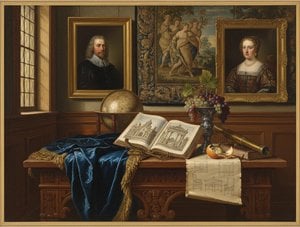
A pivotal moment in van Blijenberch's life arrived with his relocation to London around 1617. Here, he found himself in high demand as a court painter, capturing the likenesses of prominent figures within James I’s circle. This period produced some of his most celebrated works, including portraits of Prince Charles (later King Charles I), William Drummond of Hawthornden, and the Earl of Pembroke. These paintings are not merely representations of physical appearance; they strive to convey character and status through carefully observed gestures, attire, and expressions. The meticulous detail evident in these portraits—the texture of velvet, the sheen of jewels, the subtle nuances of facial features—demonstrates van Blijenberch’s technical proficiency and his keen eye for capturing the essence of his subjects.
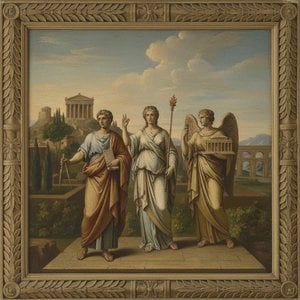
Beyond individual portraits, van Blijenberch also contributed significantly to the Mortlake Tapestry Works. These elaborate tapestries, commissioned by James I, depicted scenes from classical mythology and history, and van Blijenberch’s designs played a crucial role in their overall aesthetic impact. His involvement in this project highlights his versatility as an artist, demonstrating his ability to translate complex narratives into visually compelling compositions suitable for large-scale textile art.
Influences and Artistic Style
Van Blijenberch's artistic style is a delicate balance between Mannerist elegance and emerging realism. He inherited the dramatic lighting and compositional techniques of Mijtens, but tempered them with a greater sensitivity to naturalism and an increased focus on psychological depth. His portraits are characterized by a refined sense of color, a subtle use of chiaroscuro (the contrast between light and dark), and a remarkable ability to capture the inner lives of his subjects. The influence of the Flemish masters is undeniable, yet van Blijenberch’s work possesses a unique character that distinguishes it from purely academic styles.
Legacy and Recognition
Despite the relative obscurity surrounding his life, Abraham van Blijenberch's legacy endures through his remarkable portraits and designs. His works are considered prime examples of Flemish painting from the early 17th century, showcasing a sophisticated understanding of portraiture and decorative arts. Following his return to Antwerp in 1621 or 1622, he became a mentor to Theodoor van Thulden, further cementing his position as an influential figure in the artistic community. While detailed records of awards and recognition are scarce, his contributions continue to be celebrated by art enthusiasts and scholars alike, offering a glimpse into the vibrant cultural scene of early modern Europe.
Van Blijenberch’s work stands as a testament to the dynamic exchange of ideas that characterized the artistic landscape of his time – a bridge between the Mannerist traditions of the past and the emerging realism of the future.