The Primordial Contest: Ancient Rivalries and the Birth of Visual Deception Perceptual Paradox: The Technical Precision of Trompe l'Oeil and Optical Illusion The Primality of Perception: Ancient Rivalries in Visual Realism The Architecture of Illusio...
The impulse to bridge the gap between a flat surface and the three-dimensional world is as old as the medium of painting itself. Long before the term trompe l'oeil was formalized in the nineteenth century, artists engaged in a fundamental struggle between what the mind knows to be pigment and what the eyes insist is reality. This tension often manifested as a contest of skill, where the goal was not merely representation but a total conquest of the viewer's senses.
Ancient Greek lore provides one of the earliest recorded instances of this competitive spirit through the rivalry between Zeuxis and Parrhasius. Legend tells us that Zeuxis rendered a cluster of grapes so convincingly that birds descended from the sky to peck at them. However, he was eventually defeated by Parrhasius, whose painting of a draped curtain was so realistic it could not be pulled away from the canvas. This ancient anecdote establishes the core objective of perceptual art: the creation of a visual paradox that challenges our biological hardware.
Modern science suggests these illusions are not mere errors in sight but results of the brain using efficient shortcuts. When we encounter a visual paradox, our minds apply learned logic to atypical situations, attempting to reconcile the flat plane with the perceived depth. This pursuit remains the foundation of all illusionistic traditions, from the earliest murals to the most complex modern compositions.
Mathematical Precision: Renaissance Perspective and the Construction of Depth
Experience the meditative precision of Laurent Fabre’s Neo-Abstract masterpiece featuring navy and ochre geometric rings in a unique 3x3 grid, an exclusive studio creation available for your private collection.
During the Renaissance, the development of linear perspective transformed the canvas from a symbolic plane into a window. Artists began to apply mathematical rigor to the depiction of space, utilizing vanishing points to organize compositions and create an illusion of infinite depth. This era marked a shift from purely decorative elements to a calculated manipulation of the viewer's physical orientation within a room.
This architectural ambition found its peak in works like the Apotheosis of St Ignatius by Andrea Pozzo, where an illusionistic dome was created on a flat surface. Such techniques, known as quadratura, allowed painters to open up walls and ceilings, suggesting a connection to the heavens. The mastery of foreshortening and light enabled artists like Mantegna and Melozzo da Forlì to command the viewer's gaze from below, creating an impression of looking directly into an infinite sky through di sotto in sù techniques.
The Renaissance fascination with perspective drawing fundamentally altered how we perceive the boundaries of a painting. By treating the canvas as a structural extension of the room, artists moved beyond simple depiction toward a sophisticated manipulation of space. This mathematical approach remains a cornerstone for any artist seeking to command the physical presence of their work within a curated interior.
The Dutch Golden Age: Still Life as a Meditation on Mortality
Evert Collier (1642–1708): The Trompe-l'œil Master of Mortality Evert Collier, born circa 1642 in Breda, Noord-Brabant, emerged as a prominent figure within the Dutch Golden Age artistic landscape—a period characterized by unparalleled innovation and...
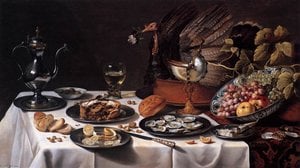
By the seventeenth century, the still life had emerged as a professional specialization, particularly within the Netherlands. The English term "still life" finds its roots in the Dutch stilleven, a genre that moved beyond mere decoration to embrace profound allegorical weight. While these works often featured domestic items—drinking glasses, books, or shells—they were frequently imbued with religious and symbolic meaning.
The vanitas tradition, prevalent during this era, utilized everyday objects to meditate on the transient nature of human existence. Artists like Edwaert Collier used meticulously rendered journals, medals, and sealing wax to reflect on decay and remembrance. A skull or a withered flower served as a quiet reminder of mortality, often accompanied by the phrase Omnia mors aequat—death makes all equal. This period saw the elevation of "low" subjects into high art, where the texture of a brass lamp or the subtle crinkles in a piece of paper became vehicles for intellectual contemplation.
Samuel Dirksz van Hoogstraten, a luminary of this era, pushed these boundaries further with his mastery of trompe l'oeil. In works such as his 1655 Trompe-l'oeil Still-Life, he used the technique to deceive the eye, presenting a wooden cabinet adorned with towels and papers that seemed to exist beyond the painted surface. Through meticulous attention to tonal gradulence and light, these Dutch masters transformed the inanimate into a profound dialogue on life and its inevitable end.
Architectural Ambition: From Roman Mosaics to Modern Spatial Expansion
The Primordial Contest: Ancient Rivalry and Modern Perception The Art of Deception: A Study of Trompe l'Oeil and Optical Illusion in Fine Art The Mechanics of Visual Deception: From Ancient Greece to Modern Perception Perceptual art Perceptual art is...
The history of illusion is also a history of architectural integration. In the ancient Roman world, the walls of Pompeii, Herculaneum, and the Villa Boscoreale featured realistic perspective still lifes, including the familiar motif of a glass bowl of fruit. These paintings were not merely decorative; they functioned to suggest larger rooms, creating the illusion of windows, doors, or hallways where none existed.
Roman emblema mosaics in wealthy homes demonstrated a range of food and celebrated the seasons, acting as signs of hospitality. This tradition of using art to expand the perceived boundaries of a space finds a modern echo in large-scale contemporary works. For instance, Maria Bettina Cogliatti’s 1998 color field painting, Trompe l'oeil, overlooks the Katastrophenbucht in Switzerland, utilizing the technique to engage with the surrounding landscape on a massive scale.
Whether through a Roman floor mosaic or a modern mural, the goal remains the same: to manipulate the viewer's perception of their environment. The use of trompe l'oeil in architecture allows for a seamless blending of the physical structure with the imagined space, proving that the desire to expand our horizons through art is a permanent fixture of human habitation.
The Psychological Portal: Surrealism and the Subconscious Landscape
A Doorway to the Subconscious: Exploring Dalí’s “Overture in Trompe l'Oeil” Salvador Dalí, a name synonymous with surrealism, possessed an unparalleled ability to unlock the hidden landscapes of the mind and translate them onto canvas. “Overture in T...
As we moved into the twentieth century, the technical mastery of illusion underwent a psychological shift. The focus transitioned from replicating the external world to unlocking the hidden landscapes of the mind. Artists began to use the tools of trompe l'oeil not just to mimic texture or depth, but to create portals into the subconscious.
Salvador Dalí’s 1972 work, Overture in Trompe l'Oeil, exemplifies this evolution. While the painting employs the traditional technique of rendering a solid stone archway and a substantial wooden door, it serves as an introduction to a world suspended between reality and dream. By including mundane objects like birds or a clock, Dalí anchors the viewer in a recognizable reality only to disorient them with surreal elements. The illusion is no longer just about the physical presence of an object, but about the psychological weight of what lies behind the curtain.
This progression from the literal grapes of Zeuxis to the dreamscapes of Dalí demonstrates the enduring power of visual deception. Whether through the meticulous rendering of a piece of paper by Vermeer or the architectural trickery of the Baroque, the ability to challenge the eye remains one of the most potent tools in the artist's repertoire. At WahooArt.com, we celebrate this legacy of craftsmanship, offering hand-painted reproductions and custom commissions that honor the profound history of illusion and the enduring beauty of the observed world.
Odkrijte Abraham Hendricksz. van Beyerenja, nizozemskega slikarja natirnih razpoložj (1620-1690). Občutite njegove majstorije kakoljih in sadnih kompozicij v Leidenu, Delftu in Amsterdamu. Ogledajte se dela na Mauritshuis!
Pieter Claesz Soutman (1593-1657) was a Dutch Golden Age painter known for realistic still lifes, portraits & group scenes. Influenced by Rubens & Hals, he served as court …
Step into the dreamscape of Salvador Dalí. Explore our curated guide to 25 iconic Surrealist masterpieces, from melting clocks to surreal landscapes. Find inspiration and museum-quality art reproductions for your space. Discover all masterpieces on WahooArt.com.
Immerse yourself in the luminous world of Laurent Fabre. Explore our curated selection of 25 iconic Neo-Abstract masterpieces, celebrating geometric precision and chromatic harmony. Find museum-quality art reproductions for your space. Discover all masterpieces on WahooArt.com.



 Perceptual Paradox: The Technical Precision of Trompe l'Oeil and Optical Illusion
 Celestial Geometry in Navy and Ochre: A Monumental Study of Harmonic Precision
 Edwaert Collier
 The Architecture of Illusion: Examining the Legacy of Trompe l'Oeil and Optical Art
 Overture in Trompe l'Oeil