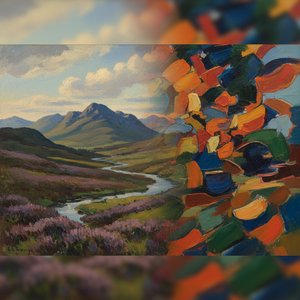
The Luminous Legacy of William Mouncey
In the quiet, mist-shrouded corners of Galloway, where the light dances across rolling hills and coastal vistas, the spirit of William Mouncey remains eternally preserved. Born in 1852 within the artistic cradle of Kirkcudbright, Mouncey was more than just a painter; he was a foundational architect of a movement. His life, though relatively brief, concluded in 1901, left behind a profound legacy that helped define the very essence of Scottish Impressionism. Growing up in a family steeped in artistic tradition, his early years were characterized by an intimate connection to the natural world, a bond that would later manifest as a deep, soulful resonance in every brushstroke he applied to canvas.
Mouncey’s journey was one of self-discovery and profound environmental influence. Rather than relying solely on formal academic rigidity, he honed his craft through dedicated self-study and an experimental approach to the medium. This independence allowed him to absorb the vibrant artistic spirit of the Kirkcudbright Artists’ Colony, a sanctuary for creative minds where luminaries like Margaret Hornel flourished. By joining forces with these fellow visionaries, Mouncey played an instrumental role in transforming Kirkcudbright into a renowned haven for Impressionistic experimentation. Within this collaborative atmosphere, he learned to move beyond mere representation, seeking instead to capture the fleeting, ephemeral moods of the Scottish landscape.
Technique and the Poetry of Light
To gaze upon a Mouncey original is to witness a masterclass in atmospheric perspective. His technique was never about the clinical precision of lines, but rather about the emotional weight of color and light. He possessed a singular ability to translate the transient moments of twilight and dawn into permanent visual poetry. His canvases are celebrated for their luminous palettes and loose, energetic brushstrokes, which work in harmony to convey the warmth and vitality of his surroundings. Whether depicting the rugged textures of a woodland path or the soft glow of a pastoral scene, Mouncey prioritized the emotional resonance of the atmosphere over the literal depiction of form.
His repertoire was as diverse as the landscapes he loved. While he is most famously remembered for his sweeping vistas of the Galloway hills and coastal reaches, his work often delved into the intimate rhythms of rural life. His paintings frequently featured:
- Evocative Landscapes: Capturing the dramatic interplay of light and shadow across woodlands and hillsides.
- Genre Scenes: Offering tender, nostalgic glimpses into the everyday labors and quiet moments of country living.
- Atmospheric Studies: Utilizing Impressionistic textures to evoke the damp, heavy air of the Scottish coast or the golden warmth of an autumn afternoon.
A Lasting Impression on Scottish Art
The historical significance of William Mouncey extends far beyond the borders of Galloway. His reach was international; his works found their way into prestigious galleries and institutions, including the Royal Scottish Academy in Edinburgh, the Royal Glasgow Institute, and even as far afield as the Whitechapel Art Gallery in London and the Carnegie Institute in Philadelphia. This widespread recognition helped elevate the Kirkcudbright movement to a position of prominence within the broader European art scene. In his final years, his exhibitions at Messrs James Connell & Sons in Glasgow brought his evocative visions to the wider public, ensuring that his name would endure.
Today, Mouncey stands as a pioneer who bridged the gap between traditional landscape painting and the modern, emotive freedom of Impressionism. His ability to infuse the rugged Scottish terrain with a sense of romanticism and light continues to inspire collectors and historians alike. Through his eyes, we do not merely see the landscape; we feel its pulse, its weather, and its timeless, quiet beauty.
Otázky a odpovede
Aká je popularita diel umelca William Mouncey?
Štatistiky o dielach umelca William Mouncey sú dostupné na jeho stránke Štatistiky.
Ako nájdem všetky diela od umelca William Mouncey v konkrétnej technike?
Ak chcete nájsť všetky diela umelca William Mouncey v konkrétnej technike, navštívte jeho stránku Všetky médiá.
Koľko umelých diel od William Mouncey je možné si v katalógu prehliadnuť?
Na stránke Všetky diela si môžete prelistovať 22 umelých diel diel od umelca William Mouncey.