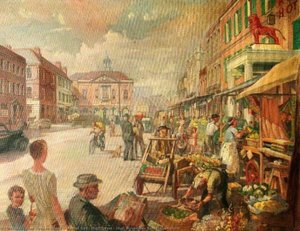
A Life Forged in Resilience: The Story of Victor Elford
Victor Elford (1912-2003) was an artist whose life, deeply marked by the tumultuous events of the 20th century, found its most poignant expression in evocative paintings of biblical figures and landscapes. Born in Plymouth, Devon, his early years were steeped in the natural beauty of the English countryside—a formative influence that would resonate throughout his artistic career. A move to Buckinghamshire at a young age further cemented this connection with nature, as he spent much of his childhood immersed in its tranquility. He initially pursued formal training at an art college in Buckinghamshire, but it was a period of practical experience, nine years working on the interiors of ships for Waring & Gillow—including the opulent liner Queen Mary—that honed his technical skills and eye for detail. This early work demanded precision and a sophisticated understanding of design, qualities that would later distinguish his paintings.
From Ship Interiors to Campfire Charcoals: A Turning Point
The outbreak of World War II dramatically altered the course of Elford’s life. Serving in the Royal Air Force, he found himself stationed in West Africa, a landscape vastly different from the rolling hills of his youth. Tragedy struck when his ship was torpedoed, forcing him and his comrades to abandon it. Stranded in this unfamiliar environment, with limited resources, Elford discovered an unexpected creative outlet: using charred wood from campfires as his drawing medium. This experience proved pivotal. Stripped bare of conventional materials, he was compelled to rely on instinct and resourcefulness, forging a raw, immediate connection between himself and the land. It was in this crucible that the seeds of his unique artistic style began to germinate—a style characterized by its emotional depth and powerful sense of place.
A Prolific Career and Recognition
Upon his return to England, Elford dedicated himself fully to painting, quickly gaining recognition for his evocative works. He became a popular artist, celebrated for his ability to capture the spiritual essence of biblical narratives and the serene beauty of natural landscapes. His paintings often featured traditional scenes rendered with a distinctive blend of Romanesque and Baroque influences—a testament to his broad artistic knowledge and willingness to experiment. In 1969, he received an award for *Burnished Gold*, a captivating depiction of anchored boats at sunset, solidifying his reputation within the art world. Another notable achievement was the high price fetched at Sotheby’s for his painting of Olympic oarsman Jack Beresford at Henley Regatta in 1925, demonstrating the growing demand for his work and its appeal to collectors.
Themes of Faith, Nature, and the Human Spirit
Elford's artistic output centered around two primary themes: biblical figures and landscapes. His depictions of religious subjects were not merely illustrative; they were imbued with a profound sense of faith and humanity. He sought to portray the emotional struggles and spiritual triumphs of his characters, often employing dramatic lighting and expressive brushwork to convey their inner turmoil. Simultaneously, his landscape paintings served as meditations on the beauty and power of nature—a source of solace and inspiration throughout his life. His work frequently featured African female figures, a direct reflection of his wartime experiences and a testament to the enduring impact of that period on his artistic vision. He masterfully blended realism with an almost ethereal quality, creating images that resonated deeply with viewers.
Legacy and Historical Significance
Victor Elford’s paintings offer a compelling glimpse into the life of an artist shaped by both personal tragedy and profound spiritual conviction. His ability to seamlessly integrate diverse artistic influences—from Romanesque simplicity to Baroque grandeur—resulted in a unique style that continues to captivate audiences today. His works are held in public collections, including the Plymouth City Museum and Art Gallery, ensuring his legacy endures for generations to come. He stands as a testament to the power of art to transcend adversity, offering hope and inspiration through evocative depictions of faith, nature, and the enduring human spirit. His paintings remind us that even in the darkest of times, beauty can be found—and created—through resilience, resourcefulness, and unwavering dedication to one’s craft.