Max Liebermann, 1847 – 1935

Max Liebermann: The 100 Most Famous Paintings

Slobodný hodina v Amsterdamskom sieti (1876) is the most famous painting by Max Liebermann. Self Portrait with Kitchen Still LIfe (1873) and Corner of a Dutch Village with Washing Hung up to Dry (1890) are the next two works the world knows best. From the 280 works of Max Liebermann in our catalogue, here are the 100 that collectors and museum visitors look at most, with the year, the museum and the story of each.

Poriadkované podľa nášho skóre popularity, ktoré kombinuje počet vyhľadávaní, návštev a objednávok pre každé dielo. Aktualizované október 2026. Every masterpiece on this page can be ordered as a museum-quality, hand-painted oil reproduction or a fine art print, at the size you choose.

Portrét Max Liebermann
Max Liebermann · 1847 – 1935
Narodený · zomrel
1847 – 1935, Berlín
Pohyb
Impressionist painting
Diela v našom katalógu
280
Najznámejšie
Slobodný hodina v Amsterdamskom sieti (1876)
Najviac diel v
Alte Nationalgalerie

Top 10: Max Liebermann's best-known paintings

Slobodný hodina v Amsterdamskom sieti (1876) od Max Liebermann
1

Slobodný hodina v Amsterdamskom sieti

1876 · Olej na plátne

„Slobodný hodínka v Amsterdamskom siestri“ od Maxa Liebermanna je fascinujúca prváčika, ktorá nádherne zachytáva moment spoločenského života v 19. storočí Amsterdamu. Maľba nás pozýva do vonkajšieho dvora, kde sa ženy a deti stretajú, vytvárajúc scénu bohatú na sociálnu interakciu a kultúrnu dedičnosť. Liebermann, významný predstaviteľ impresionizmu v Nemecku, bol známy svojimi schopnosťami vyjadrovať dušu každodenných okamihov. Jeho diela často podchytávali neobvyklé momenty a vyzývali k zmenu tradičných umeleckých konvencií, usilujúc…

Self Portrait with Kitchen Still LIfe (1873) od Max Liebermann
2

Self Portrait with Kitchen Still LIfe

1873 · Oil On Canvas · Stadtisches Museum, Gelsenkirchen

To stand before Max Liebermann’s Self Portrait with Kitchen Still Life is not merely to observe a painting; it is to step directly into the vibrant, sun-drenched moments of late nineteenth-century Berlin. Created in 1873, this oil on canvas captures more than just a likeness; it encapsulates the artist's profound belief that true beauty resides within the quotidian—the humble objects and simple acts of daily life. Liebermann, a master whose…

Corner of a Dutch Village with Washing Hung up to Dry (1890) od Max Liebermann
3

Corner of a Dutch Village with Washing Hung up to Dry

1890 · Oil On Panel · Harvard Art Museums, Cambridge

The air feels heavy with the scent of damp fabric and the salt of a nearby coast. In this corner of a Dutch village, time seems to pause, caught in the soft, overcast light of 1890. A white building dominates the immediate view, its red door and blue shutters providing the only sharp interruptions to the muted, earthy tones of the village. Above the doorway, laundry hangs from a line,…

Portrait of Richard Strauss (1918) od Max Liebermann
4

Portrait of Richard Strauss

1918 · Oil · Alte Nationalgalerie, Berlín

This 1918 impressionist painting by Max Liebermann presents a black and white portrait of Richard Strauss. The subject is depicted sitting in a chair with his hands clasped together, wearing a suit and tie. He is shown with a mustache and appears to be looking directly at the viewer. To provide depth to the scene, the background features a curtain behind the seated man.

Restaurant De oude Vink (1905) od Max Liebermann
5

Restaurant De oude Vink

1905 · Oil

There is a certain quietude found in the middle of a crowd, a feeling captured here in 1905. In Restaurant De oude Vink, we find ourselves seated among patrons enjoying a meal under the dappled shade of trees. The scene is one of casual, unhurried leisure. Green chairs are scattered around tables, some occupied by figures lost in conversation, others left empty as if the guests have only just stepped…

Self-portrait (1916) od Max Liebermann
6

Self-portrait

1916 · Oil On Canvas · Kunsthalle Bremen, Bremen

An older man sits in a moment of quiet creation, his presence filling the space with a heavy, contemplative dignity. He faces the viewer directly, his gaze steady and unblinking, even as his hands remain occupied with the tools of his trade. In his right hand, he holds a palette, while his left hand brings a brush toward an easel, capturing a fragment of life in real-time. The light enters…

The Preserve Makers (1879) od Max Liebermann
7

The Preserve Makers

1879 · Oil On Canvas · Museum der bildenden Künste, Leipzig

The Preserve Makers is a somber and intimate realist painting that captures a group of women gathered within a dimly lit, rustic interior. The composition is dense and crowded, utilizing a shallow depth of field that brings the figures into the immediate foreground to create a sense of enclosure and shared labor. These women are engaged in the communal task of preparing vegetables, their presence evoking a sense of quiet…

The rest of the Max Liebermann ranking, 11 to 100

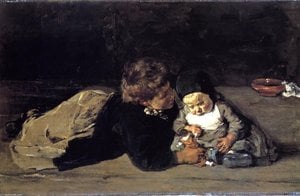
The farrier (1874) od Max Liebermann
#11

The farrier

1874 · Staatliche Kunsthalle Karlsruhe

The farrier (Beim Hufschmied) is an oil on panel painting by Max Liebermann. Created about 1874, the work belongs to the genre art category. It captures a specific…

Commission a hand-painted copy →
Albert Einstein (1879–1955) (1922) od Max Liebermann
#13

Albert Einstein (1879–1955)

1922 · The Royal Society

Max Liebermann's 1922 portrait of Albert Einstein isn’t merely a likeness; it’s a carefully constructed distillation of intellect, contemplation, and the burgeoning promise of a revolutionary mind. Painted…

Order a reproduction →
Portrait Dr. Wilhelm Bode (1909) od Max Liebermann
#15

Portrait Dr. Wilhelm Bode

1909 · Alte Nationalgalerie

In this 1909 oil painting, titled Portrait Dr. Wilhelm Bode, the artist Max Liebermann presents a formal study of a man of significant intellectual standing. The work captures…

Order a reproduction →
The Siblings (1876) od Max Liebermann
#16

The Siblings

1876 · Staatliche Kunstsammlungen

In the quietude of Max Liebermann’s 1876 masterpiece, “The Siblings,” time seems to suspend its forward march, allowing a singular moment of human connection to breathe. This monochrome…

Bring it home →
Swimmers (1875) od Max Liebermann
#17

Swimmers

1875 · Dallas Museum of Art

We are looking at Swimmers, a work by Max Liebermann that captures a quiet, unposed moment of daily life. Also known by the title Swimming boys, this painting…

Commission a hand-painted copy →
Dutch Farmhouse with Woman (1882) od Max Liebermann
#33

Dutch Farmhouse with Woman

1882 · Frye Art Museum

To gaze upon Max Liebermann’s "Dutch Farmhouse with Woman" is to step across the threshold of time and into a moment suspended in golden, gentle light. This 1882…

Bring it home →
A Dutch lacemaker (1881) od Max Liebermann
#55

A Dutch lacemaker

1881 · Hamburger Kunsthalle

The painting titled A Dutch lacemaker (Eine holländische Klöpplerin) is an oil on canvas work by the artist Max Liebermann. This specific piece was executed in 1881. The…

Bring it home →
Gerhart Hauptmann (1912) od Max Liebermann
#56

Gerhart Hauptmann

1912 · Hamburger Kunsthalle

A dignified and somber oil portrait of an elderly man, rendered with expressive, painterly brushstrokes that convey a sense of psychological depth and realism. The composition is a…

Order a reproduction →
Parrot Avenue (1902) od Max Liebermann
#76

Parrot Avenue

1902 · Kunsthalle Bremen

Max Liebermann's "Parrot Avenue," painted in 1902, is a captivating example of Impressionism that transports viewers to a vibrant scene of urban life. Measuring 88 x 72 cm,…

Commission a hand-painted copy →
Table with Pieces of Meat (1877) od Max Liebermann
#77

Table with Pieces of Meat

1877 · Neue Pinakothek

To gaze upon Max Liebermann’s Table with Pieces of Meat is to step directly into the warm, luminous heart of late nineteenth-century Berlin. This oil on canvas from…

Order a reproduction →
The Surgeon, Ferdinand Sauerbruch (1932) od Max Liebermann
#81

The Surgeon, Ferdinand Sauerbruch

1932

In the quiet, contemplative depths of Max Liebermann’s 1932 masterpiece, The Surgeon, Ferdinand Sauerbruch, we are invited into a moment of profound psychological stillness. The painting presents a…

Bring it home →
Jewish Street in Amsterdam (1908) od Max Liebermann
#88

Jewish Street in Amsterdam

1908 · Städel Museum

Jewish Street in Amsterdam is an oil painting by Max Liebermann. Created in 1908, the work depicts a bustling street market scene located in Amsterdam. The subject matter…

Bring it home →

Max Liebermann's paintings by period

The subjects Max Liebermann painted most

The four subjects that return most often among these masterpieces, with the finest example of each.

Where to see Max Liebermann's paintings

8 múzeá, v ktorých sa nachádza najviac obrazov z tejto stránky.

Múzeá Mesto Diela umelca Max Liebermann Obrazy z tohto zoznamu
Alte Nationalgalerie, BerlínAlte Nationalgalerie Berlín 17 Portrait of Richard Strauss, Portrait Study of Emil Rathenau, Portrait Dr. Wilhelm Bode
Hamburger Kunsthalle, HamburgHamburger Kunsthalle Hamburg 8 The Net Menders, The Terrace at the Hotel Louis C. Jacob in Nienstedten on the Elbe, A Dutch lacemaker
Bavarské štátne múzeá výtvarného umenia, MníchBavarské štátne múzeá výtvarného umenia Mních 7 Self portrait in painting smock (Selbstbildnis im Malkittel), Children Bathing in the Sea, Still life of meat (Fleischstillleben)
Wallraf-Richartz-Museum, KölnWallraf-Richartz-Museum Köln 6 Two riders on the beach, Self-portrait, The artist's daughter riding
Staatliche Kunsthalle Karlsruhe, KarlsruheStaatliche Kunsthalle Karlsruhe Karlsruhe 5 The farrier, The Basketweavers (Die Korbflechter), Copy of the Bohémienne after Frans Hals (Young woman)
Stadtisches Museum, GelsenkirchenStadtisches Museum Gelsenkirchen 3 Self Portrait with Kitchen Still LIfe, The Flower Terrace in the Wannsee Garden, Facing Northwest
Kunsthalle Bremen, BremenKunsthalle Bremen Bremen 3 Self-portrait, Parrot Avenue
Staatliche Kunstsammlungen Dresden, DresnoStaatliche Kunstsammlungen Dresden Dresno 3 Alfred von Berger, On the Alster in Hamburg

Max Liebermann through the decades: one masterpiece for each

  1. 1860s
  2. 1870s
    Slobodný hodina v Amsterdamskom sieti (1876) od Max Liebermann
    No. 1 of 100

    Slobodný hodina v Amsterdamskom sieti

    Vek 23 – 32

    „Slobodný hodínka v Amsterdamskom siestri“ od Maxa Liebermanna je fascinujúca prváčika, ktorá nádherne zachytáva moment spoločenského života v 19. storočí Amsterdamu. Maľba nás pozýva do vonkajšieho dvora, kde…

  3. 1880s
  4. 1890s
  5. 1900s
    Restaurant De oude Vink (1905) od Max Liebermann
    No. 5 of 100

    Restaurant De oude Vink

    Vek 53 – 62

    There is a certain quietude found in the middle of a crowd, a feeling captured here in 1905. In Restaurant De oude Vink, we find ourselves seated among…

  6. 1910s
    Portrait of Richard Strauss (1918) od Max Liebermann
    No. 4 of 100

    Portrait of Richard Strauss

    Vek 63 – 72 · Alte Nationalgalerie

    This 1918 impressionist painting by Max Liebermann presents a black and white portrait of Richard Strauss. The subject is depicted sitting in a chair with his hands clasped…

  7. 1920s
    Albert Einstein (1879–1955) (1922) od Max Liebermann
    #13 of 100

    Albert Einstein (1879–1955)

    Vek 73 – 82 · The Royal Society

    Max Liebermann's 1922 portrait of Albert Einstein isn’t merely a likeness; it’s a carefully constructed distillation of intellect, contemplation, and the burgeoning promise of a revolutionary mind. Painted…

  8. 1930s
    The Surgeon Dr. Ferdinand Sauerbruch (1932) od Max Liebermann
    No. 57 of 100

    The Surgeon Dr. Ferdinand Sauerbruch

    Vek 83 – 88 · Hamburger Kunsthalle

    The painting, titled The Surgeon Dr. Ferdinand Sauerbruch, is an oil on canvas created in 1932. The portrait depicts a man wearing glasses and a white coat, seated…

Max Liebermann's paintings: frequently asked questions

What is the most famous Max Liebermann painting?Show the answer

Slobodný hodina v Amsterdamskom sieti (1876). Next come Self Portrait with Kitchen Still LIfe (1873) and Corner of a Dutch Village with Washing Hung up to Dry (1890).

At what age did Max Liebermann paint Slobodný hodina v Amsterdamskom sieti?Show the answer

29 years old: Slobodný hodina v Amsterdamskom sieti dates from 1876 and Max Liebermann was born in 1847.

Which are the 10 most famous Max Liebermann paintings?Show the answer

Slobodný hodina v Amsterdamskom sieti, Self Portrait with Kitchen Still LIfe, Corner of a Dutch Village with Washing Hung up to Dry, Portrait of Richard Strauss, Restaurant De oude Vink, Self-portrait, The Preserve Makers, Schreitender Bauer, KIRCHGANG IN Laren a Alfred von Berger. The ranking above gives the year and the museum of each.

How many paintings by Max Liebermann are there?Show the answer

Our catalogue lists 280 works by Max Liebermann, dated from 1865 to 1932.

Where can I see the most famous Max Liebermann paintings?Show the answer

Most of them are in Alte Nationalgalerie (Berlín), Hamburger Kunsthalle (Hamburg) a Bavarské štátne múzeá výtvarného umenia (Mních). The table above lists the museums one by one.

In which period did Max Liebermann paint the best-known works?Show the answer

In 1910s: 18 of the 100 works on this page date from then, among them Portrait of Richard Strauss.

What is the earliest famous Max Liebermann painting, and the latest?Show the answer

The earliest on this page is Portrait of Felix Liebermann (1865), the latest The Surgeon Dr. Ferdinand Sauerbruch (1932).

What subjects did Max Liebermann paint?Show the answer

Man (10), Portrait (6) a Garden scene (6), among the 100 works on this page.

What did Max Liebermann paint on, and with what?Show the answer

Oil On Canvas: 29 of the 100 works on this page.

Which movement does Max Liebermann's art belong to?Show the answer

Impressionist painting, as the paintings on this page show.

What Max Liebermann paintings does the Alte Nationalgalerie hold?Show the answer

Portrait of Richard Strauss, Portrait Study of Emil Rathenau a Portrait Dr. Wilhelm Bode are among the 9 works on this page held by the Alte Nationalgalerie, Berlín.

Where can I buy a Max Liebermann reproduction?Show the answer

Yes. Every painting on this page can be ordered as a museum-quality, hand-painted oil reproduction or a fine art print, in the size you choose, from the painting's own page.

Max Liebermann: biography

A Life Immersed in Light: The World of Max Liebermann

Max Liebermann, narodený 20. júla 1847 v Berlíne, bol jedným z najvýznamnejších nemeckých impresionistických umelcov. Jeho cesta k tomu, aby sa stal uznávaným majstrom svetla a farieb, však nebola priamočará. Počas svojho detstva bol vedený k tradičným povolaniám – právu a filozofii na Berlínskej univerzite – no jeho pravou vášňou sa ukázala byť maľba. Tento raný intelektuálny výzor však zrejme ovplyvnil jeho pozorovateľské oko a hlboké pochopenie sveta, ktoré sa prejavilo v jeho dielach. Dôležitým posunom bol pobyt v Weimarovi, Paríži a Holandsku – mestách, kde sa stretol s rôznymi umeleckými štýlmi a položil základy pre kariéru, ktorá bola definovaná schopnosťou zachytiť plynulé momenty s precíznym citom k svetlu a farbám. Liebermann nebol len maľoval to, čo videl; prekladal samotnú esenciu skúsenosti na plátno. Jeho skoré diela často zobrazovali každodenný život, najmä prácu pracujúcich tried, s naturalizmom, ktorý vyzýval k zdaneniu romantického estetiky doby. Tieto maľby neboli určené ako sociálny komentár, ale skôr úprimné portréty ľudského života, plné dôstojnosti a rešpektu.

Embracing Impressionism in a German Context

Liebermannova umelecká cesta bola hlboko ovplyvnená jeho stretom s francúzskym realizmom a, čo je dôležité, s burzujúcim impresionistickým pohybom. Duch Édouarda Maneta – jeho odvaha, odmietanie akademických konvencií, zameranie sa na súčasný život – rezonoval s Liebermannom. Avšak nejednoducho napodobňoval to, čo videl v Paríži; namiesto toho adaptoval tieto princípov na nemecké citové prostredie, čím vytvoril impresionizmus jedinečný pre seba. Jeho paleta sa stala jasnejšou, jeho štetcové pohyby slobodnejšie a spontánne, a jeho témy sa presunuli k scénam buržoázneho voľného času a pokojnej kráse jeho záhrady pri jazere Wannsee. Táto záhrada sa stala dlhodobým motívom v jeho dielach, poskytovala útočisko pred rýchlo sa meniacej realite vonkajšieho sveta a ponúkala nekonečné zdroje inšpirácie pre jeho skúmanie svetla a atmosféry. On nebol len maľoval kvetiny a rastliny; zachytával pocit leta, teplo slnka, jemný vietor šúrajúci listami. Okrem krajinky sa Liebermann etabloval ako veľmi žiadaný portrétnik, vytvoril viac ako 200 objednaných diel, vrátane ikonických zobrazení postáv ako Albert Einstein a Paul von Hindenburg. Tieto portréty neboli len náhľad; boli hlboké štúdie charakteru, odhaľujúce vnúšorný život jeho subjektov prostredníctvom jemných gest a výrazov.

A Champion of Artistic Freedom

Liebermann nebol spokojný len s maľovaním; aktívne presadzoval umeleckú inováciu a nezávislosť. Rozpoznal obmedzujúce obmedzenia, ktoré uvalili tradičné umelecké kruhy, stal sa hnacou silou Berlinskej Secesie v roku 1898, kde vedenie tohto avantgardného hnutia trvalo viac ako desať rokov. Secesia vyzývala konvencie, poskytovala platformu pre umelcov pracujúcich mimo akademických hraníc. Tento záväzok k umeleckej slobode sa rozšiel aj za jeho vlastné diela; Liebermann svedomite veril, že umelci by mali byť slobodní na preskúmanie svojej vize bez zásahu politických alebo ideologických tlakov. Jeho zvolenie do Króľovského akadémie umenia v roku 1909 a následné predsedníctvo v roku 1920 boli dôkazmi jeho rastúceho vplyvu v nemeckom umeleckom svete, no tieto postavy priniesli aj stret s narastajúcim prílevom antisemitizmu a nacionalizmu, ktorý nakoniec ohrozil jeho životnú prácu.

Shadows of a Changing World: Legacy and Resilience

Nárast nacionálizmu v 30-tych rokoch ovplyvnil Liebermannove neskoré roky. Jeho princípny postoj proti diskriminácii viedol k jeho odchodu z Króľovského akadémie umenia v roku 1933, statočný čin, ktorý signalizoval jeho odmietanie kompromisu s hodnotami. Napriek rastúcemu prenasledovaniu pokračoval v maľovaní, našiel útočisko a účel v umení. V Berlíne zomrel v februári 1935. Jeho manželka, Martha, tragicky ukončila svoj život v roku 1943, aby sa vyhol deportácii, čo bolo bolestivé prejavom hrôz Holocaustu. Počas mnohých rokov po vojne bol Liebermannov umelecký dielom častečne prehliadaný, no v posledných desaťročiach došlo k novému uznaniu jeho prínosov nemeckému impresionizmu a moderné histórii umenia. Dnes je spomínaný nie len ako vynikajúci maľiar, ale aj ako odvážny obhajca umeleckého vyjadrenia a symbol odporu proti totalitám. Jeho diela stále fascinujú divákov svojou luminézno krásou, hlbokými pozorovaniami a trvalou ľudskosťou.

Key Achievements & Lasting Influence

  • "The Twelve-Year-Old Jesus in the Temple": Toto skoré dielo vyvolalo značnú debatu kvôli nekonvenčnému zobrazovaniu Ježiša ako Semita, čo podkopával tradičné náboženské ikonografie.
  • Leadership of the Berlin Secession: Jeho kľúčová úloha v vedení tohto avantgardného hnutia vyzývala umelecké normy a otvárala cestu pre moderné umenie v Nemecku.
  • Presidentship of the Prussian Academy of Arts: Významná uznanie jeho umeleckej hodnoty, aj keď nakoniec kompromitované s rastom nacionálizmu.
  • Masterful Portraiture: Jeho schopnosť zachytiť esenciu svojich subjektov v viac ako 200 objednaných portrétoch zabezpečil jeho povstanie ako vedúci portrétnik.
  • Influence on German Impressionism: Liebermann úspešne preložil princípy impresionizmu do jedinečného nemeckého kontextu, čo inšpirovalo generácie umelcov.

Všetky 280 diela od Max Liebermann →