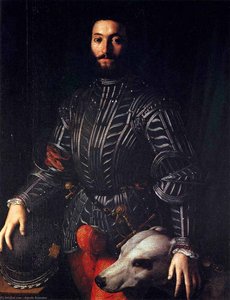
Agnolo Bronzino, 1503 – 1572

Obrazy: 100 najznámejších diel umelca Agnolo Bronzino, zoradených podľa popularity

Najznámejším obrazom umelca Agnolo Bronzino je Venícia, Čoho a Čas (Allegória Lásky) (1540), ktorý sa nachádza v múzeu National Gallery v meste Londýn. Spolu s Portrét Eleonory da Toledo (1555) a Venus, Cupido and Satyr tak dopĺňa trojicu diel, ktoré pozná každý. Náš katalóg obsahuje 189 diel od umelca Agnolo Bronzino; nižšie uvádzených 100 je tých, na ktoré sa svet pozerá najčastejšie, pričom pri každom uvádzame rok vytvorenia, múzeu, v ktorom sa nachádza, a dôvod jeho významu.

Poriadkované podľa nášho skóre popularity, ktoré kombinuje počet vyhľadávaní, návštev a objednávok pre každé dielo. Aktualizované október 2026. Každé majstrovské dielo na tejto stránke si môžete objednať ako ručne maľovanú olejobraskovú reprodukciu múzeálnej kvality alebo ako umeleckú tlač, v rozmeroch podľa vašej voľby.

Portrét Agnolo Bronzino
Agnolo Bronzino · 1503 – 1572
Narodený · zomrel
1503 – 1572, Florencia
Pohyb
Manierizmus
Diela v našom katalógu
189
Najznámejšie
Venícia, Čoho a Čas (Allegória Lásky) (1540)
Najviac diel v
Galleria degli Uffizi

10 najznámejších obrazov od Agnolo Bronzino

Venícia, Čoho a Čas (Allegória Lásky) (1540) od Agnolo Bronzino
1

Venícia, Čoho a Čas (Allegória Lásky)

1540 · Olej na plátne · National Gallery, Londýn

Agnolo Bronzinoho obraz “Venus, Cupid a Čas – Alegória Lásky” je fascinujúcou cestou do srdca 16. storočia. Tento dielo, vytvorené v roku 1540, nie je len krásny obraz; je to komplexná alegória plná symboliky, ktorá vyjadruje hlboké myšlienky o láske, čase a ľudskej poveternosti. Bronzino, majster florentského Mannerizmu, dokázal spojiť elegantnú gráciu s prejavom emócie, čím vytvoril dielo, ktoré dodnes očarúva divákov svojou subtilnou krásou a hlbokým významom.

Portrét Eleonory da Toledo (1555) od Agnolo Bronzino
2

Portrét Eleonory da Toledo

1555 · Olej na paneli

Hľadieť na Portrét Eleonory da Toledo od Agnola Bronzina znamená vstúpiť priamo do vzácnej a vznešenej atmosféry vysokej renesancie florentskej. Tento obraz, vytvorený v roku 1555, presahuje rámec obyčajného podobenstva; je to starostlivo vybudovaný monument statusu, moci a nesmiernej rafinovanosti. Subjekt, Eleonora da Toledo, vyžaruje takmer hmatateľnú auru aristokratickej dôstojnosti. Bronzino ju zachytáva nielen ako ženu, ale ako symbol vplyvu rodu Medici – postavu, ktorej samotný postoj hovorí o bohatstve…

Venus, Cupido and Satyr od Agnolo Bronzino
3

Venus, Cupido and Satyr

Oil

A pale, reclining figure occupies the center of the frame, her skin possessing the cool, polished sheen of marble. This is Venus, the goddess of love, draped in a way that emphasizes the tension between soft flesh and the hard edges of the composition. Beside her, Cupid clings to her form, a small, fleshy presence that embodies the sudden, sharp sting of passion. Their limbs are elongated, stretching toward one…

Portrait of Andrea Doria as Neptune (1550) od Agnolo Bronzino
4

Portrait of Andrea Doria as Neptune

1550 · Oil On Canvas · Pinacoteca di Brera, Miláno

In the grand theater of the Italian Mannerist period, few images command the eye with such authoritative grace as Agnolo Bronzino’s Portrait of Andrea Doria as Neptune. This is not merely a portrait of a man, but a profound exercise in political allegory and divine projection. The subject, the legendary Genoese admiral Andrea Doria, is stripped of the heavy silks and velvet doublets typical of sixteenth-century aristocratic portraiture. Instead, Bronzino…

St. John the Baptist (1542) od Agnolo Bronzino
5

St. John the Baptist

1542 · Oil On Panel · J. Paul Getty Museum, Los Angeles

The figure of St. John the Baptist emerges from the shadows, rendered with a muscular intensity by the Florentine master Bronzino. This depiction captures the patron saint of Florence in a moment of profound spiritual tension. Created about 1542 - 1545, the work possesses a striking verticality that speaks to its original purpose. It does not exist in isolation but remains a fragment of a larger sacred narrative, having once…

Deposition (1565) od Agnolo Bronzino
6

Deposition

1565 · Oil On Canvas · Galleria dell'Accademia di Firenze, Florencia

“Deposition,” painted in 1565 by the Florentine master Agnolo Bronzino, is not merely a religious scene; it's a meticulously crafted tableau of restrained emotion and profound psychological depth. Commissioned for the Observant Monastery in Cosmopoli, this work transcends simple narrative to become a meditation on grief, loss, and the delicate balance between earthly sorrow and divine grace. Bronzino, renowned for his “reserved elegance,” achieved this through an almost unnervingly controlled…

Portrait of a Young Man (1555) od Agnolo Bronzino
7

Portrait of a Young Man

1555 · Oil On Canvas · Nelson-Atkins Museum of Art, Kansas City

To gaze upon this portrait is to step directly into the rarefied atmosphere of mid-sixteenth-century Florence, a world governed by the subtle power plays and exquisite tastes of the Medici court. Agnolo Bronzino, the master chronicler of such elite circles, captured not merely a likeness, but an entire social stratum. The sitter, though anonymous to us today, embodies the controlled elegance expected of those who moved within the gilded cage…

Cosimo de Medici in Armour (1545) od Agnolo Bronzino
8

Cosimo de Medici in Armour

1545 · Oil On Panel · Thyssen-Bornemisza Museum, Madrid

The gaze of the Grand Duke of Tuscany, Cosimo I de' Medici, meets the viewer through the work titled Cosimo de Medici in Armour. Created by the Florentine artist Bronzino, this portrait captures the ruler in a moment of poised authority. The image emerges from the mid-16th century, dated about 1545, and presents a commanding presence through its structured composition. It exists as a significant version of the painting held…

Portrait of Cosimo I de' Medici as Orpheus (1537) od Agnolo Bronzino
9

Portrait of Cosimo I de' Medici as Orpheus

1537 · Oil On Panel · Philadelphia Museum of Art, Philadelphia

In this portrait, we encounter Cosimo I de' Medici, not merely as a ruler, but as the mythological musician Orpheus. He is positioned in a three-quarter view from behind, turning his gaze back toward us with a sense of psychological alertness. His body, rendered with a polished, marble-like texture, possesses an idealized beauty that speaks to the High Mannerist style. A single splash of crimson red drapery provides a sharp…

Portrait of Eleonora of Toledo and Her Son, Francesco de'Medici (1549) od Agnolo Bronzino
10

Portrait of Eleonora of Toledo and Her Son, Francesco de'Medici

1549 · Oil On Panel · Cincinnati Art Museum, Cincinnati

In this vertical half-length portrait, we encounter the Duchess of Florence, Eleonora of Toledo, and her son, Francesco de' Medici. The composition is defined by a controlled, almost sculptural stillness. Eleonora stands slightly behind the young boy, her hand resting upon his shoulder in a gesture that is both protective and formal. There is a certain aristocratic detachment in their expressions, a cool composure that characterizes the Florentine Mannerist style.…

Agnolo Bronzino, obrazy od 11 do 100

Eleonora di Toledo (1560) od Agnolo Bronzino
#12

Eleonora di Toledo

1560 · National Gallery of Art

A woman stands in a red dress, her hand resting upon her hip with a quiet, unyielding confidence. The fabric of her gown is a heavy, structured thing,…

Získajte si ho domov →
Venus cupid time od Agnolo Bronzino
#13

Venus cupid time

National Gallery

The painting depicts a bedroom setting centered on two naked figures, Venus and Cupid. One woman lies down while another stands over her; they are holding hands and…

Získajte si ho domov →
Pierantonio Bandini (1555) od Agnolo Bronzino
#14

Pierantonio Bandini

1555 · Národná galéria Kanady

Agnolo Bronzino’s “Portrait of Pierantonio Bandini,” painted circa 1550-1555, is not merely a likeness; it's an exquisitely crafted distillation of Renaissance ideals – a study in dignified composure…

Objednajte si ručne maľovanú kópiu →
Holy Family (1540) od Agnolo Bronzino
#16

Holy Family

1540 · Galleria degli Uffizi

Agnolo Bronzino's "Holy Family," painted around 1540, isn’t merely a depiction of a biblical scene; it’s a carefully constructed tableau of serenity and profound familial love. Emerging from…

Objednajte si ručne maľovanú kópiu →
Eleonora di Toledo (1543) od Agnolo Bronzino
#17

Eleonora di Toledo

1543 · Národní galerie Praha

In the quiet corridors of the Národní Galerie in Prague, there exists a window into the opulent heart of the sixteenth century. Agnolo Bronzino’s Eleonora di Toledo is…

Objednať reprodukciu →
Ugolino Martelli (1535) od Agnolo Bronzino
#20

Ugolino Martelli

1535

To stand before Agnolo Bronzino's Ugolino Martelli is to encounter the very essence of High Renaissance self-possession. Painted in 1535, this portrait transcends a mere likeness; it is…

Získajte si ho domov →
Pope Leo X (1555) od Agnolo Bronzino
#22

Pope Leo X

1555 · Galleria degli Uffizi

To gaze upon this portrait of Pope Leo X is to encounter a moment suspended in the opulent grandeur of the Italian Renaissance. Agnolo Bronzino, master chronicler of…

Získajte si ho domov →
Saint Sebastian (1533) od Agnolo Bronzino
#23

Saint Sebastian

1533 · The Salvador Dalí Museum

To stand before Agnolo Bronzino's depiction of Saint Sebastian is to encounter an embodiment of refined restraint—a hallmark of the High Renaissance transitioning into the sophisticated drama of…

Objednajte si ručne maľovanú kópiu →
Venus, Cupid and Jealousy (1550) od Agnolo Bronzino
#24

Venus, Cupid and Jealousy

1550 · Szépművészeti Múzeum

The world of Renaissance Florence was a crucible of artistic innovation, yet within its vibrant heart resided a figure renowned for his profound restraint – Agnolo di Cosimo,…

Získajte si ho domov →
Venus, Cupid and Time (detail) (1540) od Agnolo Bronzino
#26

Venus, Cupid and Time (detail)

1540 · National Gallery

Agnolo Bronzino's "Venus, Cupid, and Time," painted in 1540, isn’t merely a depiction of mythological figures; it’s an exquisitely crafted allegory—a visual poem brimming with ambiguity and profound…

Získajte si ho domov →
Don Garcia de' Medici (1550) od Agnolo Bronzino
#27

Don Garcia de' Medici

1550 · Museo del Prado

To gaze upon Agnolo Bronzino’s portrait, Don Garcia de' Medici, is to encounter an exquisite moment suspended in the amber glow of the Italian Renaissance. This depiction of…

Získajte si ho domov →
Miracle of the Brazen Serpent (1542) od Agnolo Bronzino
#30

Miracle of the Brazen Serpent

1542 · Palazzo Vecchio

In the heart of Florence’s Palazzo Vecchio, tucked within the sacred stillness of the Cappella di Eleonora, resides one of the most arresting spectacles of the Mannerist era:…

Portrait of a Young Man (1540) od Agnolo Bronzino
#32

Portrait of a Young Man

1540 · Metropolitné múzeum umenia

Agnolo Bronzino's “Portrait of a Young Man,” painted circa 1540, stands as an emblem of Florentine Mannerism—a stylistic movement that prioritized elegance and restraint over the exuberant naturalism…

Objednať reprodukciu →
Martyrdom of St Lawrence (1569) od Agnolo Bronzino
#33

Martyrdom of St Lawrence

1569 · Bazilika svätého Vavrinca v Ríme

Agnolo Bronzino’s “Martyrdom of St. Lawrence,” painted in 1569, isn't merely a depiction of a historical event; it’s a profound meditation on faith, suffering, and the enduring spirit…

Galatea and Pygmalion (1530) od Agnolo Bronzino
#38

Galatea and Pygmalion

1530

A sculptor’s hands once held a dream of stone. In this work from c.1530, the boundary between the inanimate and the living dissolves under a soft, transformative light.…

Získajte si ho domov →
Portrait of Cosimo I de' Medici (1545) od Agnolo Bronzino
#40

Portrait of Cosimo I de' Medici

1545 · Galleria degli Uffizi

A Portrait of Regal Dignity: Agnolo Bronzino’s Emblematic Representation of Cosimo I Agnolo di Cosimo, universally recognized as Bronzino, stands as a cornerstone of Mannerist art—a movement that…

Získajte si ho domov →
Costanza da Sommaia (1540) od Agnolo Bronzino
#41

Costanza da Sommaia

1540 · Detroit Institute of Arts

A young woman emerges from a deep, blue shadow, her presence defined by a stillness that feels almost sculptural. She is turned in a three-quarter view, her skin…

Objednať reprodukciu →
Crossing of the Red Sea (1542) od Agnolo Bronzino
#42

Crossing of the Red Sea

1542 · Palazzo Vecchio

The fresco titled Crossing of the Red Sea was executed by the Florentine artist Agnolo Bronzino. This work, completed around 1542, utilizes the fresco technique to depict a…

Portrait of a Lady in Red (detail) (1530) od Agnolo Bronzino
#44

Portrait of a Lady in Red (detail)

1530 · Städelsche Kunstinstitut Und Städtische Galerie

The year is 1530, and Florence pulses with the vibrant energy of the High Renaissance. Amidst this flourishing artistic landscape emerges Agnolo Bronzino – not merely a painter,…

Získajte si ho domov →
Portrait of a boy (1540) od Agnolo Bronzino
#45

Portrait of a boy

1540 · Bode Museum

This painting, titled Portrait of a boy, is a work by the Florentine artist Bronzino. It belongs to the genre of portraiture, capturing a singular youthful figure with…

Získajte si ho domov →
Don Giovanni de’Medici (1551) od Agnolo Bronzino
#49

Don Giovanni de’Medici

1551 · Toledo Museum of Art

This portrait of Don Giovanni de’Medici offers a quiet glimpse into the lineage of the Medici family. Executed by the Florentine master Bronzino, the work captures a young…

Získajte si ho domov →
View of the Chapel of Eleonora da Toledo (1440) od Agnolo Bronzino
#64

View of the Chapel of Eleonora da Toledo

1440 · Palazzo Vecchio

The painting presents a view of a chapel featuring a fresco that depicts the life of Christ. Within this sacred setting, the scene is populated by numerous figures,…

Portrait of the dwarf Nano Morgantе (Back) (1552) od Agnolo Bronzino
#66

Portrait of the dwarf Nano Morgantе (Back)

1552

The work before us is the Portrait of the dwarf Nano Morgante (Back), a significant oil on canvas painting executed by the Italian Mannerist artist Bronzino. Created in…

Descent of Christ Into Limbo (1552) od Agnolo Bronzino
#67

Descent of Christ Into Limbo

1552

The air feels heavy and charged with a sudden, restless energy as Christ descends into the depths of Limbo. He moves through a crowded, labyrinthine arrangement of limbs…

Portrait of a Woman (1550) od Agnolo Bronzino
#68

Portrait of a Woman

1550 · Cleveland Museum of Art

A pale, luminous face emerges from a lavender-grey void. The subject looks forward with a steady, calm gaze that refuses to yield to the viewer. Her skin possesses…

Objednať reprodukciu →
Moses strikes water from the wall rocks (1544) od Agnolo Bronzino
#75

Moses strikes water from the wall rocks

1544

The air feels heavy with anticipation as Moses raises his staff against the rugged, unyielding face of the rock. In this mid-sixteenth century fresco, a sudden, life-giving force…

Altarpiece (1540) od Agnolo Bronzino
#76

Altarpiece

1540 · Palazzo Vecchio

The year is 1540, and Florence pulses with the ambition of the Medici court. Within the private chapel of Eleonora di Toledo, Duchess of Florence, a masterpiece emerges…

Získajte si ho domov →
Venus, Cupid and Envy (1548) od Agnolo Bronzino
#78

Venus, Cupid and Envy

1548 · Szépművészeti Múzeum

Painted in 1548 by the Florentine master Agnolo Bronzino, *Venus, Cupid and Envy* is a captivating embodiment of Mannerist aesthetics – a style characterized by its deliberate artifice,…

Objednať reprodukciu →
Portrait of Pope Clement VII (1564) od Agnolo Bronzino
#81

Portrait of Pope Clement VII

1564 · Galleria degli Uffizi

A Portrait of Dignified Majesty: Agnolo Bronzino’s Pope Clement VII The Portrait of Pope Clement VII, executed by Agnolo Bronzino in 1564, stands as a cornerstone of Mannerist…

Získajte si ho domov →
untitled (4490) (1532) od Agnolo Bronzino
#82

untitled (4490)

1532

In the quiet, commanding presence of Agnolo Bronzino’s "untitled (4490)", we are transported back to the height of the Italian Renaissance, a period where portraiture served as both…

Objednať reprodukciu →
The Holy Family (1545) od Agnolo Bronzino
#83

The Holy Family

1545

The Holy Family by Agnolo Bronzino is a renowned oil painting that showcases the artist's skill in capturing dramatic scenes with incredible detail. Created in 1545, this tempera…

Získajte si ho domov →
Lucrezia Panciatichi (1540) od Agnolo Bronzino
#85

Lucrezia Panciatichi

1540

In the grand tapestry of the Italian Renaissance, few portraits capture the poised sophistication of the Mannerist era as exquisitely as Agnolo Bronzino’s Lucrezia Panciatichi. Painted around 1540,…

Objednať reprodukciu →
A Young Woman and Her Little Boy (1540) od Agnolo Bronzino
#87

A Young Woman and Her Little Boy

1540 · National Gallery of Art

In the grand tradition of the Italian Renaissance, few works capture the intersection of maternal tenderness and aristocratic poise as exquisitely as Agnolo Bronzino’s A Young Woman and…

Objednať reprodukciu →

Obrazy umelca Agnolo Bronzino podľa obdobia

Témy, ktoré Agnolo Bronzino mal najčastejšie na obrazoch

Štyri témy, ktoré sa v týchto majstrovskách najčastejšie vyskytujú, spolu s ich najkrajšími príkladmi.

Kde uvidieť obrazy umelca Agnolo Bronzino

8 múzeá, v ktorých sa nachádza najviac obrazov z tejto stránky.

Múzeá Mesto Diela umelca Agnolo Bronzino Obrazy z tohto zoznamu
Galleria degli Uffizi, FlorenciaGalleria degli Uffizi Florencia 18 Holy Family, Portrait of Lucrezia Panciatichi, Pope Leo X
Palazzo Vecchio, FlorenciaPalazzo Vecchio Florencia 11 Miracle of the Brazen Serpent, The Miracle of the Spring, Gathering of the Manna
Szépművészeti Múzeum, BudapešťSzépművészeti Múzeum Budapešť 8 Venus, Cupid and Jealousy, Adoration of the Shepherds, Venus, Cupid and Envy
National Gallery, LondýnNational Gallery Londýn 5 Venícia, Čoho a Čas (Allegória Lásky), Venus cupid time, Venus, Cupid and Time (detail)
National Gallery of Art, WashingtonNational Gallery of Art Washington 4 Eleonora di Toledo, Portrait of Eleanora di Toledo, A Young Woman and Her Little Boy
Detroit Institute of Arts, DetroitDetroit Institute of Arts Detroit 2 Costanza da Sommaia, Madonna and Child with Saint John the Baptist
Walters Art Museum, BaltimoreWalters Art Museum Baltimore 2 The Feast Given by Joseph for His Brothers, Portrait of a Baby Boy
Royal Collection, LondýnRoyal Collection Londýn 2 Portrait of a Lady in Green, Portrait of a Lady in Green

Najznámejší obraz každého desaťročia od Agnolo Bronzino

  1. 1520s
    Virgin and Child with the Young Saint John the Baptist (1528) od Agnolo Bronzino
    #55 z 100

    Virgin and Child with the Young Saint John the Baptist

    Vek 17 – 26 · Art Institute of Chicago

    In this Mannerist oil painting, three figures occupy a vertical, tightly cropped arrangement against a dark, near-black background. The Virgin Mary is positioned centrally, her form defined by…

  2. 1530s
    Portrait of Cosimo I de' Medici as Orpheus (1537) od Agnolo Bronzino
    Rank 9 / 100

    Portrait of Cosimo I de' Medici as Orpheus

    Vek 27 – 36 · Philadelphia Museum of Art

    In this portrait, we encounter Cosimo I de' Medici, not merely as a ruler, but as the mythological musician Orpheus. He is positioned in a three-quarter view from…

  3. 1540s
    Venícia, Čoho a Čas (Allegória Lásky) (1540) od Agnolo Bronzino
    #1 z 100

    Venícia, Čoho a Čas (Allegória Lásky)

    Vek 37 – 46 · National Gallery

    Agnolo Bronzinoho obraz “Venus, Cupid a Čas – Alegória Lásky” je fascinujúcou cestou do srdca 16. storočia. Tento dielo, vytvorené v roku 1540, nie je len krásny obraz;…

  4. 1550s
    Portrét Eleonory da Toledo (1555) od Agnolo Bronzino
    2. z 100

    Portrét Eleonory da Toledo

    Vek 47 – 56

    Hľadieť na Portrét Eleonory da Toledo od Agnola Bronzina znamená vstúpiť priamo do vzácnej a vznešenej atmosféry vysokej renesancie florentskej. Tento obraz, vytvorený v roku 1555, presahuje rámec…

  5. 1560s
    Deposition (1565) od Agnolo Bronzino
    #6 z 100

    Deposition

    Vek 57 – 66 · Galleria dell'Accademia di Firenze

    “Deposition,” painted in 1565 by the Florentine master Agnolo Bronzino, is not merely a religious scene; it's a meticulously crafted tableau of restrained emotion and profound psychological depth.…

Otázky k obrazom umelca Agnolo Bronzino

Ktorý obraz je najznámejším dielom umelca Agnolo Bronzino?Zobraziť odpoveď

Venícia, Čoho a Čas (Allegória Lásky) (1540), National Gallery, Londýn. Nasledujú Portrét Eleonory da Toledo (1555) a Venus, Cupido and Satyr.

Koľko rokov mal/a Agnolo Bronzino, keď bol/a vytvorená skladba Venícia, Čoho a Čas (Allegória Lásky)?Zobraziť odpoveď

37 rokov: Venícia, Čoho a Čas (Allegória Lásky) vzniklo v roku 1540 a Agnolo Bronzino sa narodil/a v roku 1503.

Akých je top 10 obrazov umelca Agnolo Bronzino?Zobraziť odpoveď

Venícia, Čoho a Čas (Allegória Lásky), Portrét Eleonory da Toledo, Venus, Cupido and Satyr, Portrait of Andrea Doria as Neptune, St. John the Baptist, Deposition, Portrait of a Young Man, Cosimo de Medici in Armour, Portrait of Cosimo I de' Medici as Orpheus a Portrait of Eleonora of Toledo and Her Son, Francesco de'Medici. Vyššie uvedené hodnotenie uvádza rok a múzeu každého z nich.

Koľko obrazov vytvoril/a Agnolo Bronzino?Zobraziť odpoveď

Náš katalóg obsahuje 189 diel umelca Agnolo Bronzino z perioda od 1525 do 1569.

Kde sa nachádzajú najznámejšie obrazy umelca Agnolo Bronzino?Zobraziť odpoveď

Väčšina z nich sa nachádza v Galleria degli Uffizi (Florencia), Palazzo Vecchio (Florencia) a Szépművészeti Múzeum (Budapešť). Tabuľka vyššie uvádza jednotlivé múzeá.

Kedy Agnolo Bronzino vytvoril svoje najznámejšie diela?Zobraziť odpoveď

V období 1540s: 36 z 100 diel na tejto stránke pochádza z tohto obdobia, pričom medzi nimi je Venícia, Čoho a Čas (Allegória Lásky).

Aké sú najskoršie a najneskoršie slávne obrazy umelca Agnolo Bronzino?Zobraziť odpoveď

Najstaršie dielo na tejto stránke pochádza z St Matthew (1525), najnovšie z Martyrdom of St Lawrence (1569).

Čo najčastejšie mal Agnolo Bronzino?Zobraziť odpoveď

Renaissance (35), Woman (16) a Portrait (16), z celkového počtu 100 diel na tejto stránke.

Akú techniku používal(a) Agnolo Bronzino najčastejšie?Zobraziť odpoveď

Oil On Panel: 33 z 100 diel na tejto stránke.

Do ktorého umeleckého smeru patrí Agnolo Bronzino?Zobraziť odpoveď

Manierizmus, ako to dokazujú obrazy na tejto stránke.

Aké obrazy od Agnolo Bronzino môžem vidieť v Galleria degli Uffizi?Zobraziť odpoveď

Holy Family, Portrait of Lucrezia Panciatichi a Pope Leo X sa nachádzajú medzi 8 dielami na tejto stránke, ktoré vlastní Galleria degli Uffizi, Florencia.

Môžem si kúpiť reprodukciu obrazu od Agnolo Bronzino?Zobraziť odpoveď

Áno. Každý obraz na tejto stránke si môžete objednať ako ručne maľovanú olejobraskovú reprodukciu múzeálnej kvality alebo ako umeleckú tlač, v požadovanom rozмере, priamo na stránke daného obrazu.

O umelcovite Agnolo Bronzino

Agnolo Bronzino: The Sculptor's Touch in Florentine Mannerism

Agnolo di Cosimo, known to history as Bronzino, emerged from the vibrant artistic landscape of Renaissance Florence in 1503, a period already brimming with genius. Born the son of a butcher, his path diverged sharply from familial trade, guided instead by an innate talent that would see him become one of the most sought-after portraitists of his era and a defining figure of Mannerism. His early training began with Raffaellino del Garbo, but it was under the tutelage of Jacopo da Pontormo that Bronzino’s artistic sensibilities truly took shape. While absorbing Pontormo's innovative style—characterized by expressive emotion and dynamic movement—he ultimately forged his own distinct voice—one characterized by a cool composure and refined detail markedly different from his teacher’s often emotionally charged works. This early period was also influenced by studies with Andrea del Sarto, exposing him to the legacies of Michelangelo and Leonardo da Vinci, foundational influences that would subtly permeate his mature style. The young Bronzino quickly demonstrated an aptitude for capturing not just physical likeness but a certain psychological depth, even in his earliest commissions.

Early Influences and Artistic Formation

Bronzino’s formative years were marked by exposure to the artistic currents of Florence under Pontormo and Sarto. Pontormo's dramatic use of color and distorted perspective—particularly evident in *Joseph with Jacob in Egypt*—challenged conventional aesthetic norms, pushing boundaries of representation and fostering experimentation. Bronzino absorbed these stylistic innovations, adapting them to his own distinctive approach. Simultaneously, the monumental sculptures of Michelangelo instilled in him a profound appreciation for anatomical precision and sculptural form—a fascination that would inform his later portraits and contribute to their remarkable realism. Leonardo da Vinci’s meticulous observation of nature and mastery of sfumato—the subtle blending of tones to create atmospheric depth—served as another crucial inspiration, shaping Bronzino's technique and elevating the expressive potential of his paintings. These influences coalesced into a synthesis that would define Bronzino’s artistic vision throughout his career.

The Medici Patronage and Florentine Court Style

Bronzino ascended to prominence thanks to the unwavering patronage of Cosimo I de’ Medici, Duke of Tuscany. Recognizing Bronzino's exceptional talent, Cosimo appointed him as the official court painter—a position he held until his death in 1572—solidifying his reputation as Florence’s foremost artistic figure. During this period, Bronzino produced a prolific output of portraits depicting members of the Medici family and their entourage—works that epitomized Florentine court style: characterized by aristocratic aloofness, polished elegance, and an unwavering commitment to formal conventions. These paintings weren't merely decorative; they functioned as powerful statements of dynastic authority and served as visual emblems of Medici prestige. The meticulous attention to detail—the sumptuous fabrics, the glittering jewelry, the carefully crafted poses—reflected Cosimo’s desire to project an image of grandeur and sophistication. Bronzino skillfully captured not only physical likeness but also psychological nuance—revealing glimpses of inner character through subtle expressions and gestures—establishing himself as a master of portraiture who elevated the genre to new heights.

A Mannerist Vision: Sculpture's Influence on Painting

Bronzino’s artistic style is fundamentally rooted in Mannerism—a movement that emerged in Florence during the mid-16th century as a reaction against the idealized beauty and harmonious balance championed by the High Renaissance. Unlike his predecessors, Bronzino rejected naturalistic representation in favor of stylized forms, exaggerated proportions, and an emotionally restrained aesthetic. He embraced elongated figures, flattened perspectives, and dramatic lighting—techniques that prioritized intellectual contemplation over sensory pleasure. This stylistic choice was profoundly influenced by Michelangelo’s sculptures—particularly *David*—which demonstrated a mastery of anatomical precision combined with expressive dynamism. Bronzino internalized Michelangelo's sculptural ethos, applying it to his paintings—resulting in works that possessed an almost sculptural quality—characterized by smooth surfaces and refined modeling. His portraits are devoid of sentimental emotion; instead, they convey an aura of dignified composure—reflecting Cosimo’s desire for a visual language that projected intellectual sophistication rather than emotional vulnerability.

Legacy and Enduring Influence

Agnolo Bronzino's contribution to Florentine art history is undeniable. He established himself as the premier portrait artist in Florence, shaping the aesthetic standards of his time and influencing generations of painters who followed him. His distinctive Mannerist style—characterized by cool composure, refined detail, and sculptural form—became a hallmark of aristocratic representation throughout Europe. Bronzino’s meticulous technique—particularly his mastery of sfumato—elevated the expressive potential of painting—demonstrating that art could transcend mere imitation of nature to achieve profound psychological insight. His enduring legacy resides not only in his iconic portraits but also in his pioneering role as a sculptor and his unwavering devotion to artistic excellence—solidifying his place among the greatest artists of the Renaissance. He passed away in Florence in 1572, leaving behind a body of work that continues to inspire admiration and scholarly debate—a testament to Bronzino’s genius and his indelible mark on art history.

Všetky 189 diela od Agnolo Bronzino →