The Visionary Spirit of Thomas Rose Miles
In the twilight of the Victorian era, a period defined by both rigid academic tradition and the burgeoning whispers of modernism, the work of Thomas Rose Miles emerged as a profound bridge between two worlds. Born in 1869 in the serene landscape of Évreux, Normandy, Miles carried within him a unique dual heritage—the classical sensibilities of his English noble roots and the atmospheric, emotive spirit of France. His artistic journey was not merely one of technical mastery but an exploration of the human condition, captured through the tactile depth of sculpture and the dramatic luminosity of maritime painting. To look upon his work is to witness a soul caught between the stability of the past and the turbulent, ever-changing currents of the future.
The foundation of Miles’s creative identity was irrevocably shaped by his encounter with one of history's most formidable masters: Auguste Rodin. Under Rodin’s tutelage, Miles learned that true sculpture does not merely represent form, but breathes life into stone and bronze through the manipulation of light and shadow. This mentorship instilled in him a lifelong commitment to naturalism and an uncanny ability to imbue his subjects with raw, palpable emotion. While his sculptural training grounded him in the principles of realism, it also gifted him the expressive freedom necessary to embrace the more fluid, impressionistic textures that would later define much of his painted oeuvre.
Maritime Drama and the Romantic Sublime
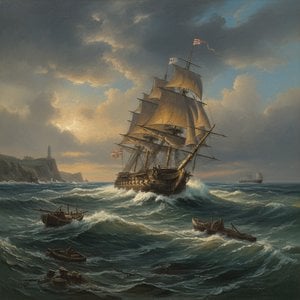
While his hands were skilled in the permanence of sculpture, Miles’s canvases often captured the ephemeral and the tempestuous. He possessed a particular fascination with the sea—a realm that embodies the sublime, where beauty and terror exist in a delicate, breathless balance. His maritime works, such as 'Dover Lifeboat- The Rescue' and 'Northward, For The Herring-shoals', serve as dramatic windows into the perils of the deep. In these pieces, one can sense the heavy impasto texture and the rhythmic movement of turbulent waves, reflecting a style that marries Romantic idealism with an almost visceral realism.
In his paintings, the ocean is never merely a backdrop; it is a protagonist. Through his use of light and color, Miles captured the spray of salt, the weight of a storm-tossed hull, and the desperate bravery of those navigating the unknown. This preoccupation with the sea allowed him to explore themes of human resilience and the overwhelming power of nature, echoing the broader artistic movements of his time that sought to find spiritual significance within the natural world. His ability to translate the chaotic energy of a maritime rescue into a structured, emotive composition remains one of his most enduring technical achievements.
A Legacy Preserved in Normandy
The historical significance of Thomas Rose Miles extends far beyond his individual creations; it resides in his profound dedication to the preservation of European art heritage. His ambitious undertaking—the establishment of the Musée Thomas-Henry in Évreux—stands as a testament to his belief that art is a collective legacy meant to be shared and cherished. Through this collection, Miles curated an exquisite dialogue between different eras, bringing together works by masters such as Jean-François Millet and various Italian Renaissance artists.
His contribution to the art world was characterized by a rare synthesis of creation and curation. By assembling a repository that celebrates both the spiritual intensity of the Renaissance and the grounded, rural realism of the 19th century, he ensured that the artistic lineage he so deeply respected would continue to inspire future generations. Though his life was tragically short, ending in 1910, the echoes of his vision remain vibrant within the halls of the Musée Thomas-Henry, where his passion for beauty, emotion, and the enduring power of the human spirit continues to resonate.
Otázky a odpovede
Ako je kariéra umelca Thomas Rose Miles rozdelená do období?
Kariéra umelca Thomas Rose Miles sa na jeho stránke Kronika odvíja obdobie po období: ako horizontálna časová os diel rozdelená do kapitol podľa období jeho tvorby.
Ako môžem sledovať dielo umelca Thomas Rose Miles rok po roku?
Stránka Časová os diel prezentuje diela umelca Thomas Rose Miles zoradené podľa dát, rok po roku.
Existuje kompletný zoznam diel umelca Thomas Rose Miles?
Každé dielo umelca Thomas Rose Miles na táto webstránka si môžete prehliadnuť na jeho stránke Všetky diela.