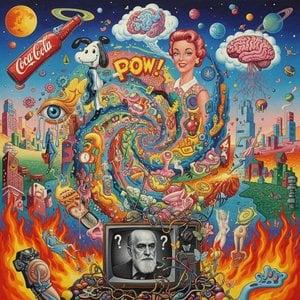
Jean-Michel Basquiat: A Voice From the Streets and Beyond
Jean-Michel Basquiat’s story is one of astonishing speed, meteoric rise, and tragic brevity—a testament to the raw energy and potent social commentary that defined his art. Born in Brooklyn in 1960 to Haitian and Puerto Rican parents, he was a product of New York City's vibrant, often turbulent, downtown scene. Unlike many artists groomed within formal institutions, Basquiat’s artistic journey began not in a studio but on the streets, as part of the graffiti duo SAMO – an acronym for “Same Old Story,” a defiant statement against the perceived complacency of the art world. This early experience profoundly shaped his aesthetic and approach, imbuing his work with a gritty authenticity that resonated deeply with audiences.
Early Years & The Rise of SAMO
Before he became a celebrated painter, Basquiat was known as SAMO, alongside Al Diaz. Together they began tagging cryptic epigrams and poems across the Lower East Side in 1976, transforming subway cars and building walls into canvases for their subversive messages. These weren’t simply random graffiti; they were carefully constructed phrases designed to provoke thought and challenge societal norms. The duo's work quickly gained notoriety, attracting attention from both art critics and the public. Their collaboration was a crucial period of experimentation, laying the groundwork for Basquiat’s later artistic explorations. The irony of their name – “SAMO” – became increasingly poignant as Basquiat began to establish himself as an individual artist, distancing himself from Diaz and forging his own unique voice.
Neo-Expressionism & The Whitney Biennial
By the early 1980s, Basquiat’s distinctive style—a potent blend of street art aesthetics, historical references, and personal introspection—began to attract serious attention from the established art world. His work moved beyond simple graffiti tags, evolving into complex paintings that incorporated a dizzying array of symbols, text, and imagery. A pivotal moment arrived in 1982 when he was selected to participate in the prestigious Documenta exhibition in Kassel, Germany—an unprecedented achievement for an artist so young and relatively unknown. This recognition catapulted him onto the international stage. Later that same year, at just 22 years old, Basquiat became one of the youngest artists ever to exhibit at the Whitney Biennial in New York, solidifying his position as a major force in the burgeoning Neo-Expressionist movement.
Themes & Techniques: A Complex Tapestry
Basquiat’s art wasn't easily categorized. He drew inspiration from a vast range of sources—African history and mythology, jazz music, pop culture, social commentary, and personal experiences. His paintings frequently explored dichotomies such as wealth versus poverty, integration versus segregation, inner experience versus external perception. He masterfully juxtaposed seemingly disparate elements – anatomical drawings alongside historical figures, text fragments with vibrant colors, and symbols of power with images of vulnerability. His technique was equally eclectic, incorporating elements of collage, drawing, painting, and assemblage. He often used found objects—newspaper clippings, maps, and commercial graphics—to create layered compositions that reflected the chaotic energy of urban life.
Legacy & A Tragic End
Basquiat’s career tragically ended in 1988 at the age of 27 due to a heroin overdose. Despite his short life, his impact on the art world is immeasurable. His work continues to be exhibited and studied worldwide, and his paintings command staggering prices at auction. The market for Basquiat’s pieces has seen remarkable growth in recent decades, with some works selling for tens of millions of dollars. More importantly than the financial value, however, is the enduring relevance of his art—a powerful testament to the struggles and triumphs of a young Black artist who dared to challenge conventions and speak truth to power. His legacy lies not just in the beauty of his paintings but also in their unflinching honesty and profound social commentary.