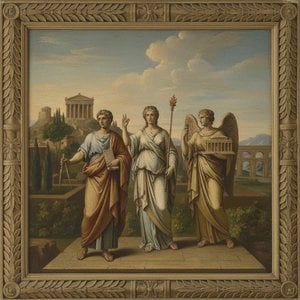
Nicolas de Launay (1739 – 1792) stands as a significant figure within the French Baroque and Rococo artistic landscape, primarily recognized for his meticulous portraiture and captivating depictions of historical events. Born in Paris, he emerged during an era marked by aristocratic patronage and a fervent interest in documenting the grandeur of royal courts and noble families. While biographical details remain somewhat sparse—a testament to the challenges faced by artists of his period—scholarly research has illuminated his formative years amidst the intellectual ferment of Enlightenment France.
Early Training & Influences: Launay’s artistic education began under Jean-François De Troy, a celebrated portraitist who instilled in him a foundational understanding of classical composition and anatomical accuracy. This mentorship undoubtedly shaped his stylistic sensibilities, favoring clarity of form and careful observation—characteristics that would define his oeuvre.
Notable Commissions & Artistic Style: Launay swiftly gained renown for his ability to capture the essence of his subjects with remarkable sensitivity. He undertook numerous commissions from prominent families throughout France, producing portraits that showcased not only physical likeness but also psychological nuance. His style is characterized by a restrained elegance—a hallmark of Rococo—marked by soft brushstrokes, delicate color palettes, and an emphasis on capturing fleeting expressions.
Engravings & Historical Narrative
Beyond painting, Launay excelled as an engraver, contributing to the dissemination of artistic ideas and historical narratives through prints. His engraving ‘Esclaves Conduits Par Les Marchands’ exemplifies his commitment to social commentary alongside technical virtuosity. Executed in monochrome linework, this powerful image confronts viewers with the brutal realities of the transatlantic slave trade—a subject that resonated deeply within the moral conscience of the time. Launay's engravings demonstrate a masterful command of tonal shading and etching techniques, reflecting the influence of Baroque printmaking traditions.
Museum Exhibitions & Legacy
Launay’s works are proudly displayed in Musée de l'Œuvre Notre-Dame in Strasbourg, where visitors can immerse themselves in medieval and Renaissance Upper Rhenish art. The cathedral sculptures and stained glass windows offer a rich visual tapestry that complements Launay’s artistic vision—a testament to the enduring power of artistic expression across centuries. Furthermore, Monastère Royal de Brou showcases Flemish masterpieces alongside royal tombs, providing another context for appreciating Launay's stylistic influences.
Connections & Artistic Dialogue
Launay’s artistic trajectory intersected with that of Nicolaes Berchem and Pieter de Hooch—luminaries of the Dutch Golden Age who championed innovative approaches to landscape painting and domestic interiors respectively. These artists shared a commitment to capturing atmospheric effects and conveying emotional depth—principles that found their way into Launay's oeuvre, demonstrating the interconnectedness of artistic movements across Europe during the eighteenth century. His engravings served as an important medium for disseminating ideas about social justice and human dignity, solidifying his place in art history as a voice for humanist values.
Ponorte sa do sveta Francisca Goya a jeho 25 najvýznamnejších diel. Objavte príbehy za ikonickými obrazmi romantizmu, portrétmi a Čiernymi maľbami. Reprodukcie obrazov pre váš interiér na WahooArt.com – luxusné dekorácie s umením.
Explore the life & work of Nicolas Poussin, a master of French Classicism. Discover his allegorical paintings, Roman influences, and enduring impact on art history. Expert analysis & insights.
Explore the life & art of Charles Le Brun, master of French Baroque Classicism. Discover his royal commissions, influence on Versailles, and enduring legacy through detailed analysis & stunning artworks.