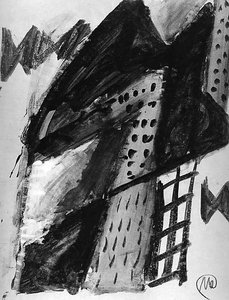
Markus Lüpertz: A Life in Art
Early Life and Education
- Born: 1941 in Reichenberg, Czechoslovakia (now Liberec, Czech Republic).
- Lüpertz’s family relocated to West Germany in 1948, settling in Rheydt.
- Early artistic endeavors were initially thwarted by dismissal from a painting apprenticeship and the bankruptcy of a commercial art teacher.
- He studied at the Werkkunstschule of Krefeld (1956-1961) with Laurens Goosens, supplementing his studies with manual labor like mining and road construction.
- A brief and tumultuous period at the Kunstakademie Düsseldorf ended in expulsion due to conflicts with faculty.
Early Career & Formation of a Style
- Following his studies, Lüpertz worked as a freelance artist, initially in Düsseldorf.
- A short stint in the French Foreign Legion ended with desertion before deployment to Algeria.
- In 1962, he moved to West Berlin, becoming a founding member of Gallery Grossgörschen alongside other prominent artists like Karl Horst Hödicke.
- His early work began to establish his signature style – characterized by bold brushstrokes, archetypal imagery, and a rejection of prevailing minimalist trends.
Recognition & Academic Career
- Awards: Lüpertz received the Villa Romana Prize in 1970, allowing him to study in Florence, Italy. He also won the German Association of Critics Prize in 1974.
- He held professorships at the Academy of Fine Arts in Karlsruhe (1974-1986) and later at the Kunstakademie Düsseldorf (1986-2009), serving as its rector for over two decades.
- As director, he invited influential artists like A.R. Penck, Jannis Kounellis, and Rosemarie Trockel to teach, shaping a generation of German artists.
Artistic Development & Themes
- Lüpertz’s work defies easy categorization, but is generally considered part of the Neo-Expressionist movement.
- His paintings and sculptures often explore themes of history, mythology, and abstraction.
- Recurring motifs include landscapes, figures, and symbolic objects imbued with personal and cultural significance.
- He frequently references classical art and literature, reinterpreting them through a contemporary lens.
- Style: His style is characterized by expressive brushwork, vibrant colors (though often muted), and a sense of raw energy. He works across painting, sculpture, and graphic arts.
Major Achievements & Historical Significance
- Lüpertz’s long tenure as director of the Düsseldorf Academy cemented his influence on contemporary German art.
- His participation in the Venice Biennale (1993) alongside Georg Baselitz and Anselm Kiefer highlighted his position as a leading figure in post-war German art.
- He is known for his uncompromising artistic vision and willingness to challenge conventional norms.
- Beyond visual arts, Lüpertz publishes the journal *frau und hund* (and its international editions), demonstrating his multifaceted creative interests.
- His work continues to be exhibited internationally, solidifying his legacy as one of Germany’s most important contemporary artists.