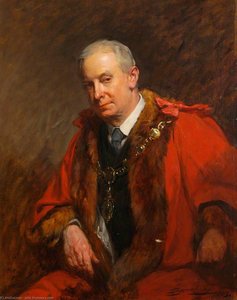
A Victorian Chronicler: The Life and Art of John Seymour Lucas
John Seymour Lucas, born in London in 1849, occupies a unique position within the landscape of Victorian art. He wasn’t simply a painter of historical scenes; he was a meticulous re-creator of moments past, a visual storyteller dedicated to immortalizing pivotal episodes from Britain's often turbulent history. While perhaps not as widely celebrated today as some of his contemporaries, Lucas enjoyed considerable acclaim during his lifetime, culminating in his election as a Royal Academician and establishing him as a sought-after portraitist and costume designer. His journey began unconventionally – an apprenticeship as a woodcarver preceded his embrace of the canvas – a grounding in three-dimensional form that would profoundly influence the remarkable realism for which he became known. This early training instilled within him a deep appreciation for detail, texture, and the tangible qualities of materials, elements that permeate his historical compositions. Formal education at St. Martin's Lane Art School and the Royal Academy Schools provided a solid technical foundation, but it was travels through Europe – particularly to Holland and Spain – that truly ignited his artistic vision.
Influences and Artistic Development
The impact of Dutch Masters like Van Dyck and Spanish masters such as Diego Velázquez is profoundly evident in Lucas’s work. He wasn’t merely imitating their styles; he was absorbing their mastery of light, shadow, and the psychological depth they brought to portraiture and historical narratives. Velázquez, in particular, appears to have been a guiding spirit, inspiring Lucas’s commitment to capturing not just *what* happened, but *how* it felt – the tension, the drama, the human cost of historical events. This influence manifested itself in his meticulous attention to detail, especially in rendering fabrics, armor, and architectural settings. Lucas wasn't interested in grand allegories or idealized representations; he sought authenticity, striving to recreate scenes as they might have genuinely unfolded. He began exhibiting regularly in 1872, steadily gaining recognition within the London art world, culminating in his election as an Associate of the Royal Academy in 1886 and a full Academician in 1899 – milestones that cemented his position among the leading artists of his day. His marriage to Marie Cornelissen, also an artist, further enriched his creative life and provided a supportive partnership.
Lucas’s artistic education included extensive travels around Europe, particularly Holland and Spain, where he studied the Flemish and Spanish masters. He was deeply moved by Velázquez's ability to convey emotion through subtle gestures and expressions—a skill Lucas diligently honed in his own portraits and historical paintings. This fascination with capturing psychological nuance underpinned his approach to depicting figures within dramatic contexts, ensuring that viewers experienced not merely visual information but also a palpable sense of atmosphere and feeling. He wasn’t simply reproducing images; he was reconstructing experiences, striving for an unparalleled level of realism that distinguished him from many of his peers.
Masterpieces of British History and Beyond
Lucas’s reputation rests primarily on his historical paintings, scenes meticulously researched and rendered with an almost photographic realism. Rebel Hunting after Culloden (1884) exemplifies this approach. The painting doesn't depict a glorious battle; instead, it focuses on the grim aftermath – the tense encounter between British soldiers and local blacksmiths suspected of harboring Jacobite rebels. The scene is charged with unspoken anxieties, the rough-hewn figures and smoky forge creating an atmosphere of palpable tension. Lucas painstakingly recreated the textures of leather armor, the flickering glow of the anvil, and the expressions on the faces of the participants—details that conveyed a profound understanding of the psychological complexities inherent in the historical moment. This dedication to realism wasn’t merely stylistic; it was driven by a conviction that art could illuminate the human dimension of history.
The Flight of the Five Members (Houses of Parliament), commissioned for the Royal Academy's Summer Exhibition of 1879, showcases his ability to handle large-scale compositions with impressive detail and precision. Lucas captured the solemn grandeur of the parliamentary chamber, portraying the dignitaries present with meticulous accuracy—their postures, expressions, and attire reflecting the gravity of the occasion. The painting’s masterful use of light and shadow further enhanced its dramatic impact, emphasizing the importance of visual storytelling within a historical context.
Lucas's skill extended beyond depicting battles and political intrigue; he also excelled at portraying royal ceremonies and diplomatic encounters, as evidenced by works like Reception by HM King Edward VII of the Moorish Ambassador (Royal Collection) and HRH The Prince of Wales in German Uniform. These paintings weren’t simply historical records; they were carefully constructed narratives designed to evoke a sense of national pride and imperial grandeur—a testament to Lucas's artistic vision and his ability to translate complex ideas into compelling visual representations.
A Versatile Talent: Costume Design and Watercolour
Lucas's artistic talents extended beyond oil painting, revealing a remarkable versatility. He became highly sought after as a set and costume designer for historical dramas on the Victorian and Edwardian stages. This work demanded an even deeper understanding of period detail—fabrics, silhouettes, accessories—further honing his skills in recreating authentic historical environments. One particularly noteworthy commission was designing the elaborate “Duke of Normandy” costume for Prince Alfred of Saxe-Coburg-Gotha for the Devonshire House Ball in 1897—a feat of craftsmanship that underscored Lucas’s reputation for meticulous accuracy and artistic flair. Furthermore, Lucas was a prolific watercolour artist, electing as a member of the Institute of Painters in Water Colours in 1877. This medium allowed him to explore more intimate scenes and experiment with looser brushwork, providing a counterpoint to the highly finished quality of his oil paintings—a stylistic choice that reflected his artistic sensibilities and broadened the scope of his creative endeavors. He maintained close ties with fellow artists, notably John Singer Sargent who painted a portrait of Lucas now held at Tate Britain—a testament to their mutual respect and artistic camaraderie.
Lucas joined the Sylvan Debating Club in 1872, and painted a portrait of the society's founder Alfred Harmsworth. He retired from painting towards the end of World War I and moved to Blythburgh, Suffolk where he died in 1923—leaving behind a legacy as one of Britain’s most accomplished historical painters and a celebrated costume designer whose work continues to inspire admiration for its realism and artistic merit.