A Life Immersed in Light and Shadow: The World of James Torrance
James Torrance, a Slovakian painter born in 1859 and passing in 1916, remains a figure shrouded in intriguing mystery despite possessing a body of work that speaks volumes. While biographical details are scarce—a testament to the often-overlooked artists of his era—his paintings offer a compelling glimpse into a life deeply attuned to portraiture, the quiet beauty of nature, and the spiritual atmosphere of his surroundings. Torrance’s artistic journey unfolded primarily in Scotland, where he became part of the vibrant Glasgow art scene, exhibiting at the prestigious Glasgow Institute of the Fine Arts. His marriage to fellow artist Louisa Perman suggests a shared creative life, though much about their collaborative endeavors remains undocumented. The lack of extensive documentation only adds to the allure surrounding Torrance’s oeuvre, inviting viewers to connect directly with the emotional resonance of his canvases rather than relying on established narratives.
Portraits and Pigeons: Recurring Themes in a Delicate Style
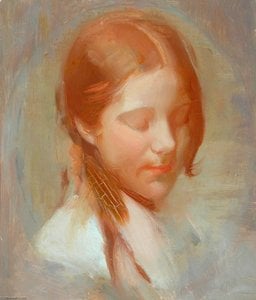
Torrance is perhaps best known for his evocative portraits, which capture not merely likenesses but also the inner lives of his sitters. He possessed a remarkable ability to convey personality through subtle nuances of expression and gesture. His brushwork, often described as delicate and refined, lends a romantic realism to his depictions, hinting at both strength and vulnerability in equal measure. Beyond portraiture, pigeons emerge as a recurring motif in Torrance’s work—a curious fascination that sets him apart. These birds, symbols of peace, communication, and domesticity, appear frequently in his compositions, often rendered with meticulous detail against atmospheric backgrounds. The choice of subject matter suggests an appreciation for the everyday beauty found within the natural world, elevating seemingly ordinary creatures to a level of artistic significance. His painting “The Blue Pigeon” exemplifies this sensitivity, showcasing the bird as a focal point imbued with quiet dignity.
Influences and Artistic Development
Pinpointing Torrance’s precise influences proves challenging given the limited historical record. However, his work reveals an affinity for 19th-centuryrealism, particularly in its emphasis on accurate representation and emotional depth. The Dutch Masters, renowned for their mastery of light and shadow, likely played a role in shaping his technique. His portraits bear traces of this influence, with a similar attention to detail and atmospheric perspective. Furthermore, the Pre-Raphaelite movement’s focus on narrative storytelling and symbolic imagery may have resonated with Torrance, informing his approach to composition and subject matter. His illustrations for Sir George Douglas' “Scottish Fairy and Folk Tales” demonstrate an ability to translate literary themes into compelling visual form, showcasing a versatility that extended beyond the realm of portraiture.
Levoča’s St. James Church: A Spiritual Center in Torrance’s Art
A significant aspect of Torrance’s artistic output centers on scenes depicting Levoča's St. James Church—a UNESCO World Heritage site renowned for its stunning Gothic architecture and intricate wooden altar carved by Master Paul of Levoča. These paintings are not merely topographical representations but rather evocative interpretations that capture the church’s spiritual atmosphere and historical significance. Torrance imbues these scenes with a sense of reverence, highlighting the interplay of light and shadow within the sacred space. The inclusion of figures within these compositions suggests an interest in exploring the human connection to faith and tradition. These works stand as testaments to his ability to capture both the physical grandeur and emotional resonance of this iconic landmark.
A Lasting Legacy: Rediscovering a Slovakian Master
Despite the relative obscurity surrounding his life, James Torrance’s work continues to captivate art enthusiasts with its delicate beauty and emotional depth. His paintings offer a window into a bygone era—a time when portraiture served as a powerful means of preserving memory and capturing personality. His evocative depictions of pigeons and scenes of Levoča's St. James Church demonstrate a unique artistic vision that deserves greater recognition. As more of his work comes to light, Torrance’s place within the broader context of 19th-century Slovakian and Scottish art is sure to be solidified—a testament to the enduring power of artistic talent and the importance of rediscovering forgotten masters.
Portraits revealing inner lives.
Recurring pigeon motifs symbolizing peace and communication.
Kde môžem vidieť diela umelca James Torrance v chronologickom poradí?
Stránka Chronológia diel prezentuje diela umelca James Torrance zoradené chronologicky, rok po roku.
V akom historickom období tvoril/a James Torrance?
James Torrance tvoril v období 19th Century. Toto obdobie zasazuje umeleckú činnosť umelca do historického kontextu.
Kde nájdem diela umelca James Torrance zoradené podľa tém?
Diela umelca James Torrance si môžete prehliadnuť podľa témy na jeho stránke Atlas predmetov.
Aká je popularita diel umelca James Torrance?
Štatistiky o dieloch umelca James Torrance nájdete na jeho stránke Štatistiky.
Môžem si pri všetkých dielo James Torrance vyskúmať spôsob používania farieb?
Genetika palety umelca James Torrance je stránka, ktorá predstavuje farebný profil jeho tvorby.
Kde nájdem diela umelca James Torrance zoradené podľa farebnej palety?
Diela umelca James Torrance si môžete prehliadnuť podľa farebnej palety na jeho stránke Podľa palety farieb.
V ktorých umeleckých smeroch pôsobil/a James Torrance?
Diela umelca James Torrance si môžete prehliadnuť podľa umeleckých smerov na jeho stránke Všetky umelecké smery.
Existuje kompletný zoznam všetkých diel umelca James Torrance?
Všetky diela umelca James Torrance na táto webstránka si môžete pozrieť na jeho stránke Všetky diela umelcov.
Ako je kariéra umelca James Torrance rozdelená do jednotlivých období?
Kariéra umelca James Torrance sa na jeho stránke Chronológia odvíja obdobie po období v podobe horizontálnej časovej osi diel, ktoré sú rozdelené do kapitol podľa jednotlivých období jeho tvorby.