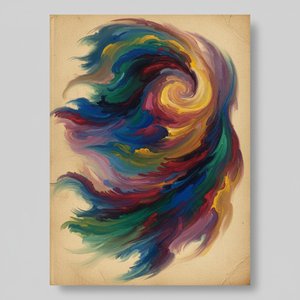
The Genesis of a Visionary: From Leipzig to Paris
The story of Hans Heinrich Hartung is one of profound movement, both physical and spiritual. Born in 1904 in the historic city of Leipzig, Germany, Hartung’s early consciousness was shaped by a deep reverence for the masters of light and shadow. His formative years were steeped in the emotive power of European Expressionism, drawing strength from the works of Rembrandt and the raw, visceral energy of German painters such as Lovis Corinth and Emil Nolde. This early exposure to the dramatic interplay of chiaroscuro instilled in him a lifelong commitment to painting that was not merely descriptive, but deeply psychological.
Hartung’s intellectual foundation was laid at Leipzig University, where he studied philosophy and art history—disciplines that would later provide the structural logic behind his seemingly spontaneous gestures. However, it was his formal training at the Dresden Academy and a transformative encounter with the Internationale Kunstausstellung in 1926 that truly ignited his modern spirit. Witnessing the innovations of French and Spanish masters, particularly the structural rigor of Cézanne, Hartung began to understand how the golden ratio and harmonious proportions could anchor even the most radical abstractions. Driven by a desire to transcend provincial boundaries, he embarked on a solo journey through Italy before settling in Paris in 1924, a move that would forever alter the trajectory of his career.
The Mastery of Gesture and Lyrical Abstraction
In the heart of Paris, Hartung adopted a solitary and disciplined approach to his craft. Eschewing the collaborative trends of his era, he devoted himself to the meticulous study of masterworks, absorbing the technical nuances of centuries of art history. This period of intense observation allowed him to develop a unique vocabulary of line and motion. His work began to move away from representational forms toward what would become known as Lyrical Abstraction—a style where the brushstroke itself becomes the subject, acting as a direct conduit for the artist's internal rhythm.
His technique was characterized by a breathtaking fluidity, often utilizing rapid, calligraphic marks that seemed to dance across the canvas. These gestural elements were never chaotic; rather, they were underpinned by the structural principles he had admired in Cézanne. The influence of the Mediterranean landscape also played a vital role in his evolution. Following his marriage to Anna-Eva Bergman and their time on the Balearic Islands, his palette and compositions began to reflect the luminous, expansive qualities of the South of France and the Mediterranean, blending atmospheric light with vigorous, rhythmic energy.
Legacy and Historical Significance
The career of Hans Hartung is marked by a remarkable resilience and an unwavering dedication to the evolution of modernism. Despite the profound disruptions caused by his experiences as a World War II veteran, he emerged with a renewed vigor, continuing to push the boundaries of abstract expression. His debut exhibition in Dresden in 1931 had already signaled the arrival of a major talent, but it was his later ability to bridge the gap between European abstraction and the burgeoning American lyrical abstraction movement that cemented his historical importance.
Hartung’s contribution to the art world lies in his ability to marry the emotional intensity of expressionism with the formal precision of classical composition. His work remains a testament to the power of the spontaneous mark, proving that abstraction can be both deeply personal and structurally profound. Today, he is remembered not just as a pioneer of a movement, but as a master of the line, whose paintings continue to resonate with the primal energy of human motion and the enduring beauty of balanced form.