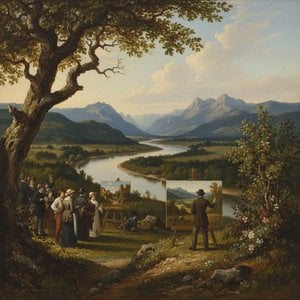
A Life Painted in Charm: Edwin Thomas Roberts and the Victorian Idyllic
Edwin Thomas Roberts, born in London in 1840 and passing in 1917, was a quintessential Victorian painter whose canvases breathed life into scenes of everyday existence. While not a name immediately recognized alongside the Pre-Raphaelites or Impressionists, Roberts carved a significant niche for himself by capturing the gentle spirit of rural England and the quiet moments of domesticity with remarkable skill. His work offered an escape – a romanticized vision of a world increasingly touched by industrialization, yet still holding onto its pastoral beauty. He was the son of Thomas Edward Roberts, but details surrounding his early artistic training remain somewhat elusive; however, it’s clear he developed a keen eye for realism coupled with a sentimental sensibility that would define his career.Early Influences and Artistic Development
Roberts' paintings are deeply rooted in the traditions of 19th-century British genre painting. Artists like David Wilkie, known for his meticulously detailed depictions of Scottish life, likely served as early inspirations. However, Roberts moved beyond mere replication; he infused his scenes with a warmth and intimacy that set him apart. His initial works focused on rural landscapes populated by figures engaged in simple activities – children at play, families enjoying leisurely pursuits, and the bustling energy of market days. These paintings weren’t grand historical narratives or dramatic allegories; they were snapshots of life, rendered with an almost photographic precision but imbued with a distinctly romantic glow.- Genre Painting Focus: Roberts dedicated himself to capturing scenes from everyday life, particularly those in the countryside.
- Realism and Sentimentality: His work balanced detailed realism with an underlying emotional warmth.
- Early Influences: Artists like David Wilkie likely shaped his initial style and subject matter.
Exhibition Success and the Royal Academy
Roberts’ talent quickly gained recognition within the London art world. He regularly exhibited at prestigious venues such as the Royal Society of British Artists and, crucially, the Royal Academy from 1862 onwards. This consistent presence solidified his reputation and allowed him to reach a wider audience. His paintings resonated with Victorian sensibilities – a public yearning for idyllic scenes and nostalgic representations of rural life. The success he found wasn’t based on groundbreaking innovation but rather on perfecting a popular formula: beautifully executed, charmingly sentimental depictions of English life. Works like “Girl on a Swing” and “To Market, To Buy a Fat Pig” exemplify this approach – paintings that evoke a sense of peace, innocence, and the simple pleasures of existence. The impasto texture in many of his works adds another layer of depth and visual interest, creating a tactile quality that draws the viewer into the scene.Themes and Symbolism within Roberts’ Oeuvre
While seemingly straightforward, Roberts' paintings often contain subtle layers of symbolism. His depictions of children weren’t merely portraits; they represented innocence, hope, and the promise of future generations. Scenes of rural life celebrated a connection to nature and a simpler way of being, contrasting with the increasingly industrialized urban landscape. The jolly anglers, for example, aren’t just men fishing; they embody leisure, camaraderie, and a harmonious relationship with the natural world. His use of light is also significant – often soft and diffused, creating a warm, inviting atmosphere that reinforces the idyllic nature of his scenes. He wasn't making overt political statements or challenging social norms, but he was subtly reinforcing Victorian values of family, community, and the beauty of the English countryside.Legacy and Historical Significance
Edwin Thomas Roberts may not be a household name today, but his work remains a valuable window into Victorian England. His paintings offer a glimpse into the aspirations and sensibilities of a society grappling with rapid change. He wasn’t a revolutionary artist, but he was a master craftsman who perfected a popular genre and created works that continue to resonate with audiences for their charm, beauty, and sentimental appeal. While his style didn't evolve dramatically over his career, his consistent quality and ability to capture the essence of Victorian life ensured his place in art history as a celebrated painter of idyllic scenes and playful depictions of everyday existence. His paintings are now sought after by collectors and museums alike, offering a tangible connection to a bygone era.Otázky a odpovede
V akom historickom období tvoril/a Edwin Thomas Roberts?
Edwin Thomas Roberts tvoril v období 19th Century. Toto obdobie zaradením umeleckej činnosti umelca do historického kontextu definuje.
Aká je popularita diel umelca Edwin Thomas Roberts?
Štatistiky o dielach umelca Edwin Thomas Roberts sú dostupné na jeho stránke Štatistiky.
Ako nájdem diela od Edwin Thomas Roberts v konkrétnej farebnej palete?
Ak chcete nájsť diela umelca Edwin Thomas Roberts v konkrétnej farebnej palete, navštívte jeho stránku Podľa farebnej palety.