A Synaesthetic Cartography of Memory: The World of Domenico Antonio Mancini
Domenico Antonio Mancini, born in Naples in 1980 and now based in Milan, is an artist whose work operates at the intriguing intersection of painting, sculpture, media analysis, and socio-political inquiry. He doesn’t simply *represent* the world; he dissects it, reconfigures its layers, and presents us with a synaesthetic experience—a blending of senses that forces a recalibration of perception. Mancini's artistic journey began with formal training at the Academy of Fine Arts in Naples, but his practice quickly evolved beyond traditional boundaries, embracing residences like the Antonio Ratti Foundation (Como) and the Mountain School of Art (Los Angeles) as crucial catalysts for experimentation. These experiences fostered an interest not merely in *what* is seen, but in *how* we see it, and the cultural forces that shape our vision. He’s a cartographer of contemporary life, charting not geographical locations but the complex terrains of historical memory and individual experience.
From Daily Life to Digital Echoes
Mancini's core preoccupation lies with the transformation of everyday existence into something resonant and deeply felt. This isn’t about romanticizing the mundane; rather, it’s a rigorous investigation into how seemingly insignificant details—a street corner, a faded photograph, an overheard phrase—can hold profound socio-political weight. He achieves this through a sophisticated engagement with media analysis, selecting tools and techniques that best serve his conceptual aims. His work often involves a deliberate act of “subtraction,” as he himself describes it, echoing Michelangelo’s approach to sculpture – not adding material but revealing what lies beneath the surface. This process extends beyond physical mediums; Mancini removes layers of information, stripping objects of their conventional function to expose their underlying significance and potential for artistic intervention. Early works like those presented in *Altre Resistenze* (2011) and *Senza titolo (estintori)* (2012) demonstrate this strategy powerfully, employing tautologies and redundancies as a form of resistance against the “paralysis of thought” and the rigid structures of perception. These aren’t simply objects; they are systems designed to disrupt our habitual ways of seeing and understanding.
The Landscape as Interface: Painting, Memory, and Technology
A significant development in Mancini's work is his exploration of landscape painting, but not as a nostalgic return to tradition. In exhibitions like *Landscapes* (2019) at the Galleria Lia Rumma in Naples, he creates immersive installations that juxtapose 19th-century Neapolitan paintings with his own previously unexhibited works. This isn’t about stylistic imitation; it's a deliberate dialogue between historical and contemporary modes of representation. Mancini introduces white monochromes overlaid with alphanumeric strings—Internet addresses leading to Google Maps street views of locations personally significant to him, yet also strategically chosen for their urban and historical importance. These digital echoes transform the paintings into interfaces, blurring the boundaries between physical space and virtual reality. The act of typing an address becomes a portal, offering an escape from the picture plane and inviting viewers to actively participate in constructing meaning. This process reflects his belief that art should not merely depict complexity but *become* a representation of it—a breach towards another realm of understanding.
Social Commentary and the Periphery’s Gaze
Mancini's work is deeply embedded in socio-political commentary, often addressing issues of urban development, collective identity, and the impact of technology on human experience. His neon installation *La periferia vi guarda con odio* (“the suburbs look at you with hatred”), featured in *Landscapes*, serves as a powerful statement about the problematic relationship between city centers and marginalized communities. The phrase, discovered scrawled on a wall in Milan, is not presented as a slogan but as a cornerstone of the exhibition—a direct reflection of the complexities inherent in urban life. This piece exemplifies his ability to transform found objects and phrases into potent symbols of resistance and social critique. He doesn’t offer easy answers or resolutions; instead, he provokes dialogue, challenging viewers to confront uncomfortable truths about their own perceptions and biases.
Historical Significance and Ongoing Exploration
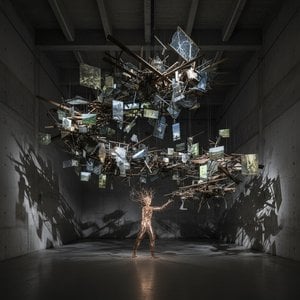
Domenico Antonio Mancini's work occupies a unique position within contemporary Italian art. His ability to seamlessly blend painting, sculpture, media analysis, and social commentary sets him apart as an artist who is both intellectually rigorous and emotionally engaging. He’s not simply reacting to the world around him; he’s actively intervening in it, creating systems of opposition that challenge conventional modes of perception and communication. Represented by Lia Rumma Gallery, Mancini continues to push the boundaries of his practice, with recent exhibitions like *Sei Dieffenbachia* (2025) demonstrating an ongoing commitment to site-specific installations and immersive environments. His work is a testament to the power of art to not only reflect reality but to transform it—to create a synaesthetic cartography of memory that forces us to see, feel, and understand the world in new and profound ways.
- Born: Naples, Italy (1980)
- Lives & Works: Milan, Italy
- Education: Academy of Fine Arts, Naples
- Key Influences: Sophisticated media analysis, socio-political issues, historical memory, synaesthetic experience.
“The artist’s quest appears to be a battle against «the paralysis of thought» and his works are systems of opposition to the rigid structure of perception and communication.” – Arshake Interview (2015)